
Suddenly the inter-city train appears rushing at them on the tracks with its deadly noise which is the only thing that alerts the people. The scene includes a train that seems to be traveling as if to arrive at the slum but then ruthlessly goes right through it. It watches and touches both sides of the slum’s tin-roofs. Who could have ignored such g-o-t-a-n-g, g-o-t-a-n-g sound that raises heartbeats of the inhabitants of the Karwan Bazaar train track Slum in Dhaka on a daily basis… at least fifty times a day?

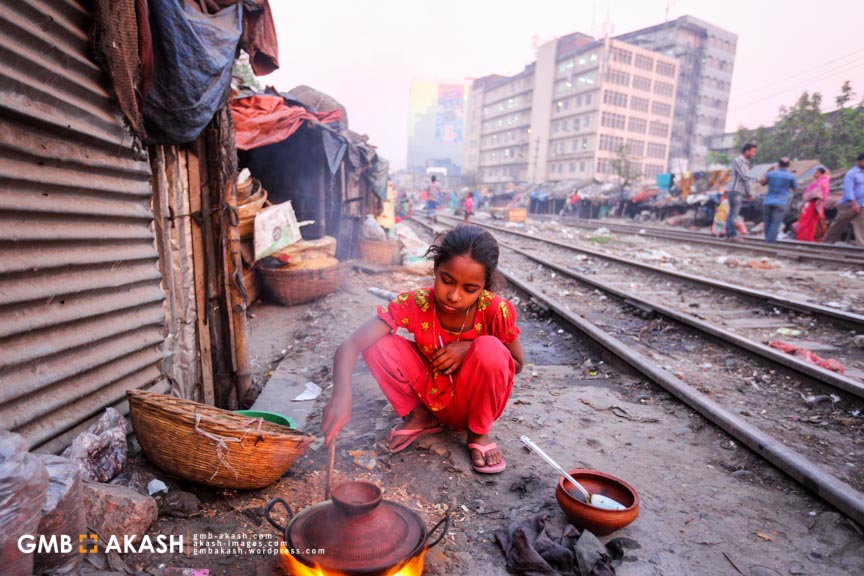
People speculate that this train track-side slum had been built after the Liberation War of 1971. Though the slum does not seem too old, several inhabitants say that they have been living recklessly here for more than thirty years. Moreover, on both sides of the curvy train tracks that are lined with 1’000s of shanties, more than a hundred huts have been built in more recent times. Some of the smallest huts with only three foot high roofs rent for as much as 2000 taka (About $25). Those houses that are newly built with heights for standing-up cost 3000 taka (About $39) for a month.

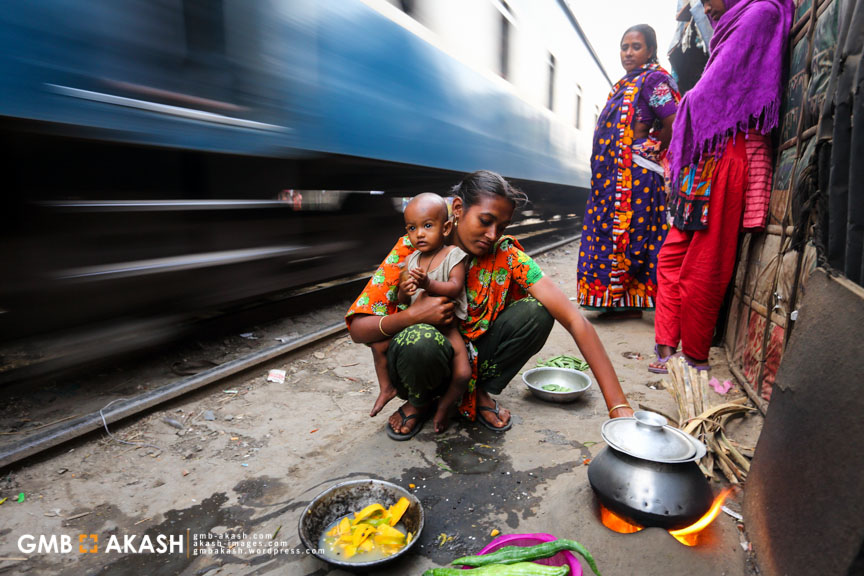
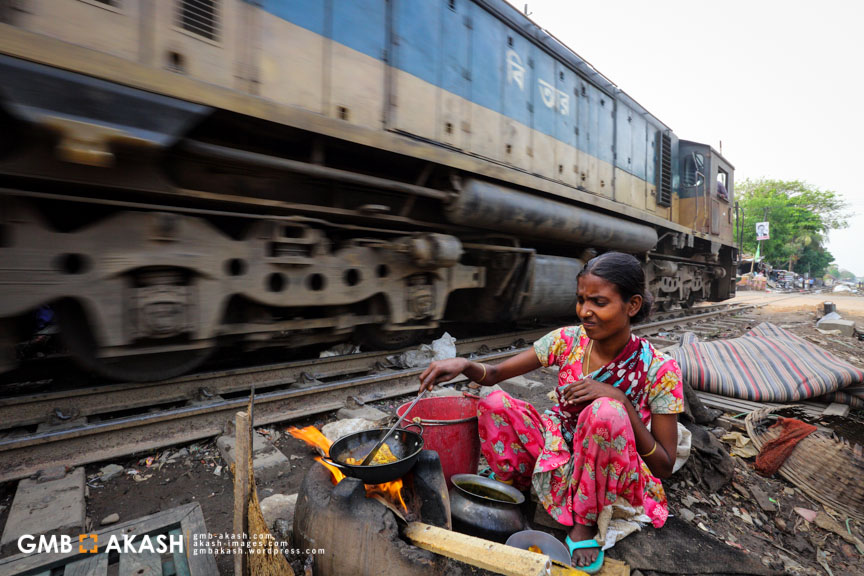
The muddy train tracks are loaded with wastage and leftover rotten vegetables. During an ordinary mid-day women are busy preparing lunch with difficulty trying to manage their mud clay oven cookers set up only one foot from the rail. When a train passes through anybody from the train could take away the potatoes that Marium Begum (35 years old) is frying in the pan. Marium says, ‘my eldest daughter is ten years old and I taught her how to save herself when the train rushes to our hut’. Marium clearly knows how much distance is safe for her two small kids. All children of the slum are well taught how to run away when a train arrives on the tracks. But a lot of times trains come simultaneously on both tracks and terrify the children. It happens many times from day to night without prior warning.

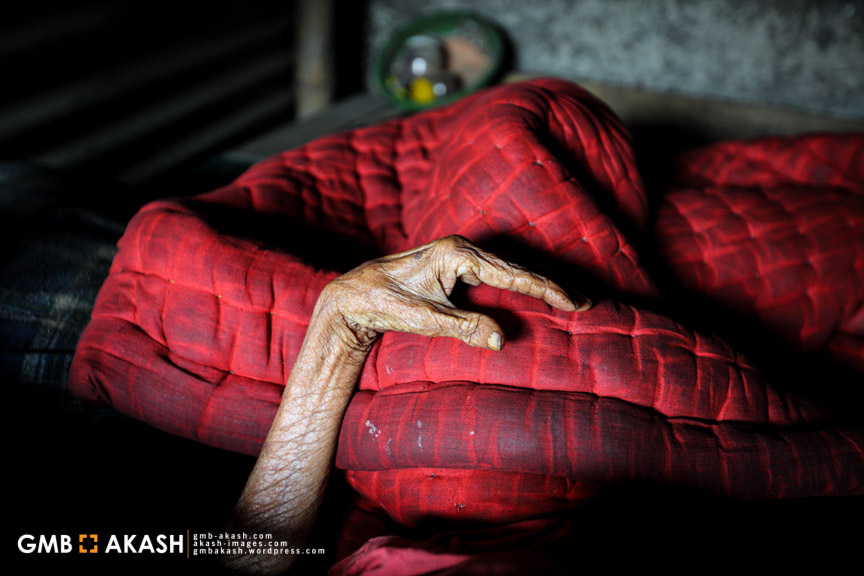
Accidents are common and dangers are unlimited. The banyan tree root that grows from the hut of Kahinur is losing its leaves because many passengers who are riding on the tops of the moving trains are picking off the leaves for fun. It also amuses the slum children who have little to do. In this impossibly tiny strip of living space a lot of children lose their legs, hands and fingers in train accidents that take place in front of their parents’ eyes.
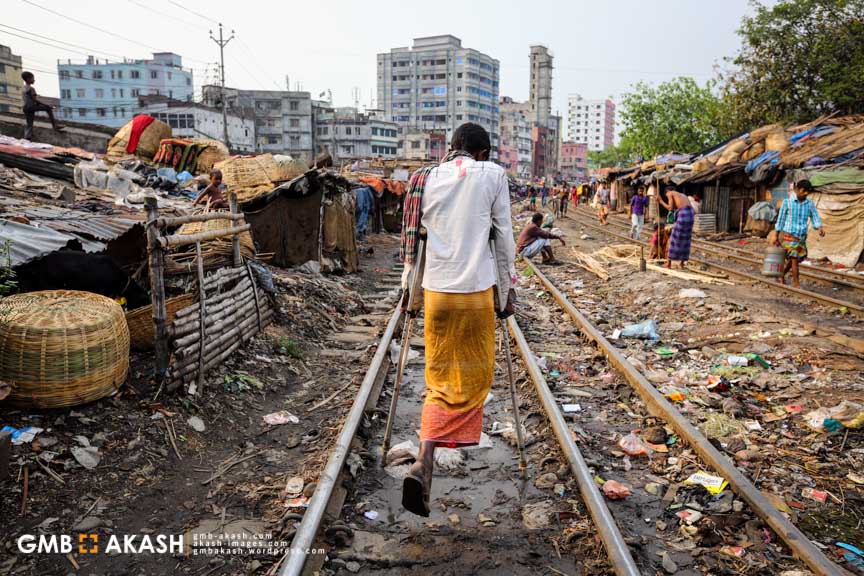

Jaleha Kahtun says, ‘If we had something in which to live in the village, we would never come to live in this train track slum. In the village the river overflowed and took away everything and now here in the bazaar is everything we own.’ Jaleha Kahtun is a rotten vegetable seller in the bazaar. She has to go to work at 5:00 in the morning. So she lives in this slum that enables her to go to the bazaar as early as possible. All of the people who are living along the train tracks are climate migrants due to frequent flooding disasters in the country.


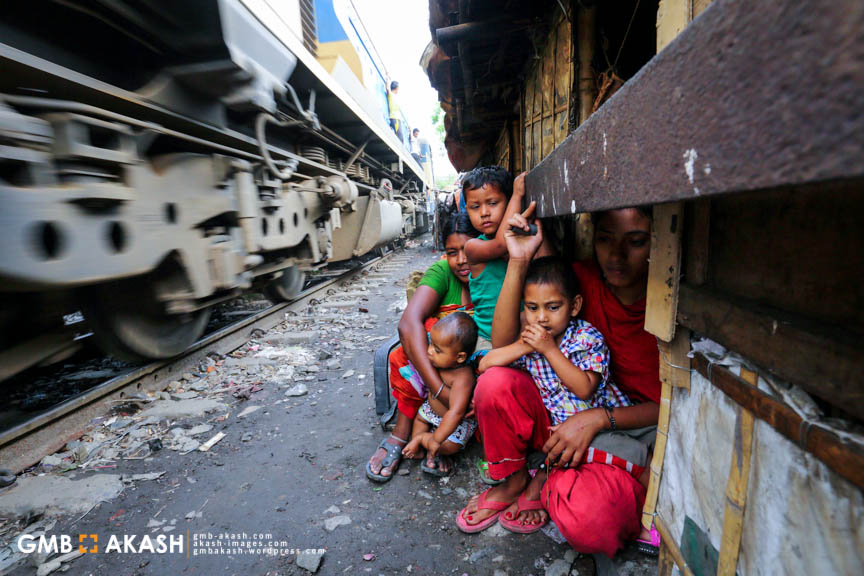
Nothing has changed in their lives since they left their villages, but now at least they can feed themselves better. Sriti (15 years old) who is sitting in the middle between the two rail lines says, ‘We now understand how to act when a train comes. If you were in my place you might die without knowing where to go after seeing a train three feet in front of you. It takes experience.’
When there are no trains all of the inhabitants are sitting on the train tracks, gossiping or arguing with each other. Children are playing here and there. To add some life to this atmosphere someone repeatedly turns on the music of popular Hindi songs. When Rasel (10 years old) starts dancing by waving his lungi and mimicking the song ‘Lungi dance’, Lungi dance,’ people near him also begin to move their bodies to the melody. But before Rashel shows his brilliant steps someone screams that the trains are coming on both sides of the rail lines. Nobody forgets to take their sitting arrangement away with them; children quickly move with their toys, a grandmother rapidly puts a pot over her vegetable curry to save it from the dust. Just like in a theater the trains get a stage upon which to perform for a few seconds and when they leave, all of the inhabitants return to their customary life on the tracks that have been occupied for more than 30 years.







 GMB AKASH