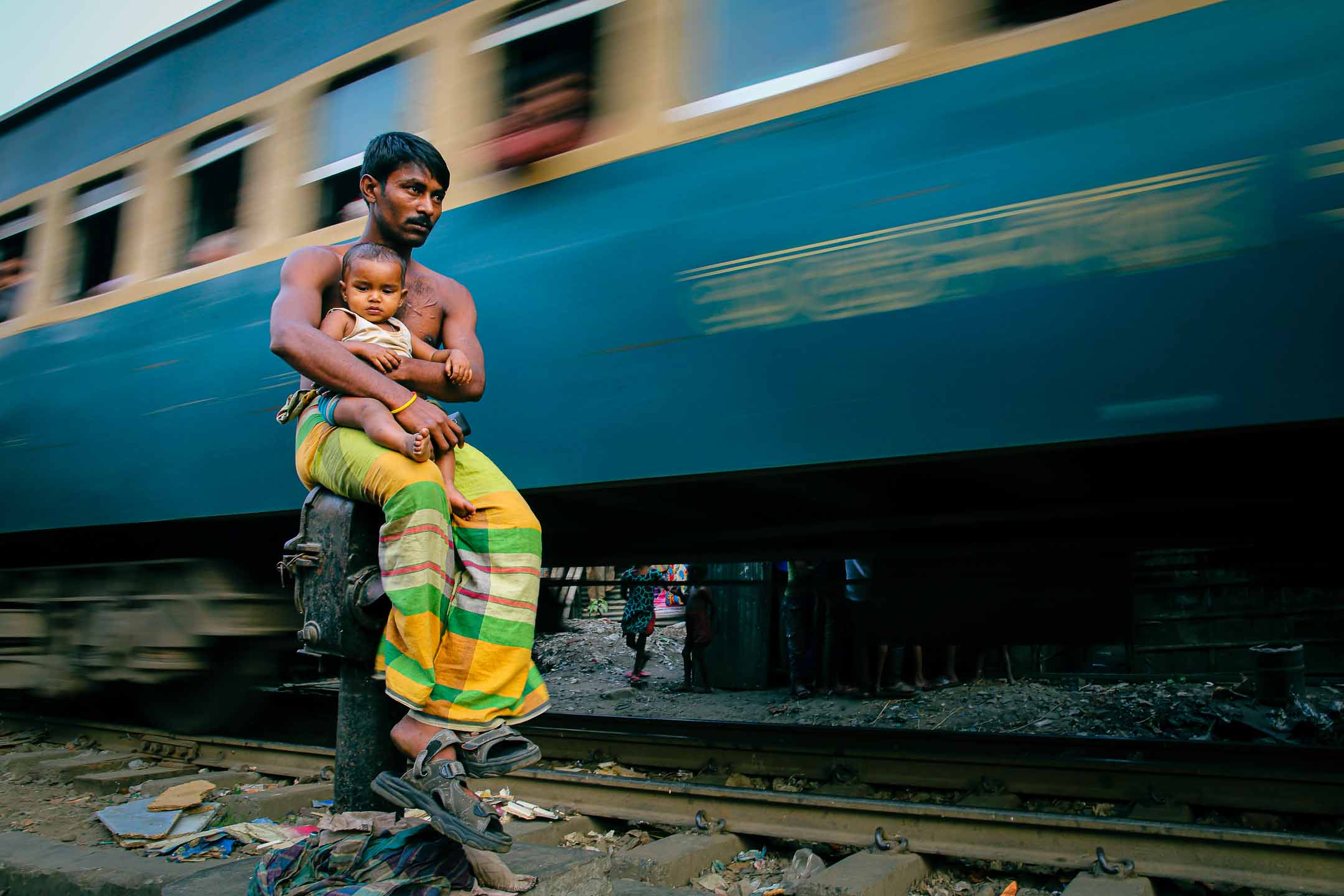
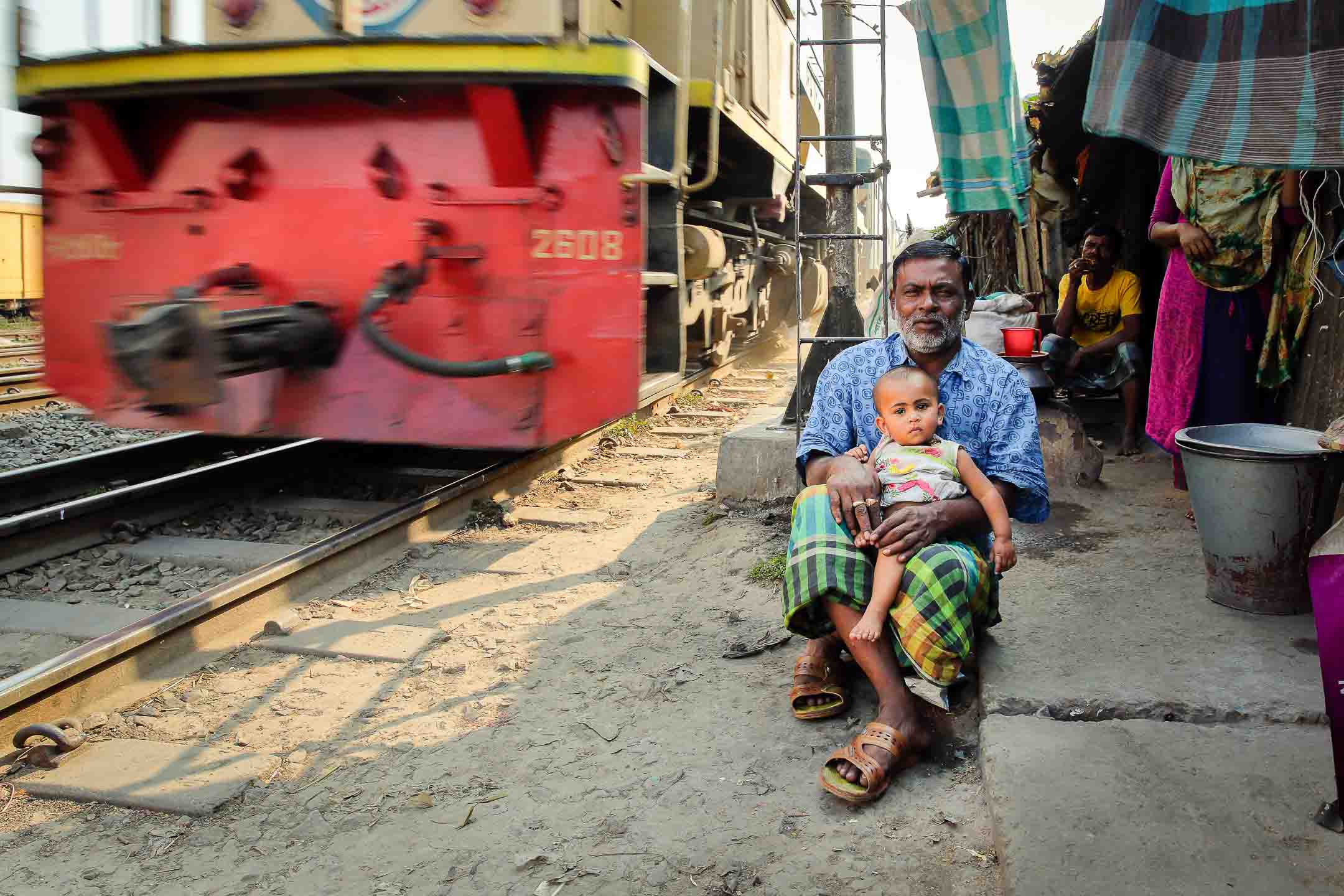
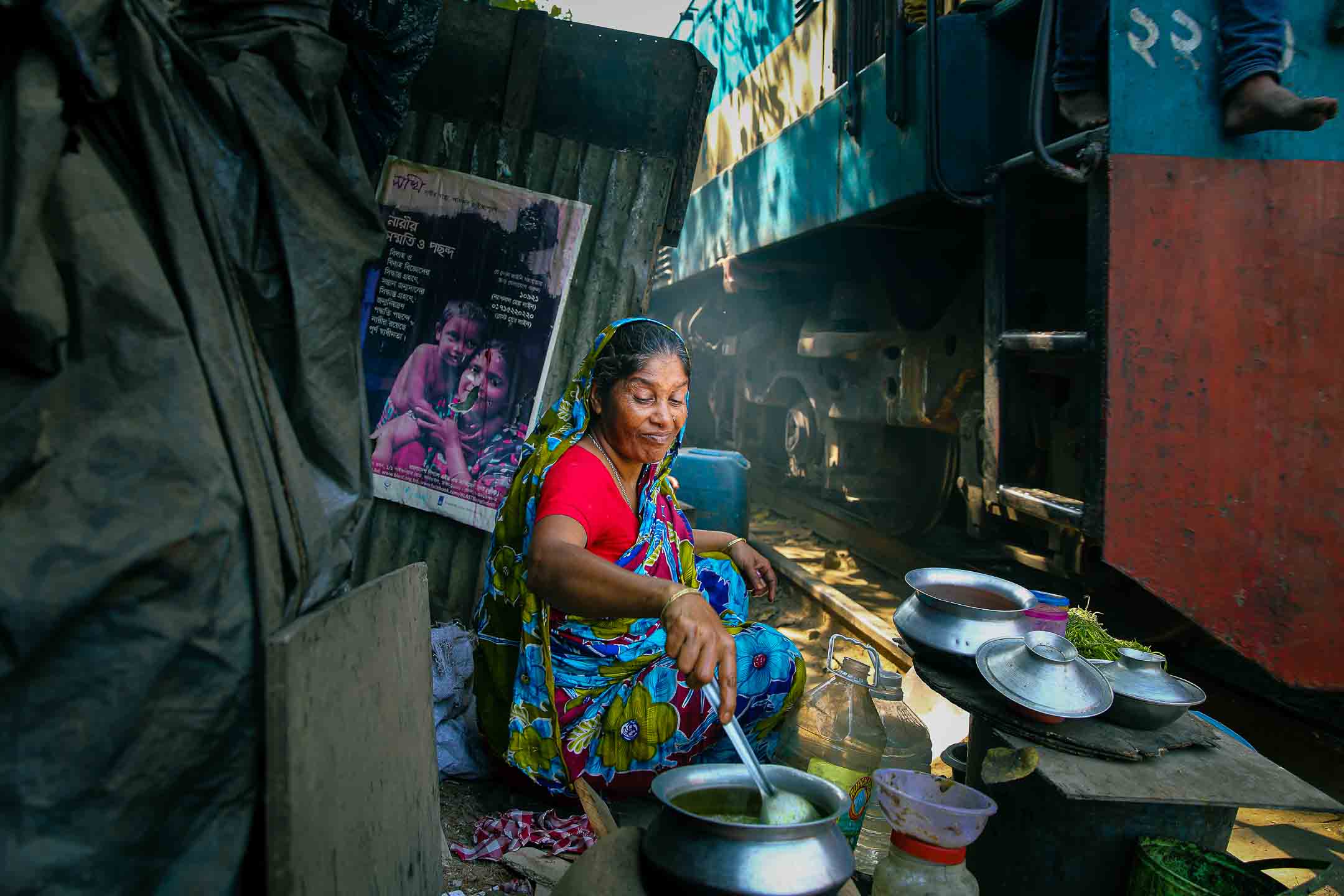
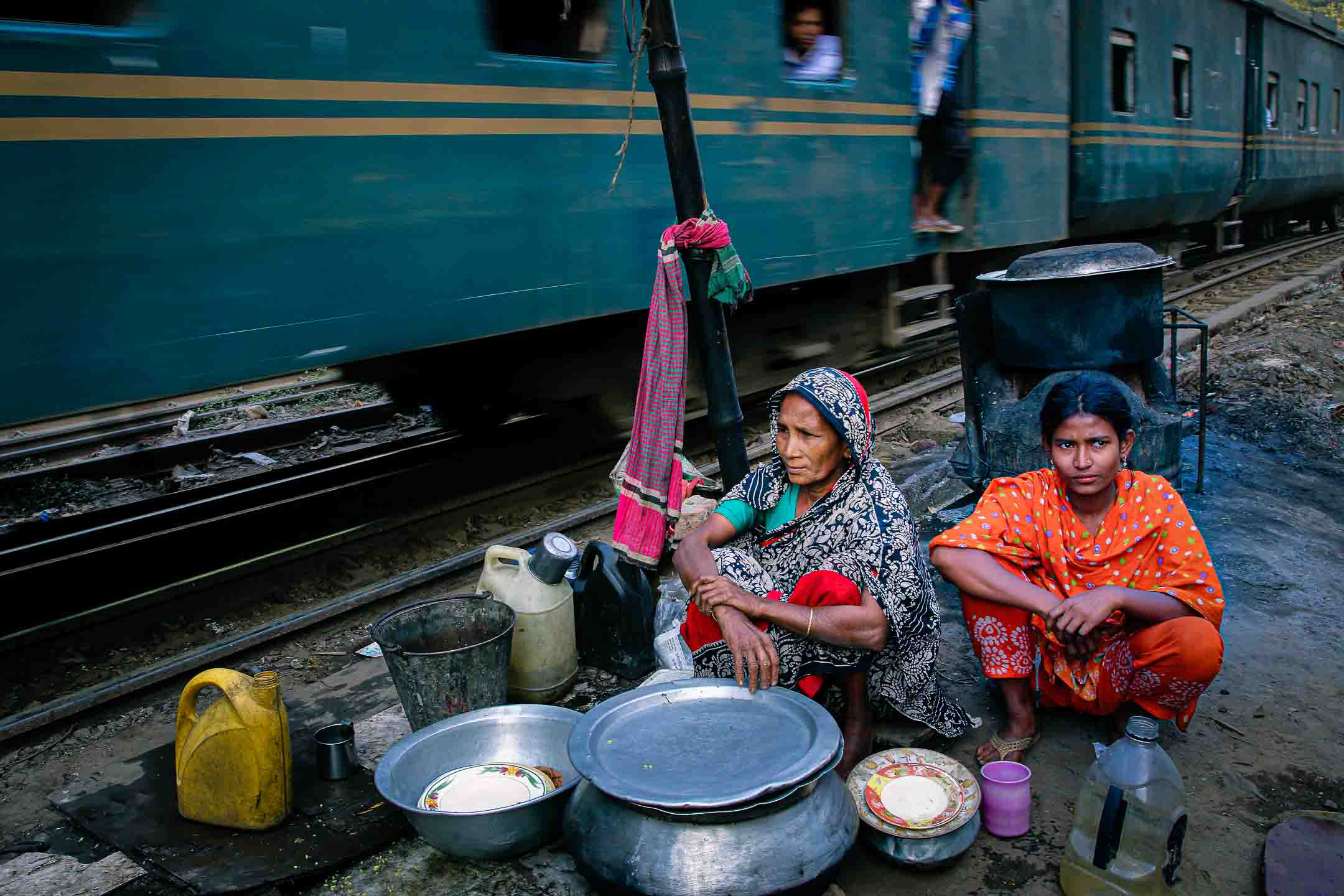
Suddenly the inter-city train appears rushing at them on the tracks with its deadly noise which is the only thing that alerts the people. The scene includes a train that seems to be traveling as if to arrive at the slum but then ruthlessly goes right through it. It watches and touches both sides of the slum’s tin-roofs.
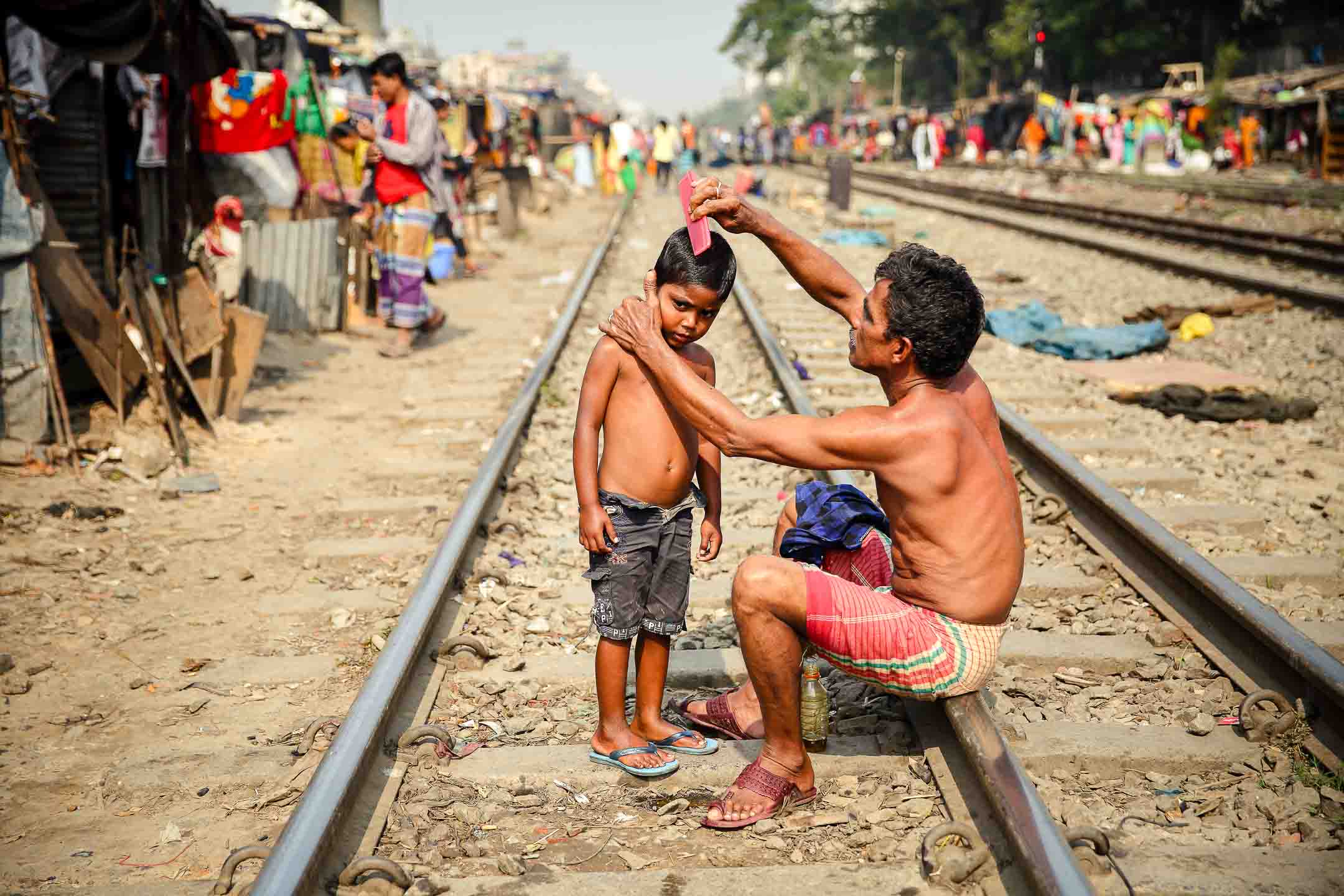
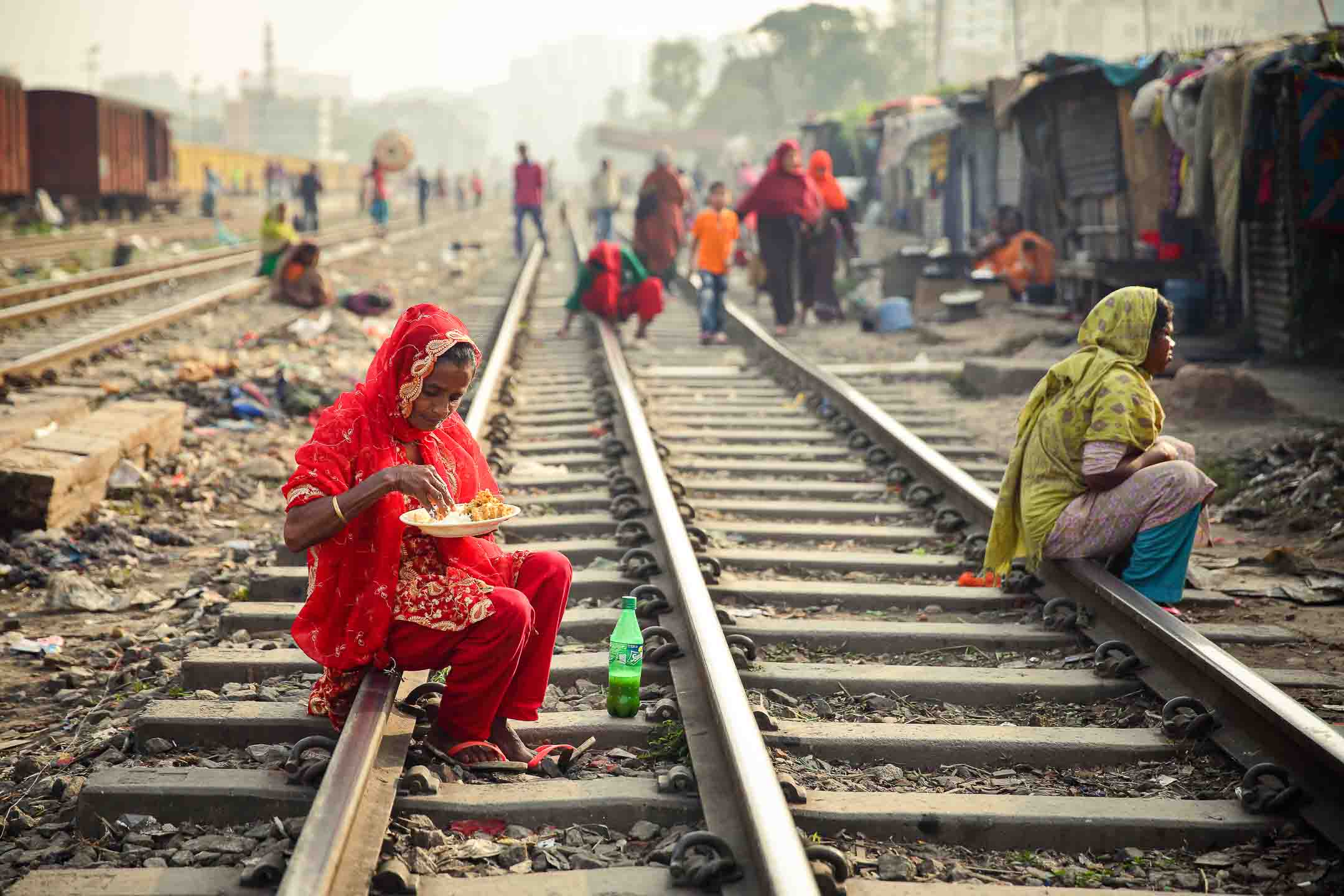
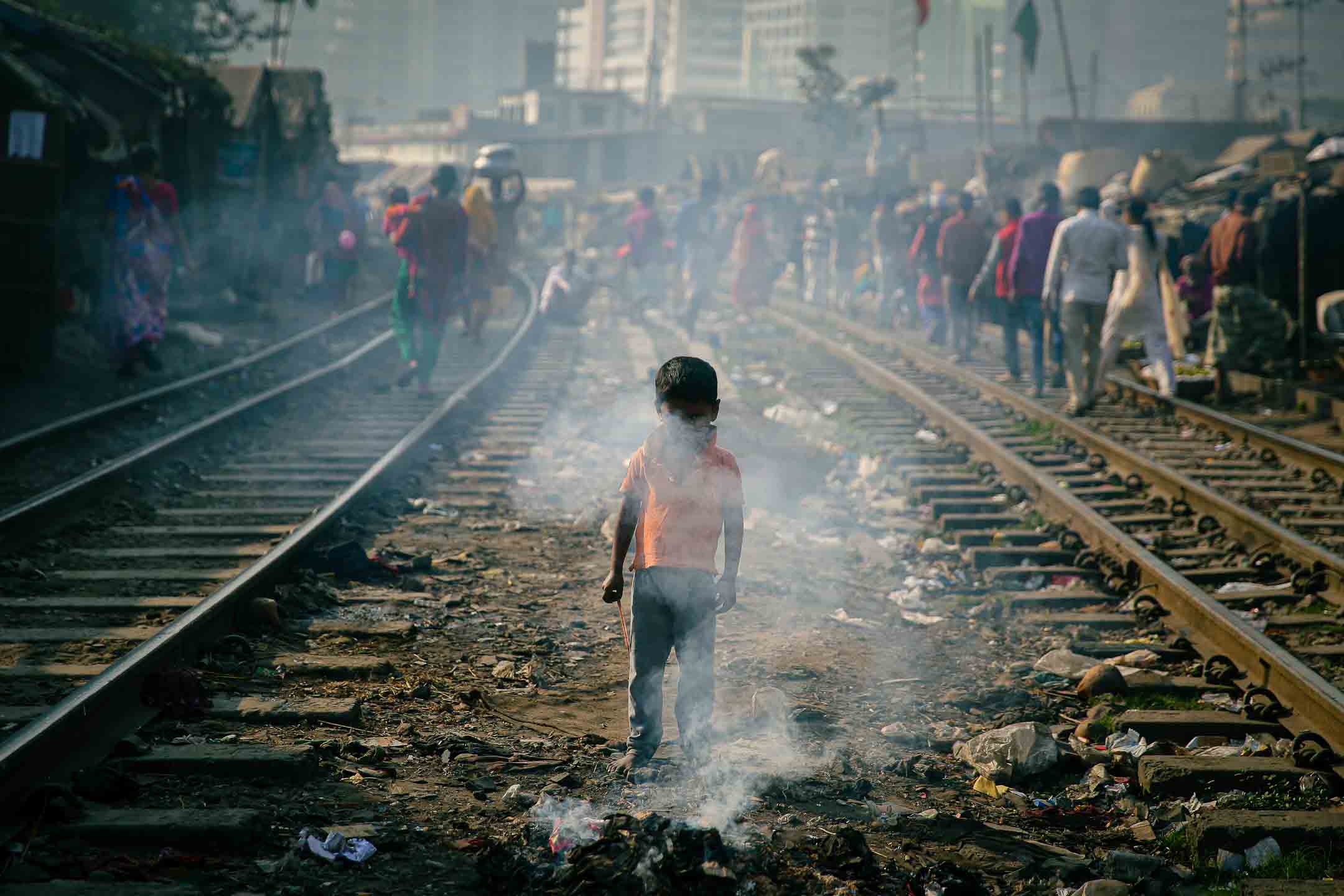
Who could have ignored such g-o-t-a-n-g, g-o-t-a-n-g sound that raises heartbeats of the inhabitants of the Karwan Bazaar train track Slum in Dhaka on a daily basis… at least fifty times a day? Speculated to have sprung up post-Liberation War of 1971, this slum, while not ancient, is home to residents who have lived here for more than thirty years.
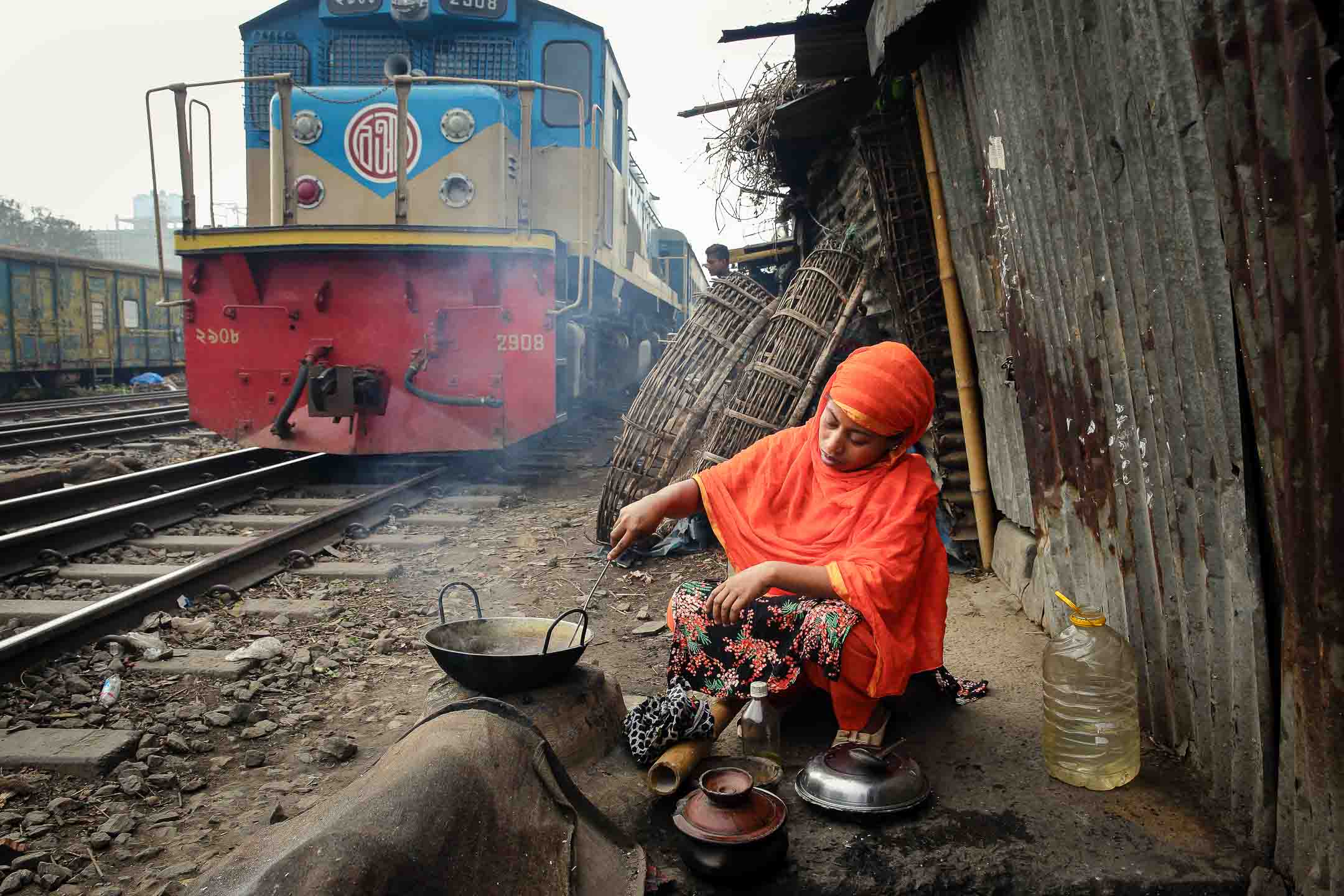
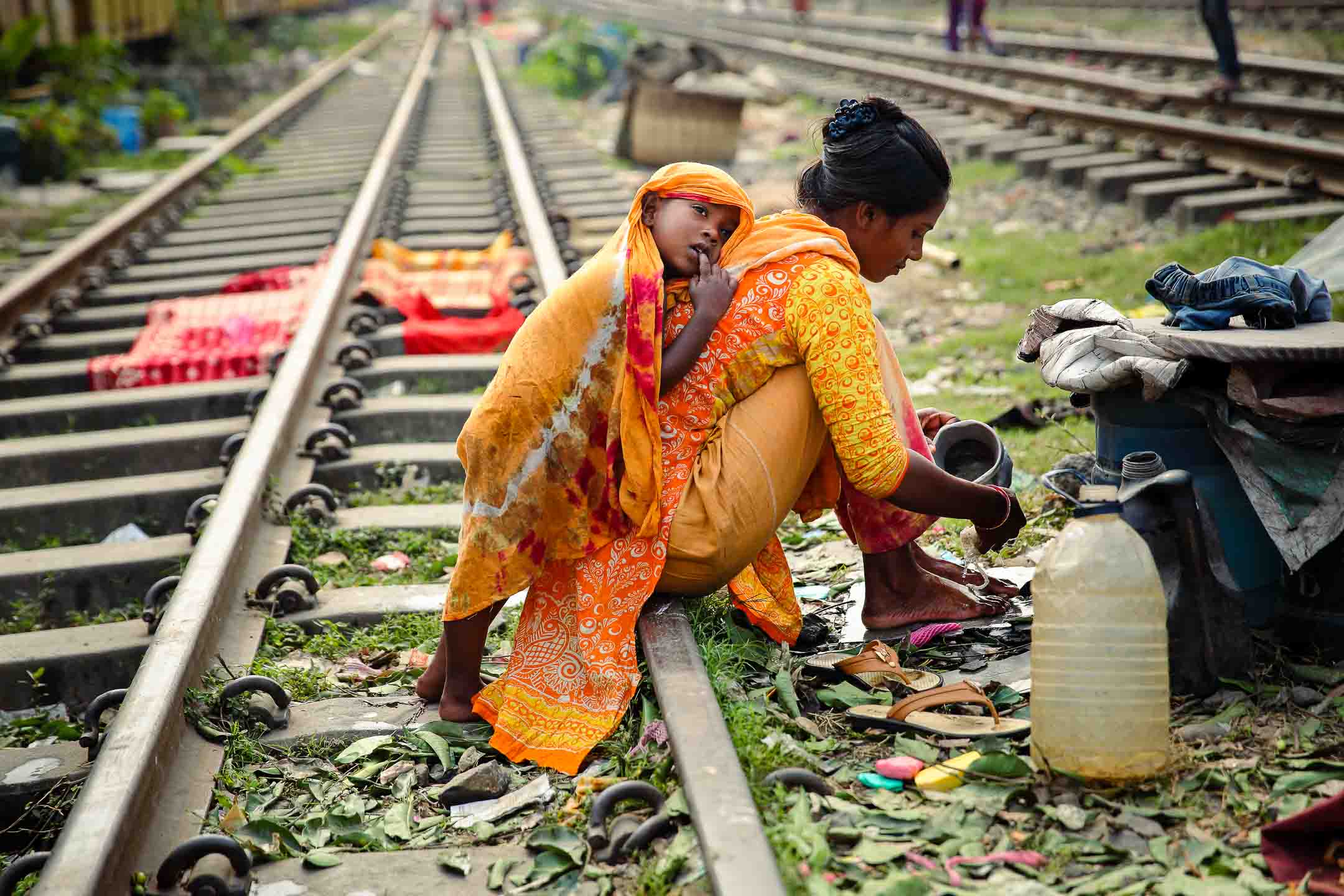
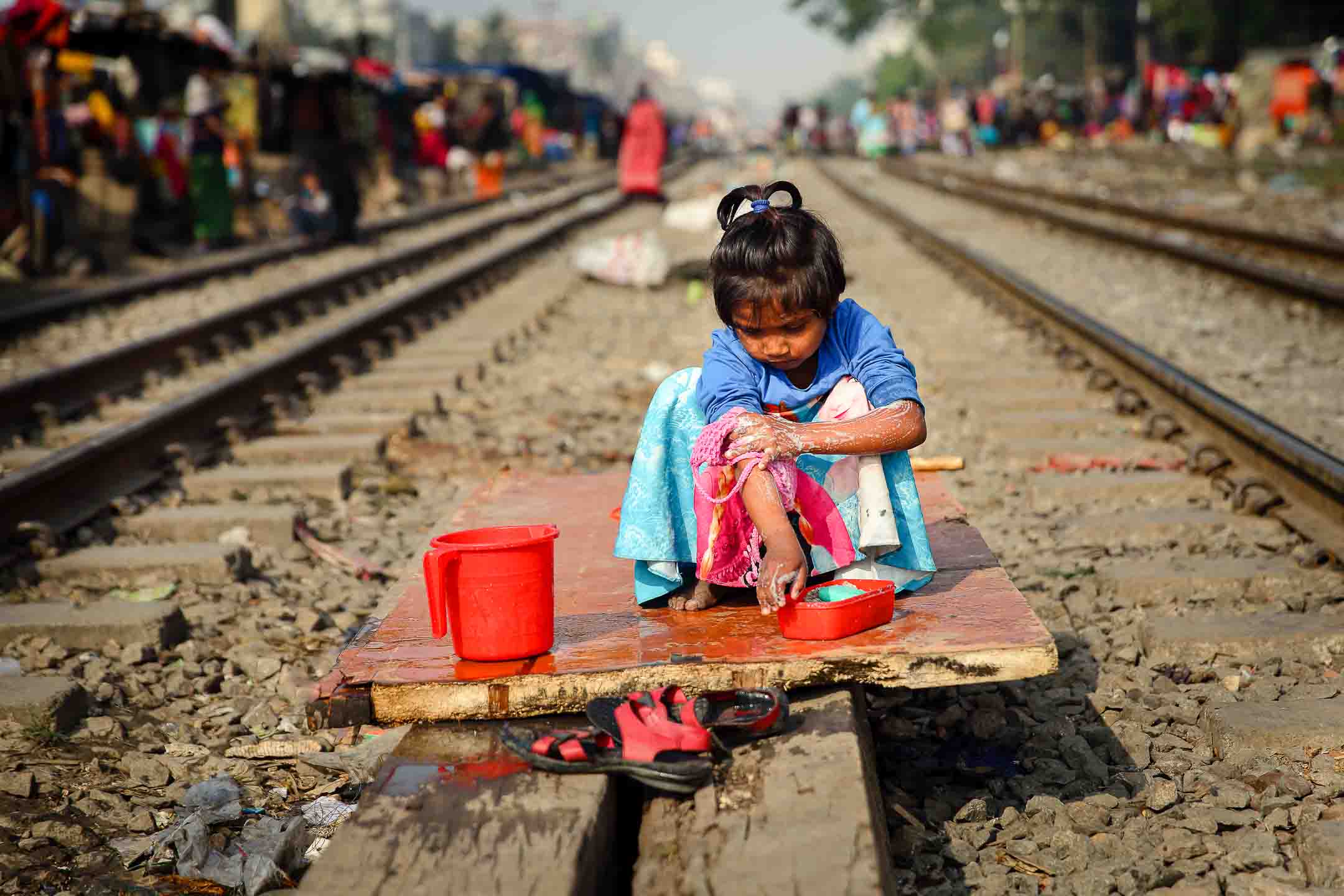
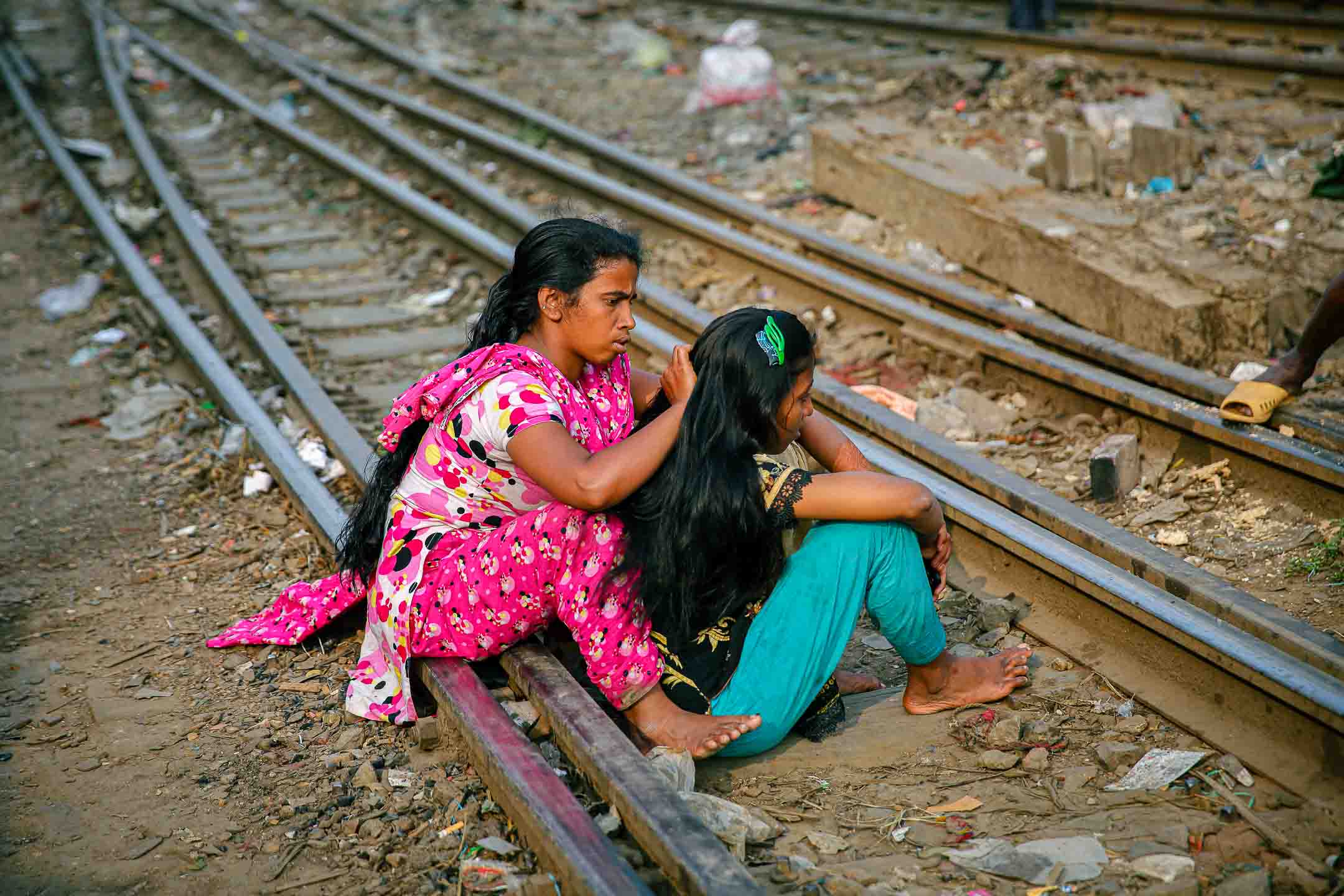
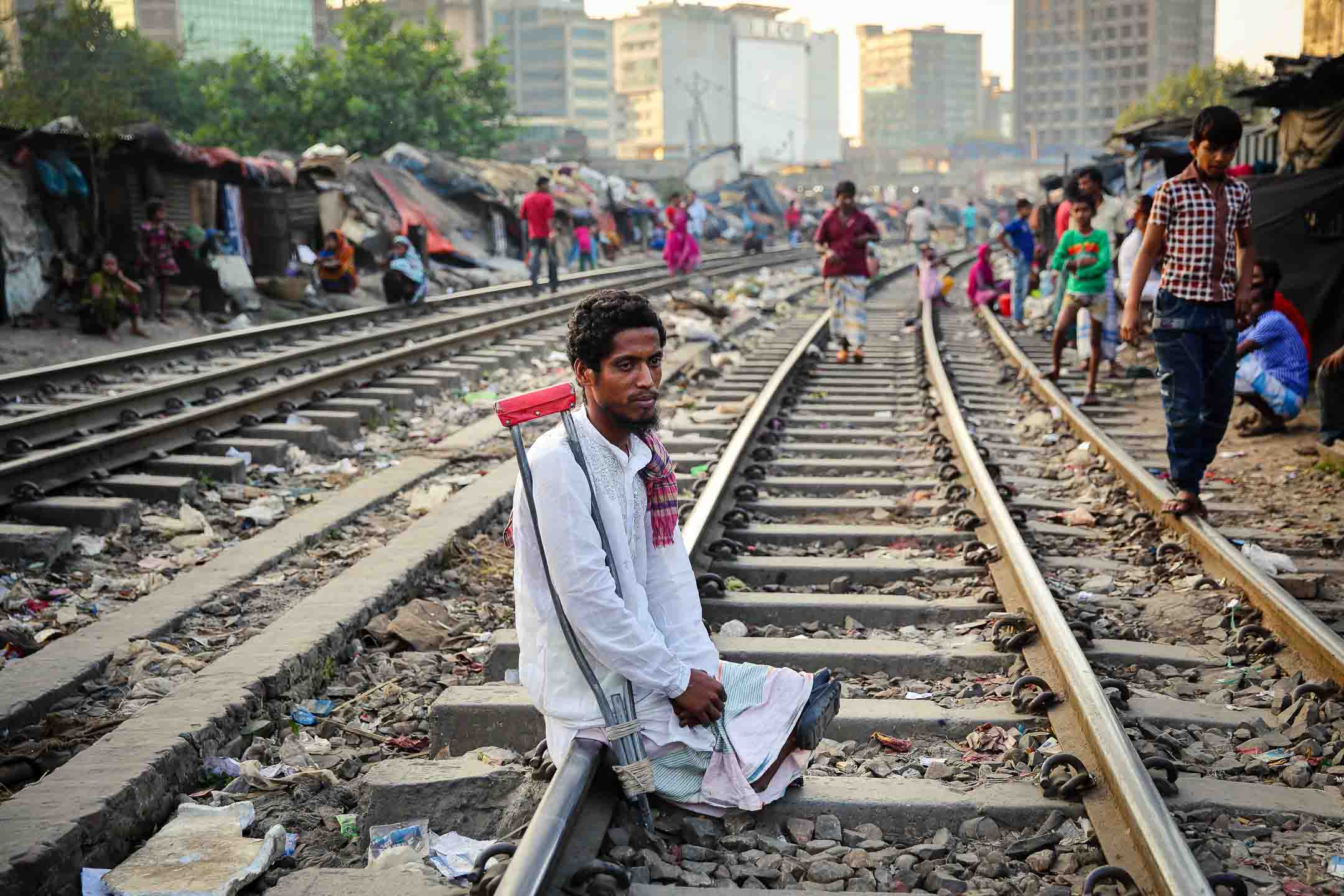
Thousands of shanties line the curvy train tracks. Some of the smallest huts with three-foot-high roofs rent for as much as 2000 taka (about $25), while newer, taller ones cost 3000 taka (about $39) per month. The muddy tracks are strewn with waste and rotten vegetables.
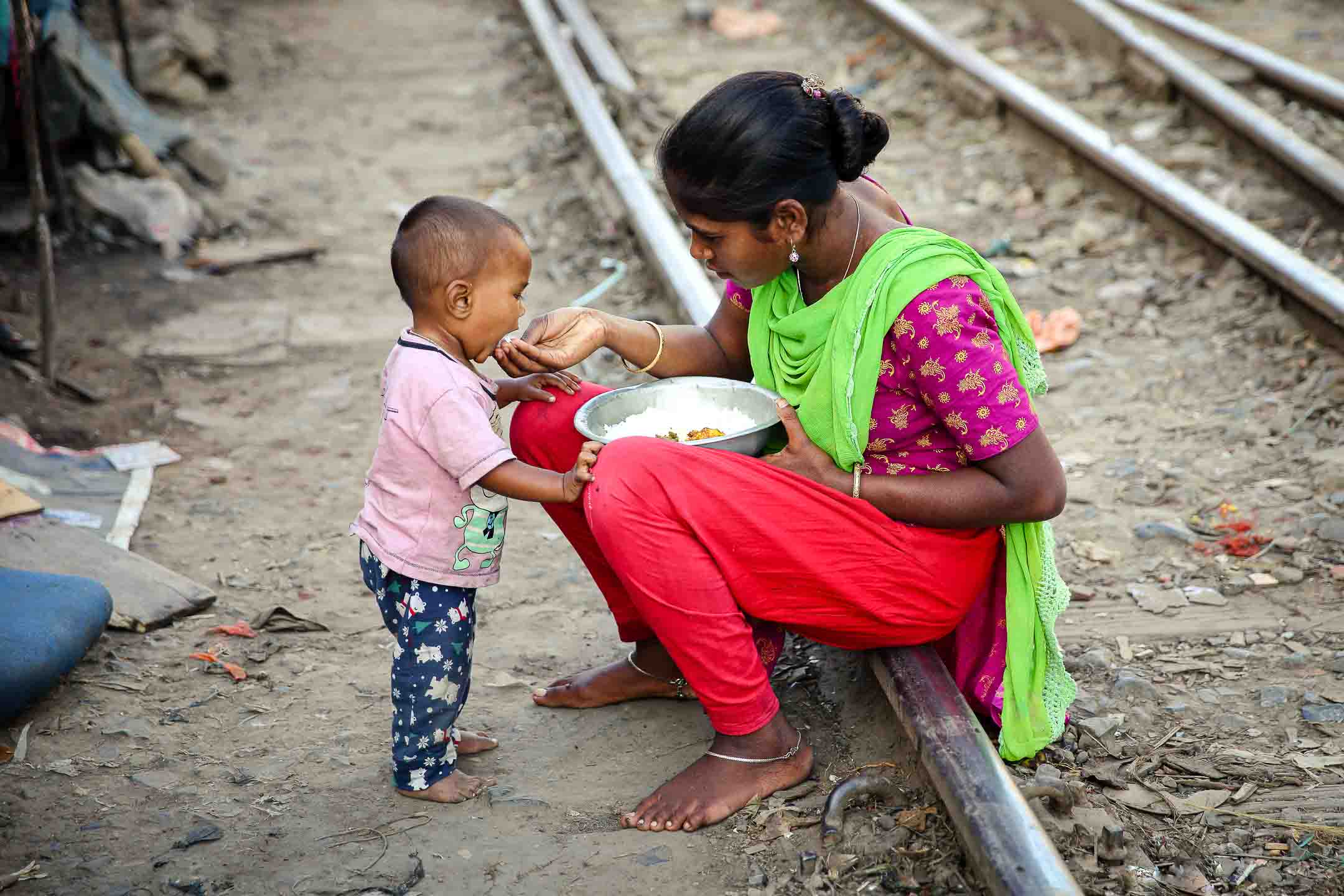
Amidst this, women like Marium Begum, 35, prepare lunch on mud clay ovens just a foot from the rails. A passing train could easily snatch the potatoes she fries in her pan. Marium recounts, “My eldest daughter is ten, and I’ve taught her how to save herself when the train rushes by.” Children here are adept at fleeing from oncoming trains, but the terror of simultaneous trains on both tracks is a frequent, heart-stopping event.
Accidents are common, with many children losing legs, hands, fingers in front of their helpless parents. Jaleha Kahtun reflects, “If we had anything in the village, we wouldn’t live here. The river overflowed and took everything. Now, everything we own is in this bazaar.” These residents are climate migrants, displaced by frequent floods. Despite the dangers, their move to the city allows them to feed their families better than they could back in their ravaged villages. Explore the stark realities and resilience of life on the edge in my photo album.
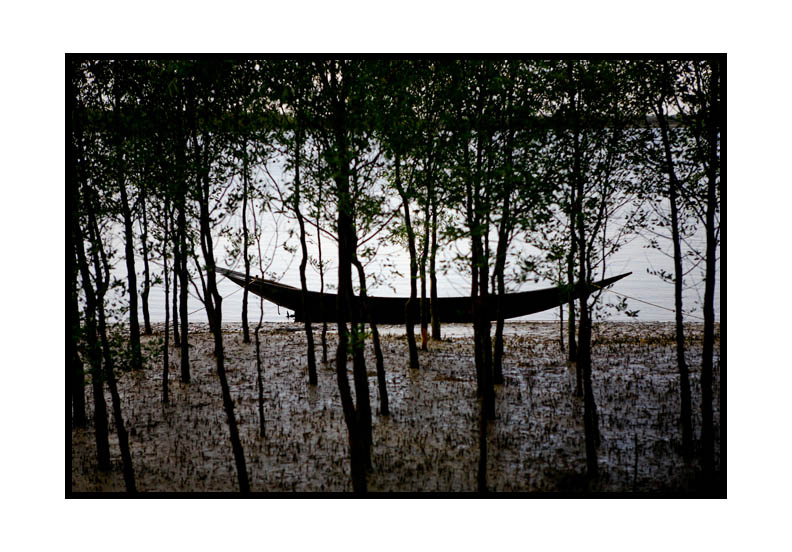
“Environs can explain much. You can feel the existence without presence. & sometimes absence is required to feel this presence more intensely. I started believing these things while I captured few moments of nonexistence. Yet these moments profound very much in exist of living being. I have taken these moments from various part of my world, however they are all alike. These are like footprints of a missing thing; you can assume the missing focus through edges. Welcome you in the puzzle. Fill in the gaps by your thought” – Gmb Akash
“Life – a one way journey….We should not regret any moment which make us smile…We should make our self happy with all little pleasure of our life ….even if we have everything, we haven’t had tomorrow…Lets fill our all gaps by our presence of love, appreciations & thoughtfulness. We may leave forever, & then our environs might tell our tale ceaselessly. Let the light lit our absence.” – Gmb Akash
“Photography has taken me to discover many unexpected territory as all time I wanted to see the sights of unseen & unforgiving incidents of reality. I was engaged in one of my personal project’s work on ‘sex workers’ for which I went to Madaripur. I have been working on ‘sex workers’ last 7 years & my works demand me to investigate their situation all over the country. Last year, in the month of August when I arrived at Madaripur it was afternoon. Shockingly I have seen thousands of apes are in street, running here & there. It was an unexpected thing of my life to see thousands of ill monkeys are moaning alone. I was traumatized, unspoken & felt awful when I understand all these thousands monkeys stand in front of me are HUNGRY. I always concern to cover stories of situation which need concentration for helping out by the assessment of the world. So I take out my camera & run to middle of them”
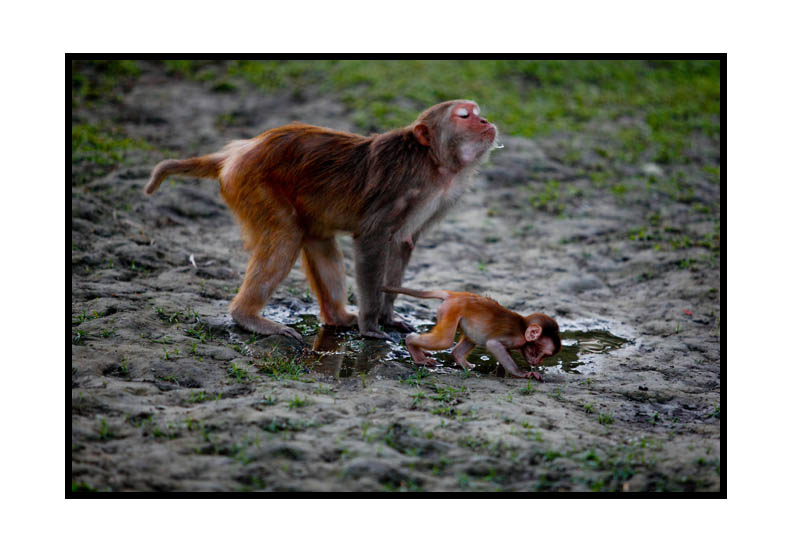
In char Muguria area, Madaripur around 2,500 monkeys are facing severe food crisis. Due to acute food crisis many mother monkeys, passing days starved or half-starved, are even unable to breast feed their babies. Quite a few monkeys have already died in this serious situation. Concerned over the pitiable life of the monkeys, locals and visitors have urged immediate arrangement of food for the monkeys. Though the local communities are already poor to feed themselves but the heartbreaking scenarios of monkeys influence them to share their own food with them. Despite keeping distance with human the unable monkeys are taking foods from people’s hands. The hungry monkeys were competing for the inadequate foods like peanut or biscuit given by the visitors. They were also trying to eat whatever they got — grass, garbage, polythene etc. Baby monkeys are suffering badly in malnutrition. Even the water crisis made their lives more pitiful. Local community sought allocation for food for the monkeys but the higher authorities are yet to give any response in this regard.
“A mother monkey by carrying its dead child was passing from trees to trees. When it came in front of me & begged foods I realized the monkey did not identify its child is already dead. This pitiable situation made me terrified. These apes, whose residents are jungle, came out for food & begging to feed themselves. These climate victims are more alike my working project of ‘Sex workers’. Human & animal all are helpless in front of starvation & need. They are survivors of dreadful situation which many of us over looked or never know”- Gmb Akash
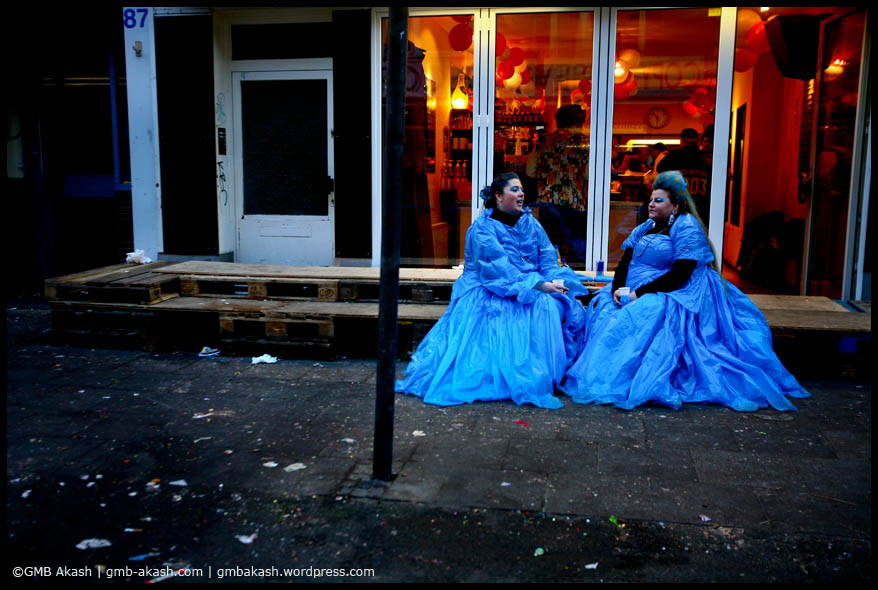
I usually take a picture of a person and then afwerward when I close my eyes for recalling what I have taken – the first thing that hits my mind is – Colour. After observing a person if we try to recall, then unconsciously colours comes first in our mind. The texture of the skin, colour of hair, colours of cloths and over all colour gives us an impression about the mood of the sight. Colour is a strong element to illustrate a person’s traits. I believe every person cover a mood of colour.
From beginning of my career I am working for those people who are living in the edge of the society.While I started working with these people I surprisingly discover – life has taken all colours from them but still they are cherishing every moment of their life with colour. Colour is their courage; colour creates enthusiasm on them to fight to live for another day. Person, who has nothing, has colour in life. In beginning of my career I took all black & white photographs of those who are colourful. I found out poverty, sorrows and depressions become vivid if I skip colour from their life.
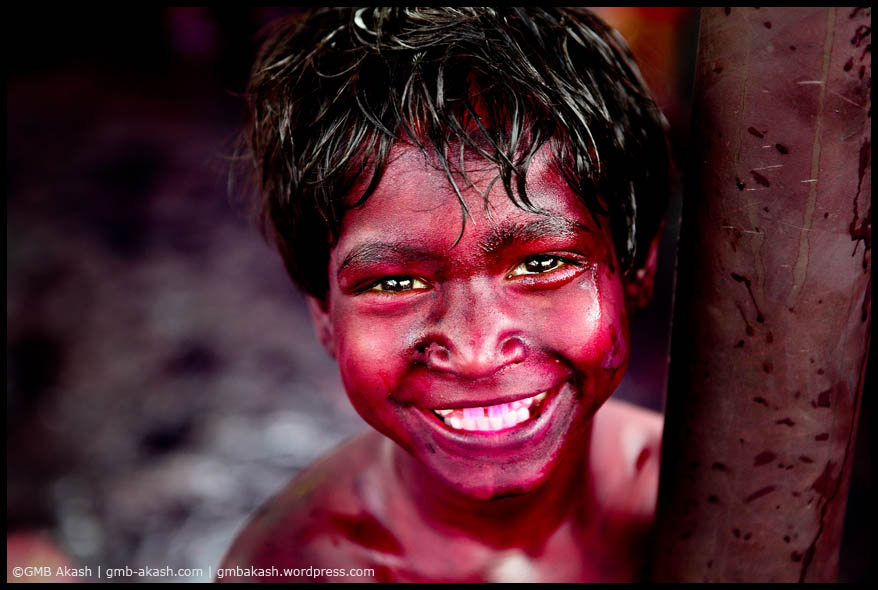
To present – ‘the present’ I start working on colour. A street child, laborer of a road or even a homeless lady all of them has colour. People who are fighting everyday to live life are heroes to me and these heroes represent colour. Their skin tone, dresses, living places all are colourful and powerful. They are deprived from all happiness of life but yet they treating themselves with colour. While I discover the truth I learned to capture the mood of colour on them.
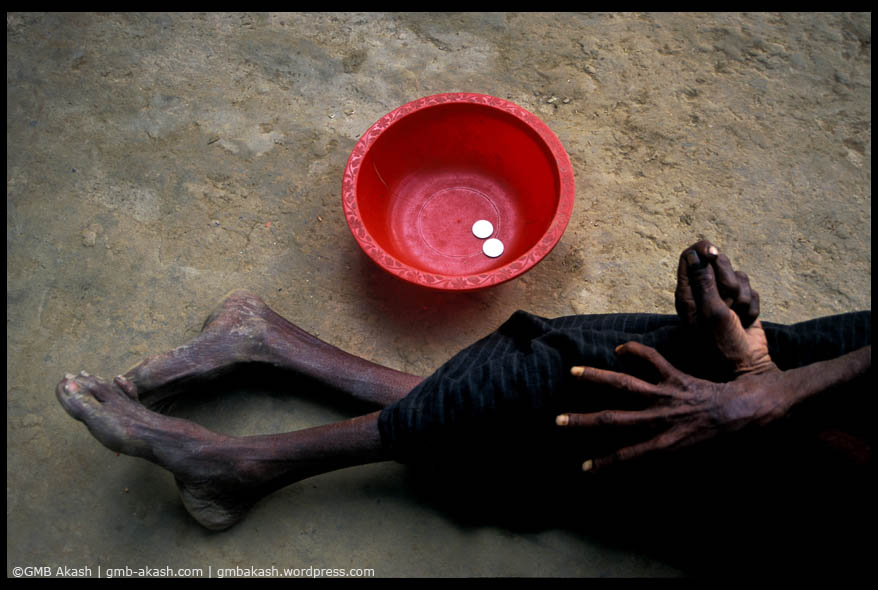
“…I realize I have no power to deny the colour of these colourful people who are straggling in a colourless, hopeless world, nevertheless they live and smile. So I can not ignore the yellow balloon of a homeless child or even a red bowl of a beggar of the street. This inspiration inspires me to work with colour. Ans I continued my journey in the path of a colourless world to meet with all these colourful souls…”- Gmb Akash
Colour arouses my work for getting the depth of the sight. I got colour in different mood in the different part of the world. But I discover people who are fighting endlessly for surviving are more colourful than any part of the world. Because of this colour is more challenging to me. I take this challenge to explore the unrevealed spirit through every capture of mine.
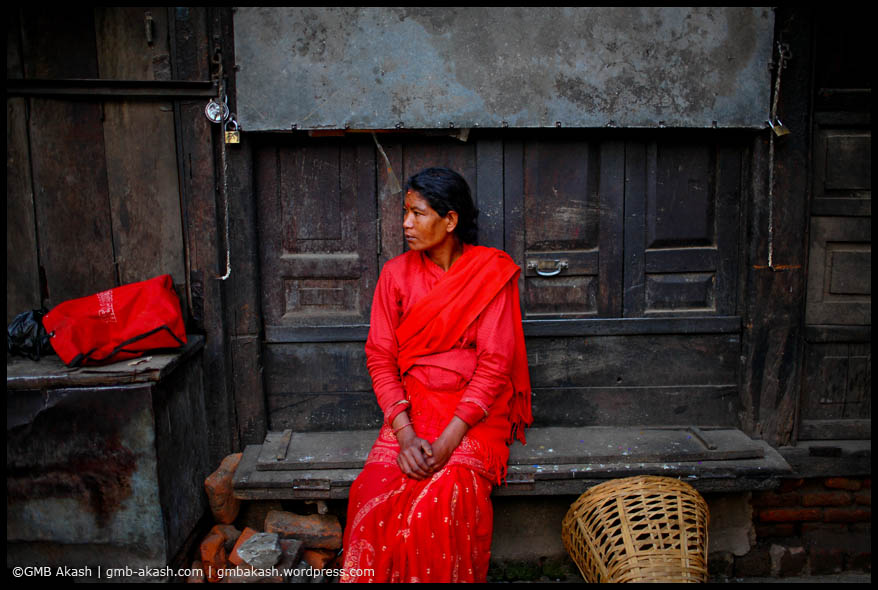
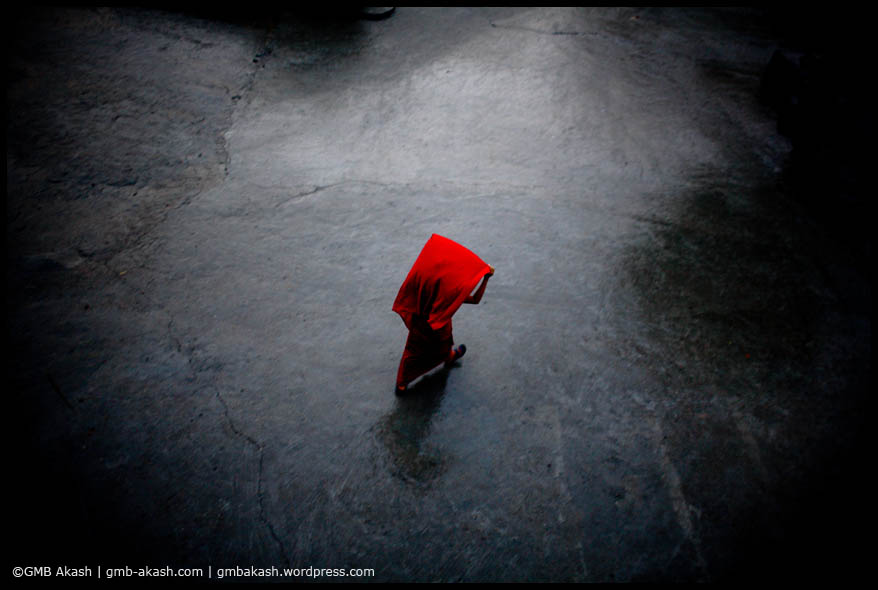
I have a special affection for red. I like to take picture in the early morning and late afternoon. Unpredictably red comes to my way often. People who are living in lower rang affectionate about the colour – Red. It is important to take a red shoot carefully. Contrast might made the capture disturbing, while too much red can destroy the attention for the subject. A good composition and balancing of colour can create an outstanding shot. Apart of all it is important to discover the right mood of colour in the right temperament of an individual.
I go to country to country to explore colour differently. I have found out different colour in different cast. You will find people of power through colour. Your experiences & observations with colour will help you to reveal certain attribute of a community through colour.
– I prefer to use natural light which allows me to capture the originality of the moment of colour.
– I try to find out a natural background which suits the subject’s colour instinctively perhaps my entire colour photos are – found situation. So I believe to observe more & more while traveling frequently.
– Working with a single colour allows me to appreciate more intricate details within the subject itself.
– I travel to discover for getting the unexpected shot yet carrying the note in mind that I am searching thing which I have seen several times but never been noticed. Searching without clue for a known thing helps me to get a good colour shot.
– I only pick colour which has meaning to the subject.
“While I am taking photos of these colourful souls I am learning to live in colour. By capturing these colour moments I have learned – few hints of red, blue & yellow has inspirations in our life. People who are fighting without anything in this world are healing their pains by indulging in colour”
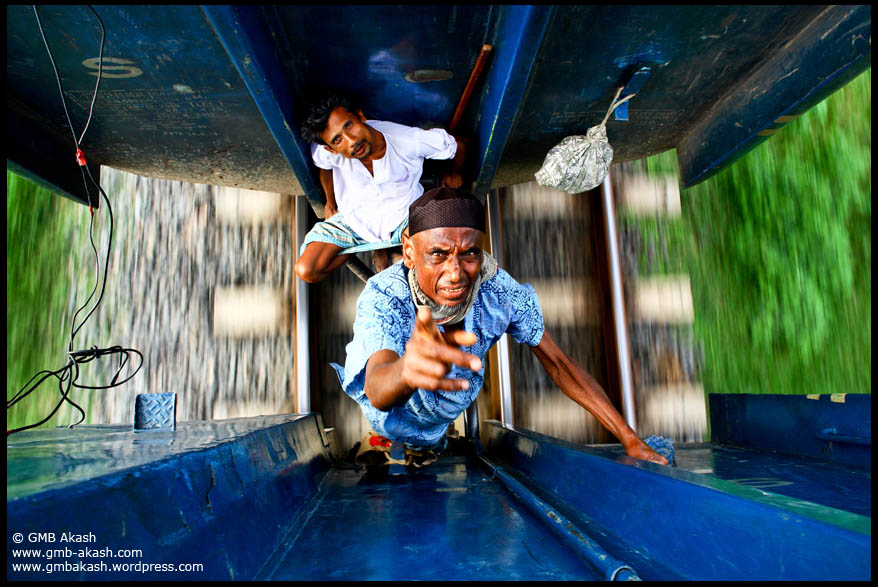
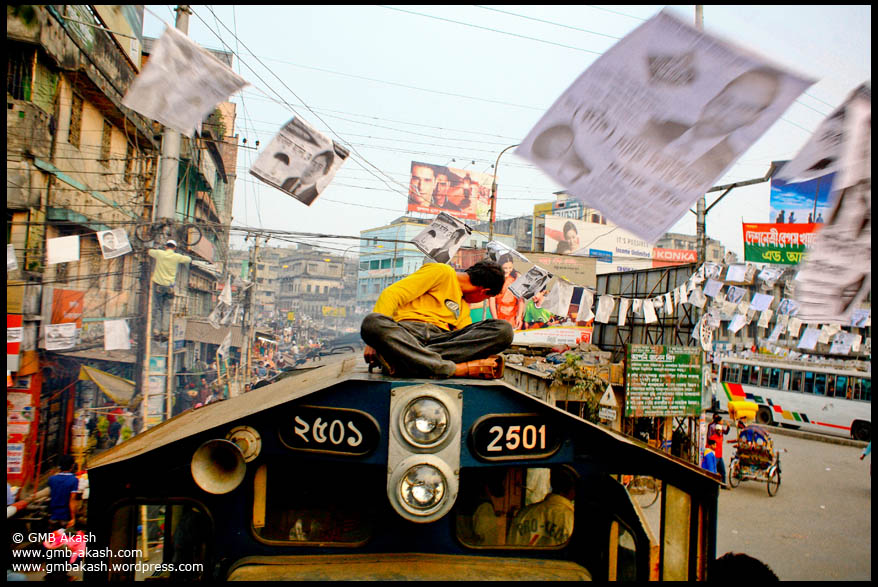
“When the train starts your feet will shake and you will automatically try to hold something, but there is nothing to hold on to. From 2005 I went up the train. Sitting or lying on the corroded metal roof of a train moving at 40 kilometers/hour is dangerous. By knowing that any time accident can happen you obvious to be nervous. It gives you an insecurity and makes it more risky. In that time there was no one who can tell me the rule of hanging in a running train, there was no example of photograph by which I can inspire myself to capture moments in camera. But I did not think twice to step into the slippery train and attempted to make a new series on the bravery of some insignificant heroic lives.”
Seven years ago I had to travel many times by train to come to the city. During traveling I noticed low income people were traveling in the roof of the train and even in between joining line of the train. Most of them were low wage working class and traveled with high risk of severe accident. I was surprised to the fact when I discovered few of them traveled many times of the day with life risk. For knowing the reason my interest had taken me to the root. I pick my camera and leave my seat. Thus my journey starts in the running train. I had a basic curiosity to know about people whom I intend to photograph. From beginning of my journey I work for those people who are fighting endlessly to survive without anything but a smile. For taking photo of them I blended myself into the same conditions which help me to get the insight of the story. This inquisitiveness leads me in the top of the train. And I become one of the free passenger of regular running train. Thus I got familiar with the scary situation of the fearful journey; discover people and above all I took pictures.
Uncountable times, I went to the roof of the train. Often traveling made me familiar with scariness of a running train. People become well-known to me. I find out so many different stories of people and their determination of surviving. When I manage myself to step straight then I pick my camera and start capturing my feelings. No one travel to risk their life to get pleasure. All were unable to manage travel cost as they were living under the margin. Many of those travelers work as day laborer, many of them goes for selling fishes in city which they collect from their villages. All of them have to return also. These travel costs can not manage by them so they risk their life in the top of the train.
This traveling is very addictive. When you will discover people who have power on them, who were bravely setting without caring anything the something will happen to you too. These people inspire you to live life without getting frustrated. They have nothing with them only have bravery to fight against all odds of life. So this journey put power inside me to fight in rest of my life with bravery and inspire to take any risk to live a life.
In winter surface of the train get slippery, once I stepped without been concern and attempted to fall. It is difficult to take picture in opposite of the direction of the running train. Along other passengers I have faced terrible winter, unwanted rains and continual heat in the top of the train. Many times wires hit me, every time I thought I should not go more. But again I can not resist myself. Getting a good picture is toughest thing while you need to spend days and months for the right moment and for the right click. I won travel photographer of the year title in 2009 on the series. Besides all I am fortunate to be able to stand in this fearful journey which will continually give me power for rest of my life.
“I recall all these journeys repeatedly. My achievement is that I established this series as one of favorite topic for photographers. I feel happy when I see photographers come from around the world to get a free ride in the top of the train and takes pictures. All these make me happy. I collect all these treasured moment and I am working for publishing a book soon on this series. I have to say, I am fortunate by killing fears of me to become able to go to the top of the train. There is nothing to hold on to, only your fearlessness”
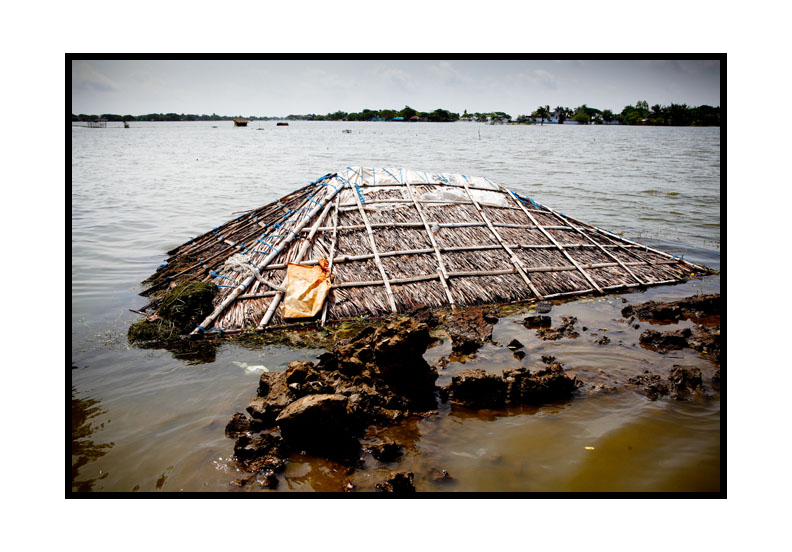
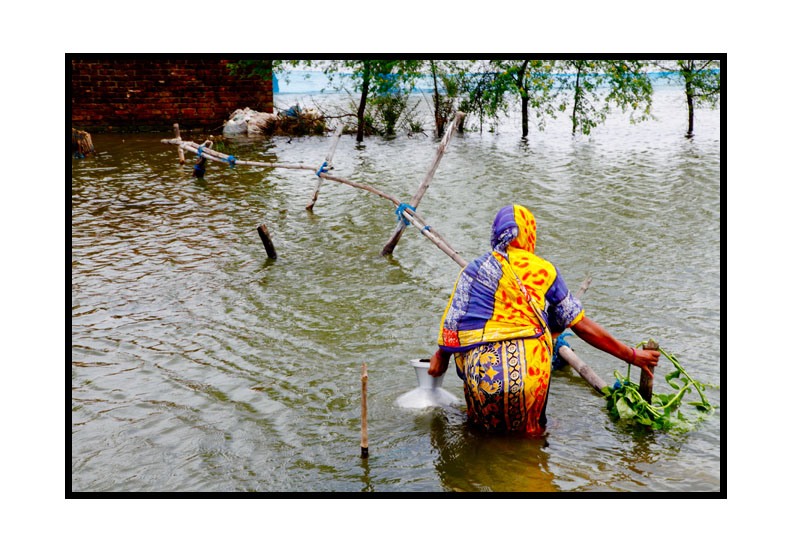
After Aila attack it has been two years Khadeza Begum sold her cattle & everything to rebuild her only shelter. Now it is another nightmare for her to stay under her destroyed house after facing another devastating flood. She has no idea how she will manage to pay back all her loans, besides passing nights in this smashed house with her husband.
Kadeza Begum said:
“We have nothing left, but we have to survive, so we’ve had to build our house again, twice in two year”.
Like Kadiza Begum It takes one year to Nobab Ali for building his house after Aila attack. Again flood hits on his all effort & left him in the flooded street. After all these devastation still he is trying to get some materials from the ruined house for covering his head in the road.
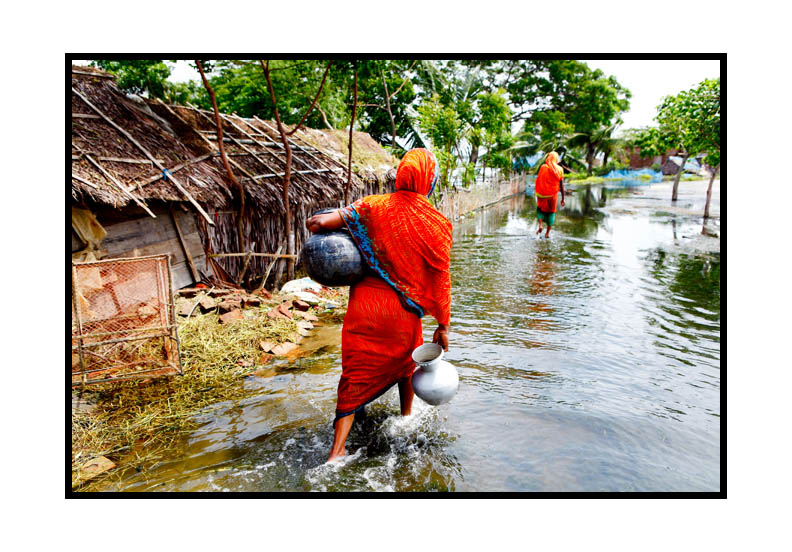
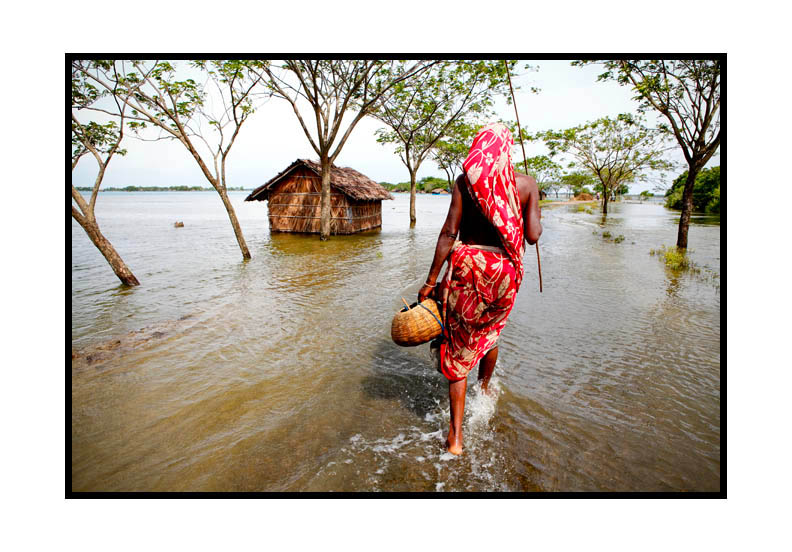
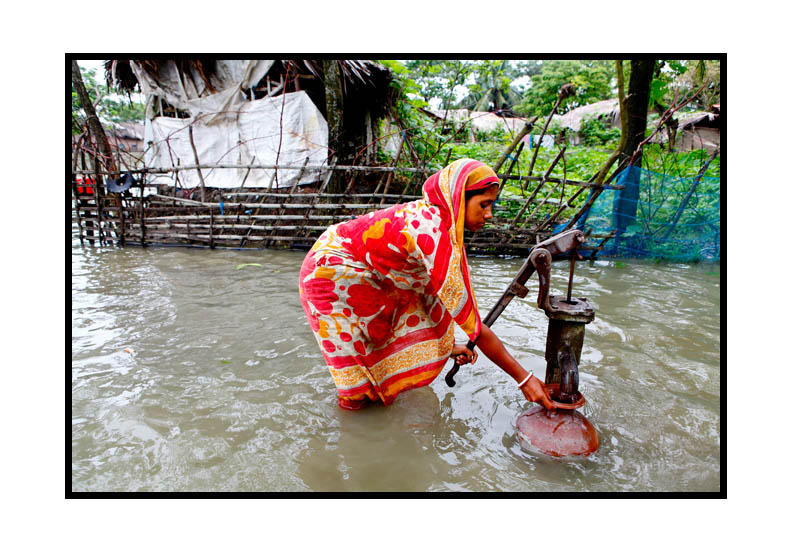
Alike them all inhabitants of Shamnagar are suffering like prisoner of devastating water kingdom. Helplessness & shouts are not getting into ears of rest of the people around the world & surroundings. In all places water & the destruction of water could experience in flood affected areas of Shatkhira. Inhabitants are collecting water after walking 3 Km. as all tube well are under water & badly affected by salt.
Amina begum told:
“Here water in everywhere, even in my house there is no sign of house only water. But we are such cursed that we have no water for drinking”
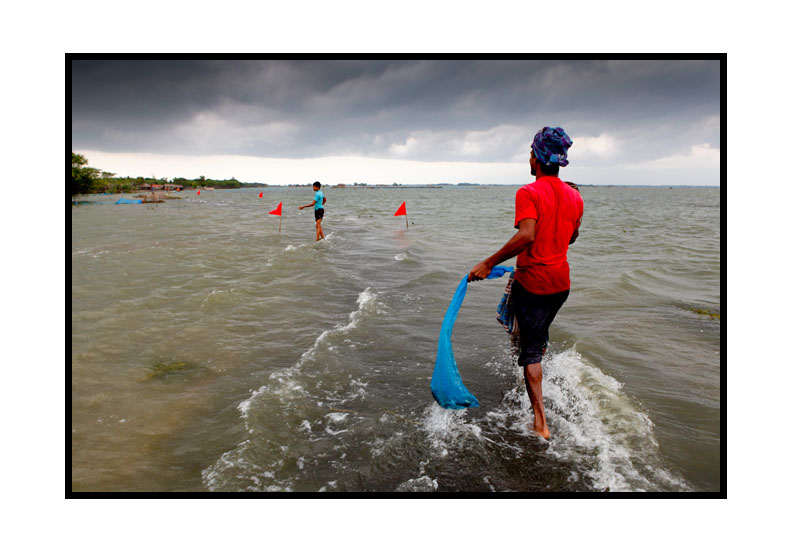
After facing devastating flood every year, they are fighting to live apart loosing shelter for existing. Still they are fighting to live. They are collecting all destroyed pieces of house to shed their head. Women go for fishing. They are healing pain of each other set aside from the remaining world.
I headed to the flood affected area of Shatkhira when all those villages are under water within three days & was out of communication. Evidentially when I reached to Shamnagar sun was setting down. I was surviving in a boat & could not see surface to stand a while. With the drowning sun the village was drowning under water. People were sheltered above in roofs of their houses. Moaning of old people & shouts of children were making the atmosphere miserable.
The southern part of the country is mostly affected by rain-fed disaster. There was heavy rain all over Bangladesh but flood has affected 14 of the 64 districts in Bangladesh. In Satkhira Kobodak, Betna, Shalta and Morichhap rivers swelled abnormally over the last seven days overflowing their banks inundating 160 villages in dozens of unions in Tala, Kalarowa, Ashashuni and Sadar upazilas. Over four lakh people of 160 villages were marooned. Crops on several thousand acres land; thousands of dwelling houses, schools, mosques, markets and ponds were inundated. Over 2,000 shrimp enclosures were washed away. Families lost everything & staying night without roofs in wild weather. Incessant rain coupled with high tide triggered by depression in Bay in the last few days caused river water rising engulfing villages on their banks. No humanitarian support has been provided to the people in the most affected districts by the government, local, national and international NGOs even after 10days of water blockage. People are suffering like prisoner of devastating water kingdom. There helplessness & shouts are not getting into ear of rest of the people around the world & surroundings.
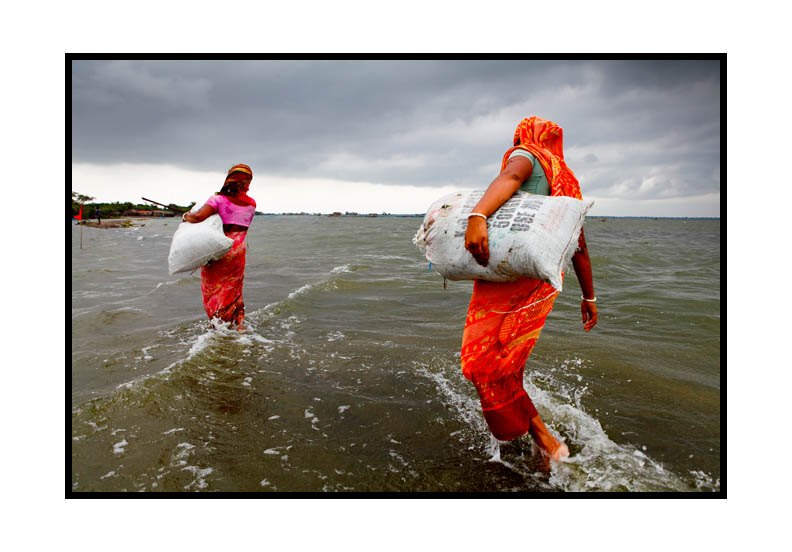
After the flood in Shatkhira, all ladies are moving for dry places by carrying their belongings. Families lost everything, passing nights without roofs in wild weather. In such a situation open air in field of water can not accommodate them for healing pains. Leaving behind everything they are moving to the city. . Hunger, helplessness & calamity force these climate refugees to the city. City welcomes them to face the uncertainty of living for their entire life time. Rootless people suffer here & there. Their tears evaporated by thirsty street of Dhaka, the capital of Bangladesh.
Bangladesh is the most vulnerable country in the world, the frontline state of climate change. Mostly to say Bangladesh seems the leader of climate change. With 140 million people, Bangladesh is one of the world’s densest nations and also one of the most vulnerable to the impacts of climate change. Like much of the delta region, it floods each every year, but the flooding has been getting worse, the waters are staying longer, and contaminating the fields and the wells with salt. People in Bangladesh live precariously close to the risks of cyclones, floods and droughts and more than 100 million people live in rural areas. Two-thirds of the country is less than 5 meters above sea level and in an average year, a quarter of the country is inundated. Bangladesh has experienced severe floods every 4 to 5 years that may cover more than 60 percent of the country, resulting in significant losses. United Nations’ Intergovernmental Panel on Climate Change predicted that rising sea levels could submerge 17 per cent of Bangladesh by 2050, creating 20 million “environmental refugees”.
Here is a short film on this concern – how people are facing the calamity by living their normal life behind:
Still images of this devastating flood could reveal people’s straggle & endless helplessness.
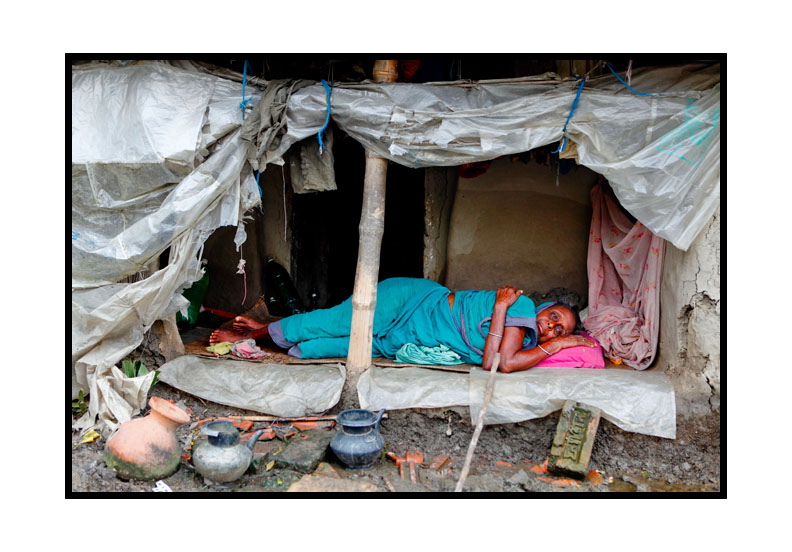
The lady is going inside her house. The flood has broken all her hope to pass a single night in serenity. After facing devastating flood every year, they are fighting to live apart loosing shelter for existing.
“I headed to the flood affected area of Shatkhira when all those villages were under water within three days & out of communication. Evidentially when I reached to Shamnagar sun was setting down. I was surviving in a boat & could not see surface to stand a while. With the drowning sun the village was drowning under water. People were sheltered above in roofs of their houses. Moaning of old people & shouts of children were making the atmosphere miserable. When I reached to the house of Khadeza Begum I closed my eyes. It took two years to rebuild the house of Khadeza after selling all her cattle as well taking huge loans after Aila attack in 2009. I was standing in front of her ruined house. The house which has been rebuilt these two years by the bravery of Khadeza. I could not answer when she was hitting me by asking why I come to take photo of her ruined house again after Aila. No one come to ask them ever how they are fighting against the will of nature. She cursed all those happy people who seat silent after hearing their news”
In 2009 Aila attacked Shatkhira area, after two years when that pain has not forgotten this place again faced the ferocious attack of flood. While in these two years affected people managed to build their destroyed home but again flood has taken last hope from them. Over four lakh people of 160 villages were marooned after the striking of flood in this 2011. Crops on several thousand acres land; thousands of dwelling houses, schools, mosques, markets and ponds were inundated. Shrimps in over 2,000 shrimp enclosures were washed away. Families lost everything & staying night without roofs in wild weather. No humanitarian support has been provided to the people in the most affected districts within the affected time of 13 days.
People were suffering like prisoner of devastating water kingdom.Helplessness & shouts are not getting into ears of rest of the people around the world & surroundings. Still they were fighting to live. They were collecting all destroyed pieces of house to shed their head. Women went to water for fishing. They were healing pain of each other set aside from the remaining world.
Hunger, helplessness & calamity force them to the city. City welcomes them to face the uncertainty of living for their entire life time. Rootless people suffer here & there. Their tears evaporated by thirsty street of Dhaka.
After discovering the insanity of nature & bravery of these sufferers I realize these people are stronger to rule their own live. If these brave people could get support of a shoulder to cry, rest of us could claim us as “Human”. I recall the statement from Helen Keller & focus my lens to capture some brave moment.
“I am only one, but still I am one. I cannot do everything, but still I can do something, and because I cannot do everything I will not refuse to do the something that I can do”- Helen Keller
Homeless people float near in the street of the city. By few road sides families are allowed to build their homes. Still climate refugees can not gather enough wasted digital prints, papers & bamboo for making plastic houses. Those who can not manage helplessly sleeps in open air by not letting the place empty. Everyday they collect papers for dwelling beside street.
Dhaka, the capital of Bangladesh is one of the most densely populated cities of the South-Asian countries. Due to rapid urbanization process, the city is emerging as a mega-city and this trend generates numerous economic and social externalities and social cost such as deterioration of environmental quality, increased pollution and congestion. 30 to 50 percent of total Dhaka residents are Slums dwellers. Slums of Dhaka city are beset with a number of socio-environmental problems specially ‘water’ crisis.
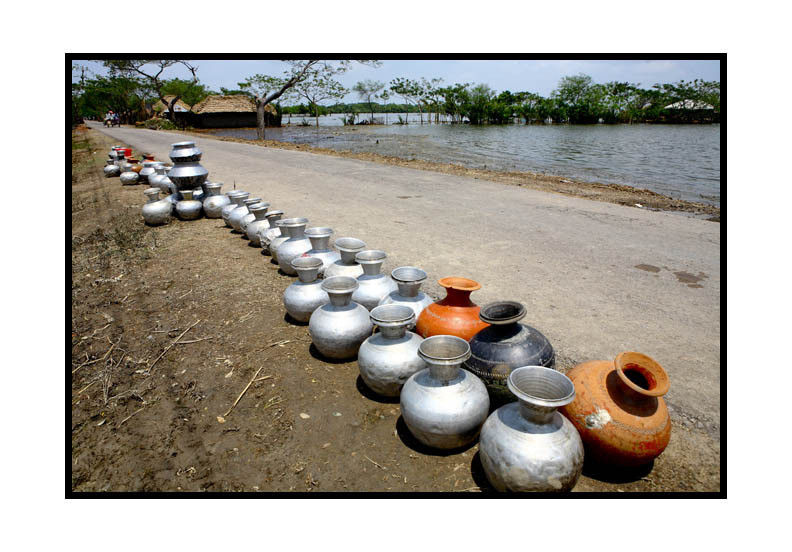
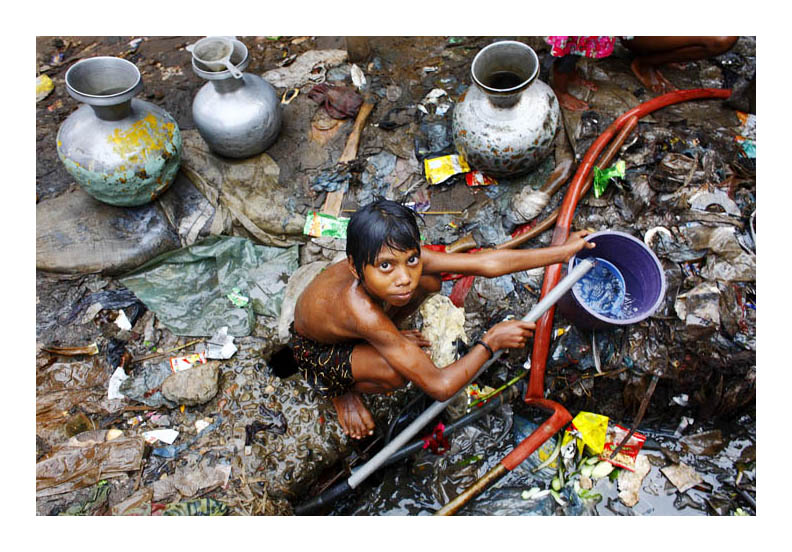
“In slums from early morning hours passed & water pot gathered gradually. Queues of water pots & lines of people are regular scenario of the slum. Government van comes once in a day with drinking water. They have no idea exact when the van will come, so they line up their water jars & sit beside. Most of the inhabitants of these slums are climate refugees. Most of the slum dwellers stand in lines before the sun rises. After passing the long queue, knowing that this impure water causes sickness, they feel that they are fortunate. Their consolation is that at least they don’t have to leave with empty pots” – Gmb Akash
Apparently the place seems like garbage, though this is the most desired place of the inhabitants of Mirpur slum in Dhaka city. For water, in this thirsty zone queue stars near midnight. After an immense time of patience they got quiet impure water which often makes them sick. In spite of all they give a cheerful smile when they touch the water after passing the long queue. No dirty water can kill their hope & smile.
In Mirpur slum, slum dwellers have to waits hours & hours in queue for water. Children use to drink water whenever they got chance to get the pipe. Slum dwellers of Mirpur hardly get drinkable water. Bad smell & impure wastage made the water high-risk. Dhaka. Bangladesh
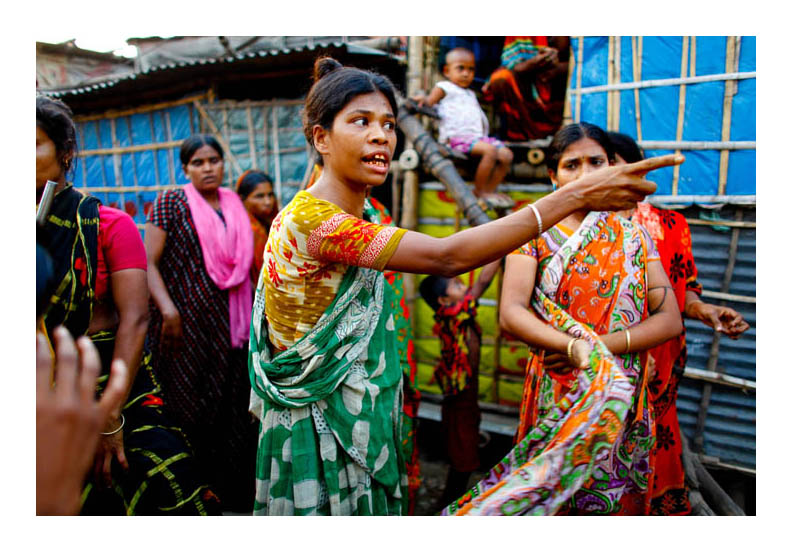
A woman is fighting for water. Children & ladies stand up in queue before the sun rises. Slum dwellers of Mirpur hardly get drinkable water. Bad smell & impure wastage made the water high-risk.
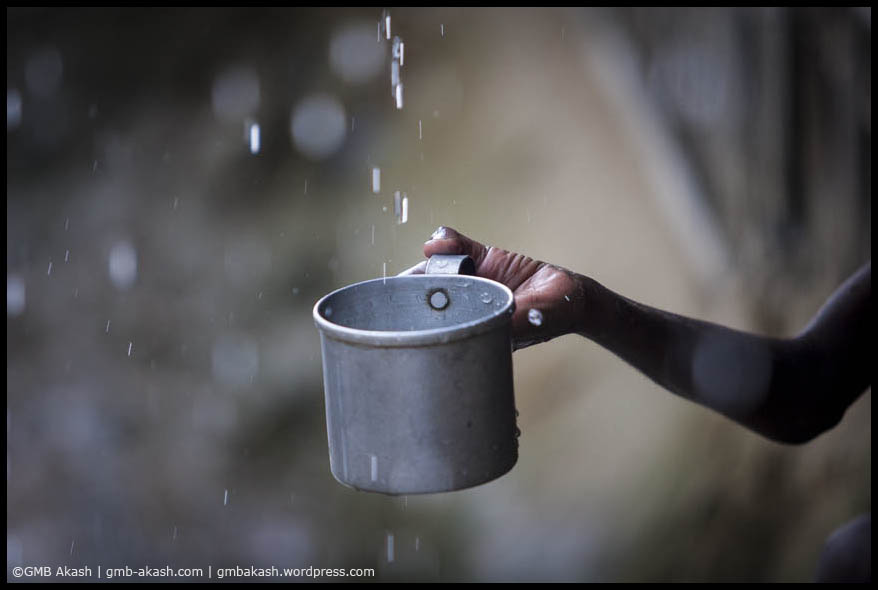
Rohingans living in Burmese refugee’s camp has no facilities for drinking water. A Rohingan woman is collecting drinking water from rain source. Water fall of mountain is the only source of water for them. Else they have to travel 2kilomiter for collecting that impure water.
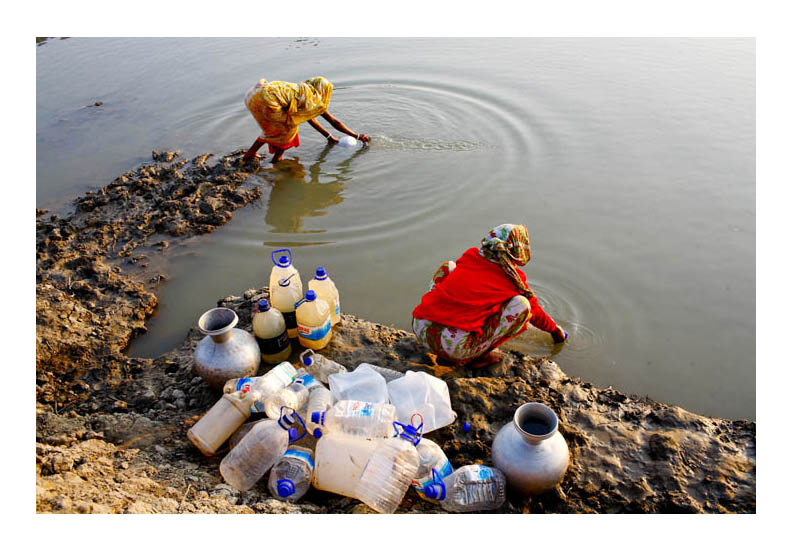
Women have to spend several hours & travels long everyday for collecting drinking water. In Shatkhira, they have to go long distance, they usually collects water from ponds. After boiling water hardly removes salts & thus they make the water drinkable.
Children & women have to spend several hours & travels long everyday for collecting drinking water. In Shatkhira, they have to go another part of the river for collecting water. After boiling water hardly removes salts & thus they make the water drinkable.
Satkhira District is in the southwest coastal area of Bangladesh. Cyclone Aila hits 14 districts on the south-west coast of Bangladesh on the 25th May 2009. The cyclone caused 190 immediate deaths, injuries to 7,103 people, damage to 6,000 kilometers of roads, more than 1,700 kilometers of embankments to collapse, more than 500,000 people to become homeless. Because of this calamity all fields got salted & farmers become helpless. As well in Shatkhira people are not getting clean drinking water, as the water is salt affected.
Children & women have to spend several hours & travels long everyday for collecting drinking water. In Shatkhira, they have to go another part of the river for collecting water. After boiling water hardly removes salts & thus they make the water drinkable. Farmers can not produce crops because of salinity. In such a situation inhabitants lives become itself a calamity living by every day’s straggle.
The woman is going to collect water from a Tube well, which is the only tube well for seven villages. The inhabitant of char in Noyakhali has to travel 3-4 kilometers by walking to collect drinking water.
“In this corner of the world people are fighting to get a pot of drinkable water. Their lives have collapsed in need of getting a pot of fresh water. People are experiencing severe thirst which may never come to an end if “Water”- could not save by Human” Gmb Akash
‘The Vanished Native’ – Existence of Rohingya refugees in Bangladesh is tale of those people who lost their freedom of living and identity now just tagged as refugees. For living decades here we still the same plastic rapping shelter that has uncountable holes. They everyday travel miles to drink mud water. Those people are struggling to get back their honour as human not as any nation. They are considered as most unwanted people in both of the zone. Still their way of living is a message that they are just suffering well –Gmb Akash
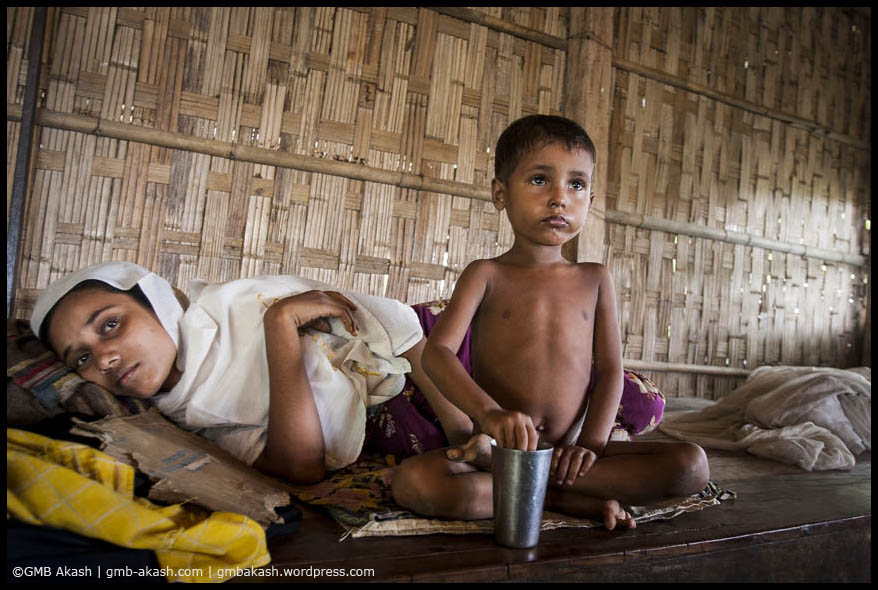
An old Rohingya lady is taking nap in her shelter. They are not allowed to do work outside or move freely. Old people like her are struggling hard for passing their last days by doing nothing.
Decades refugee families are suffering well having only a plastic shelter. If the refugees manage to get outside the camp, they are then vulnerable to harassment by the residents of the villages surrounding the camps.
In the early 1990s, more than 250,000 people belonging to the mostly Muslim Rohingya minority escaped persecution in Myanmar by fleeing across land and river borders into Bangladesh, where most were housed in 20 camps. Their living conditions are sub-standard and they are uncertain about their future. They are living without freedom of movement, permission to work or basic human rights.
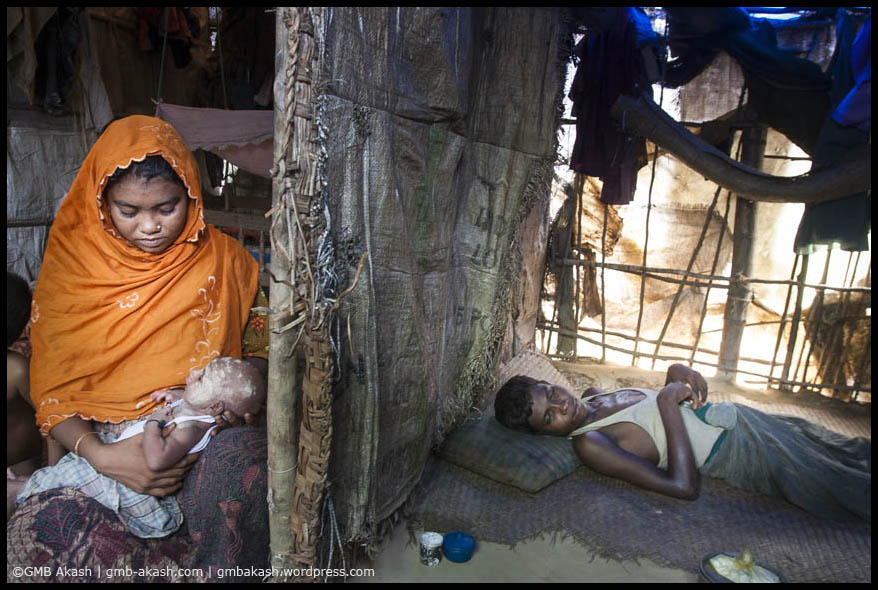
A Rohingya mother seating idle with her child. Most of the new born and children suffered from massive Malnutrition.
The experiences of violence and coercion over the years have inevitably fostered a climate of fear and distress among the refugees. They are not permitted to work. They have nothing to do to live their lives. They have no money, their husband or wives are not allowed to do any work. They are like prisoner of an open field of limited activity.
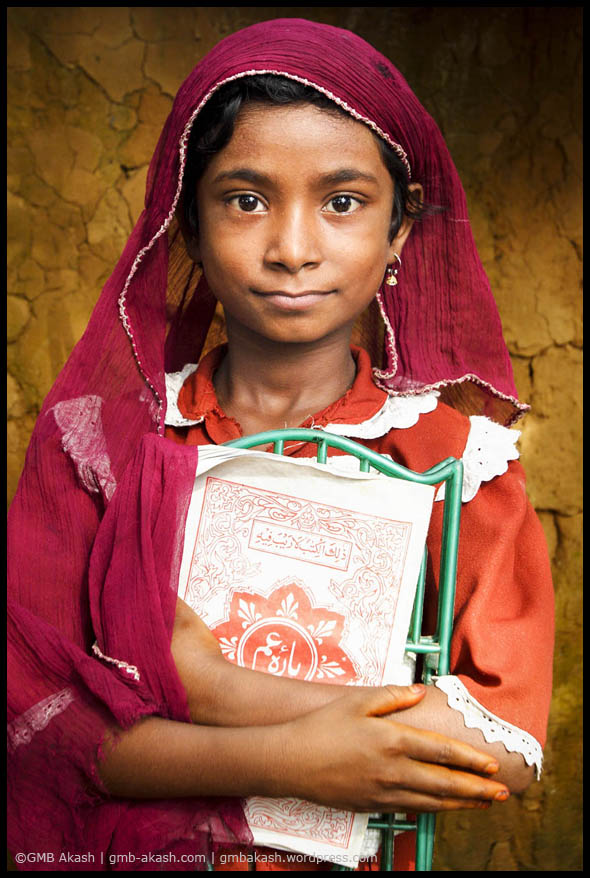
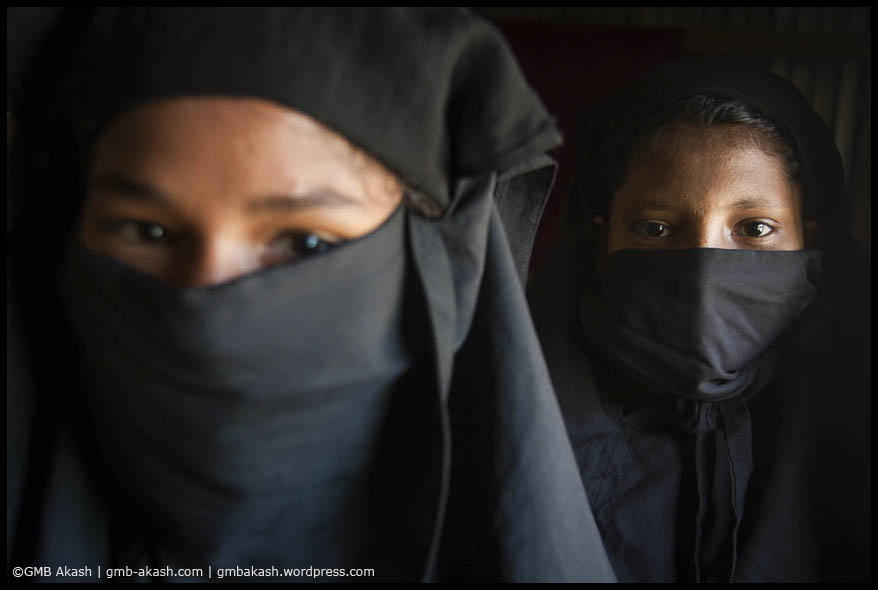
The girl belongs to the refugee group who are living without freedom of movement, permission to work or basic human rights. Besides she dreams to study, go regularly for taking part in Madrassa.
Children study the Koran (Qu’ran) in a makeshift Madrassa (Islamic school) in the Dum Dum Meah refugee camp.
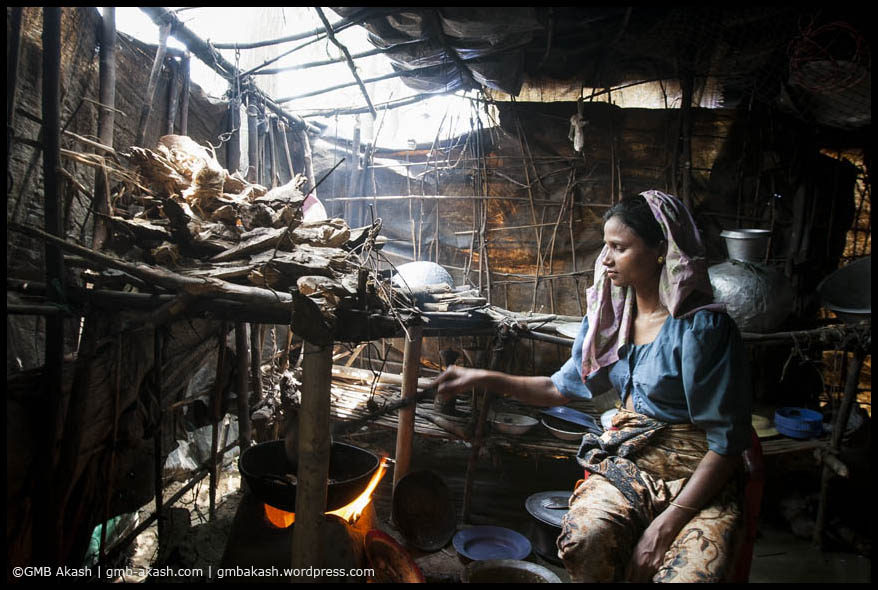
The living place displays the most unprotected residence for living as human. The rapping plastic sheet which have uncountable holes surround them generation after generation. In a small place where hardly two people can live, ironically they are living more than eight people.
Two young men are making a new house in the Dum Dum Meah refugee camp. There is no change in their accommodation scenario instead of getting only holes in every rainy season.
Rohingya refugee families have to depend fully on ration. The refugees are totally dependent on the weekly distribution of food. For many, food is the only source of income, as employment is prohibited.
A Child in the Dum Dum Meah refugee camp. Here everlasting hunger, heightened vulnerability to disease, and hampered growth will only be overcome if the Rohingya refugees get enough to eat everyday. But still it is a dream to these refugees.
“Sometimes I bathe only two to three times per month because I have to save water for other member of my family”- A woman of seven member of the family were telling about the water condition.
There is just one toilet between every 10 families. Teenagers hardly go to toilet in day time. As the toilet is visible from outside because of broken doors & holes is plastic rapping areas.
“Through the damaged door everything is visible when we go to toilet. In spite of danger we young girls go to toilet when it is dark that no one could see us”- young girl of the camp named Mya
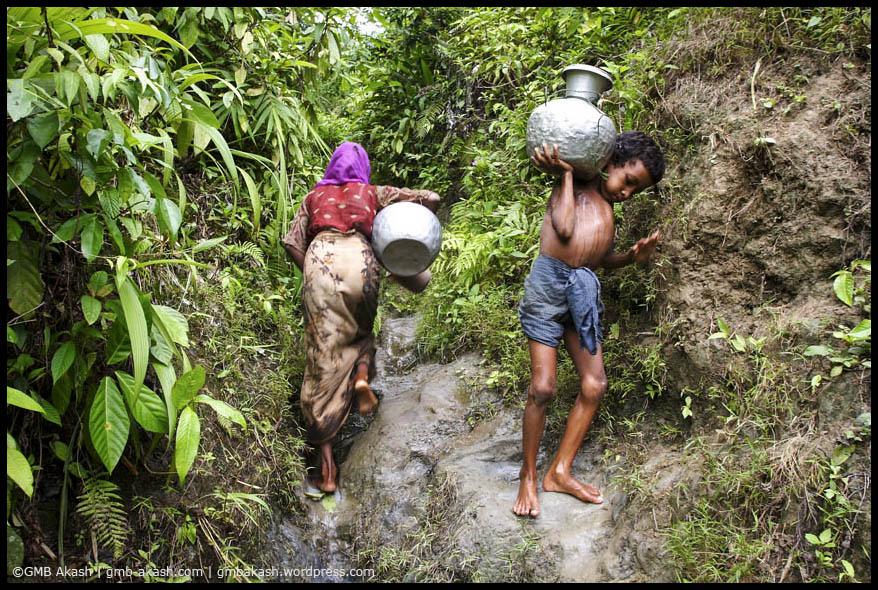
Water fall of mountain is the source of water near the Burmese refugee’s camp for Rohingyas. Rohingya families are collecting water from mountain as there is no facility of water in their camp. After 2 kilometers walking they can collect drinking water however they got sick often by this impure water source.
Besides them thousands wait, unregistered, and unsure of what their future holds. People are stateless and hopeless. They have nothing in their hands.
Rohingya families have to totally depend on ration supplies. This generates an endless cycle of food shortage as no food enters instead of only rations for them.
The boy representing the third generation of one Rohingya refugee family. They do not have any identity as nation. Despite losing everything they are fighting to get the honour as human.
“Many lives have begun in these camps in the last decades. Many will end here, too, without a birth or death certificate to prove that they ever existed. There straggle will convey message to all people who are unknown to the fact of living no where, belongs to no nation and not aware of searching identity everyday” – Gmb Akash
“Survivors” depicts the invincibility of the human spirit to survive against all odds. People who live on the edges of society have had a big impact on me and have been a great inspiration to me as a person and in my career. The existing social hierarchies have made me realize that those who live at the lowest rank on the economic ladder are the true survivors. These people are deprived of even the basic necessities of life, yet they manage to live each day with a smile on their faces. As a photographer I feel it is my task to show the world those unseen realities and to shed light on what most of us never see with our own eyes.
I have been doing my project “Survivors” for the last 10 years. In these years I tried to bring changes in some lives. But now, I moves to work on it highly by bringing the project “Survivors” in light. & lend hands to some miserable souls. Munna is one of them. Here I am revealing life & straggle of Munna – which many of you may never seen but heard many times, which many of you may imagine but never feel. Welcome to the world of a – little soldier ‘Munna’
“Born to work – A Battle of a Survivor”, First video made by me & a documentation on ‘Munna’ from the project ‘Survivors’.
‘Integrity with innocence’ this is the concrete of Munna’s character portrayal. Five years ago I first met Munna, he was same like now. He was a seven years old shy boy who never complains to anyone. At the age of five he comes to the factory. Two years he did nothing & got no money. At the age of seven, he learns & starts working. When I took his first picture his hands remarks his experiences.
Five years have passed fates of Munna & his father brings no change in their lives. Only difference is, with his five years experience Munna is getting 1600 taka ($1=72taka) per month. Moreover 12 years old Munna is running his younger sister education with his extra income of Friday overtime. His dreams confine to get more experience of hard work & made a big factory. He dreams to give good food to his family, he dreams to take them in a better place. The boy speak too less, stand always like a shadow. Whenever I took picture of him, he tried to clean his torn cloths as well hide torn areas. These little doings, little words earn respect.
20 years ago Munna’s family had come to Dhaka for better living. Time never brings any happiness in their lives. By a little donation Munna’s father bought shoe sewing materials & now he is working as cobbler. They pray that rainy season may never come. As people does not come to do shoe polish in rain time. Munna & his family are surviving in the race of life.
Like Munna around 7 million children are straggling in our country. May be it is difficult but not impossible to give hope to these 7 million children. If only every capable person lend their hands for one family.
My project “Survivors” aims to help Munna & his family. This project designed to help ten families from ten backgrounds. By little collection – a fund will hand over to Munna & his father. Munna’s father will utilize it for lifting their fates. 25% of the selling price of my book “Survivors” will give to these kinds of 10 selected families. You all are invited to stand beside Munna. Won’t you lend your hands? If your heart is moved to do so please visit “Survivors” by Gmb Akash at : http://emphas.is
“Our little help, little words, little recommendations could bring light in some dark places of this earth. ” Gmb Akash












































 GMB AKASH


