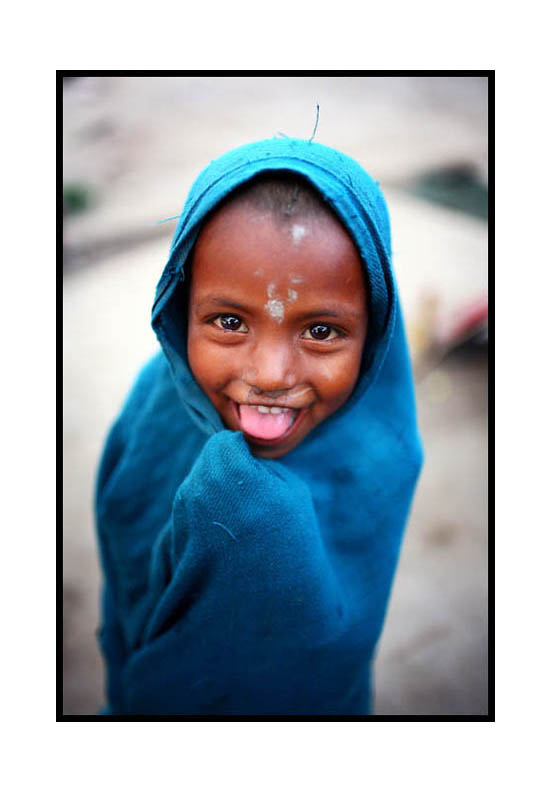
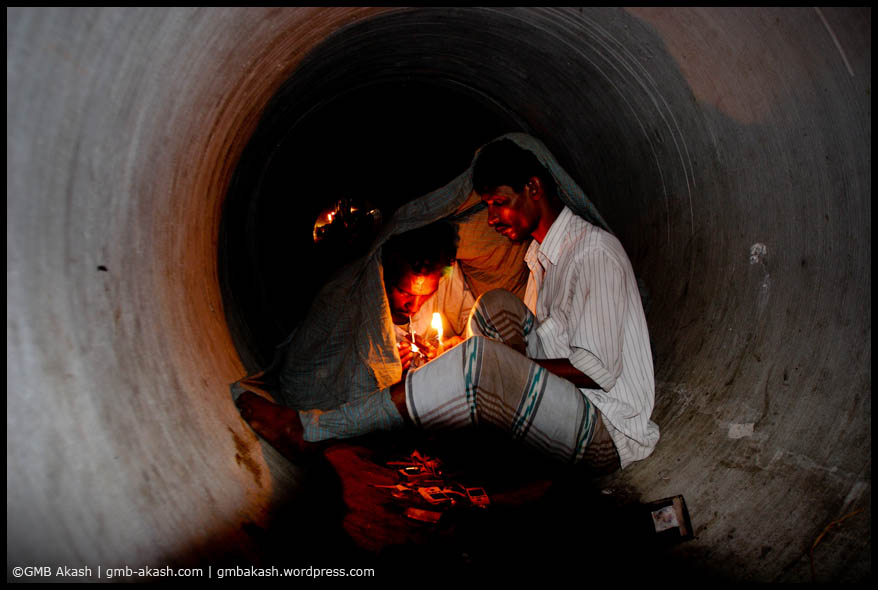
“These disorders — schizophrenia, Alzheimer’s, depression, addiction — they not only steal our time to live, they change who we are. In the time period of working with drug addict, I encounter tremendous shiver in thought of helplessness that how they are silently dying in these dark alleys and there is no dark Knight to hold them straight only we are here to celebrate the funeral of these fallen stars”
– GMB Akash
Drug addiction is a major social evil in Bangladesh, affecting thousands of young people and their families. There are thousands of addicted people in Bangladesh and most of them are young, between the ages of 18 and 30 from all walks of life. Drug addiction in young Bangladeshis is mainly seen because of reasons like depression. People try to remove depression using drugs as a tool. And this is how they become addicts.
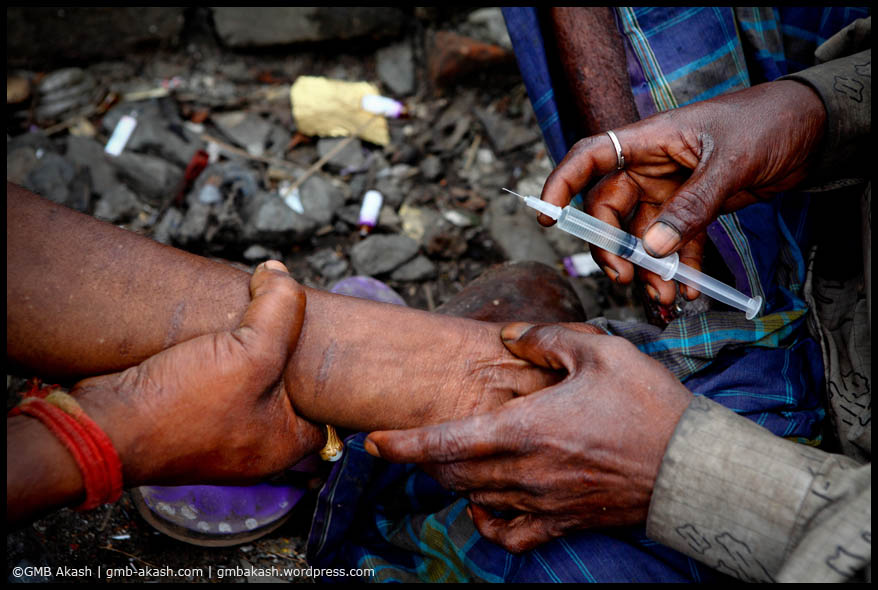
Drug users are taking drugs by sharing same needle with each other. Injecting drug users have few places to turn, and they are one of the groups most at risk of contracting and spreading HIV. Heroin is mostly smoked within aluminum foil or cigarette paper, but in Bangladesh this is injected. Injections through infected needles can cause diseases of the liver, brain, heart, lungs and spinal cord. Estimates of the number of people living with HIV/AIDS in Bangladesh range from 2,500 to 15,000 most of them are affected while taking drugs. A Heroin addict may need about Taka 500 worth of the drug a day. They neglects the needs of the family, and those are non-earning may sell off family assets. They also go out on the streets for mugging and dacoity.
“Rickshaw driver Mohammad Bashir has been addicted to heroin for most of the last 13 years. His habit cost him his job and put an enormous strain on his family. Like most addicts, he often uses shared needles. Police has caught him in the spot, members of his addict team has managed to fly. But police caught him, while he is continually requesting police to leave him in the word of his promise that he will not inject him any more with drugs”
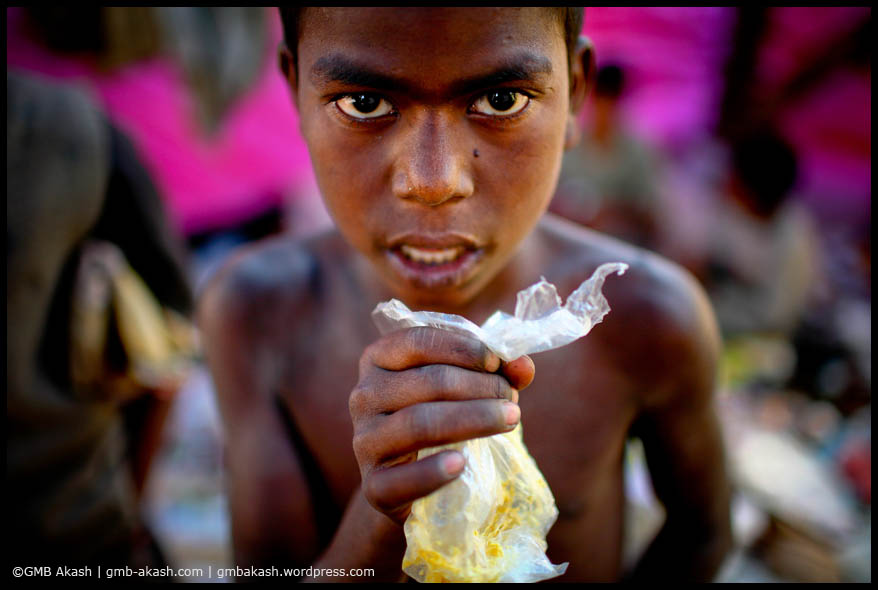
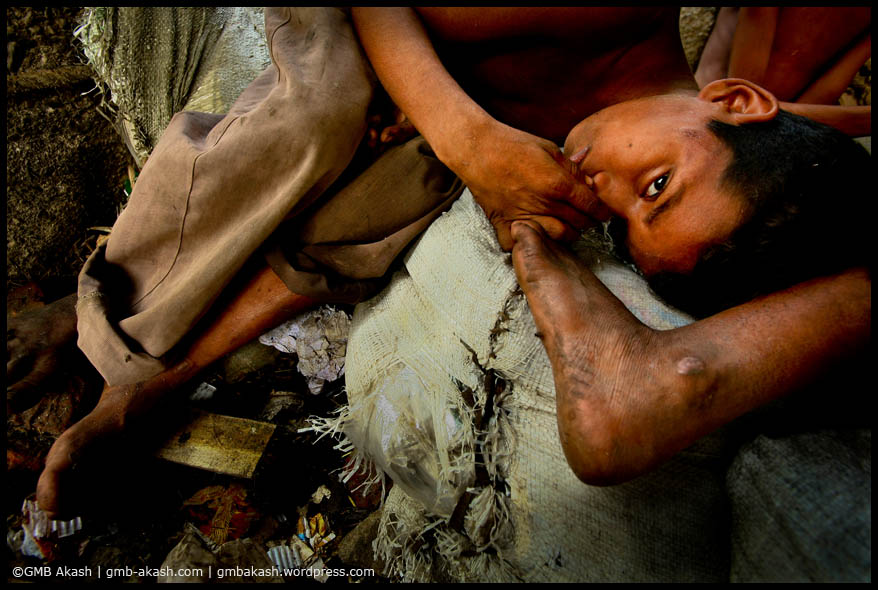
Drug addiction is increasing among the street children who live without a family, love and care. Bangladeshi youth are ‘huffing’ shoe glue, a drug locally called ‘Danti’, which is seriously harmful to mental and physical health. Up to 17 percent of street children in capital Dhaka are addicted to drugs. Children as young as 10 years old are also experimenting with alcohol, phensidyl, Heroin, Baba, Ganja, pethedrine, and other forms of available drugs. For managing the money for drags these children spends all their earnings on drugs. Some time they beg whole day in the street and end of the day spends everything on drugs.
“Bitter experiences are there too. I visit all danger territory where these addicted people living senselessly. Few of them try to beat me sometime, few of them tied me with their arms and cried and cried, few of them burst out in depression and few of them wants to end their sufferings. But this is cycle of unbearable torment which has no end. In a world with chaos and hunger, everything becomes a guerrilla struggle. It becomes almost impossible to save lives or grow dreams sometime. But yet these lives deserve our affection, attention and sympathy. No medicine is as effective as love to them. “– GMB Akash
“This is not just a story of poverty and despair. Poverty is not all that holds them back. Every day, they are willfully denied an education, opportunities, a future, and an identity. This is the story of a people whose lot it is to only exist as numbers in ration cards, relief programmes and slum-arson stories. This is the story of the Biharis of Geneva Camp. A community of over 160,000 people who have lived like animals for the last 40 years and will likely live and die as animals in congested ghettoes at makeshift camps and shanties all over Bangladesh. This is the narrative of the Biharis of Geneva Camp.”
‘Geneva Camp’ is just one of the 70 camps all over Bangladesh set up immediately after the Liberation War of 1971. In 1971, the Biharis were a torn community. The tragedy of the Bihari community unfolds as far back as 1946 — the year communal riots in Bihar tore irreparable divisions through India — with thousands of Muslims massacred in an organised pogrom that added momentum to the movement for the partition of India. This resulted in a separate homeland for the region’s beleaguered Muslims. Between 1947 and 1952, families by the thousands left their ancestral lands to take refuge in the erstwhile East Pakistan.
During the Liberation war in Bangladesh in 1971, the Pakistan army, sensing this divide, recruited some Biharis to fight the rebellious Bengalis. Whether they supported the Pakistan army or not, many Biharis remained neutral in 1971, shy of taking sides with their local brethren. Thus the division widened in those tumultuous years leading to the sub-human “ghettoisation” of the wretched children of a lesser God. After the war in 1971, the International Community for the Red Cross intervened and found out that most Biharis wanted to migrate to the truncated Pakistan. Over half a million registered “Urdu-speaking” Pakistanis found a voice at the high level Simla pact of July 1972 and later an agreement was reached in 1973 between Pakistan, India and Bangladesh on this issue. As per the agreement, the Bengali prisoners were released and sent to Bangladesh. However, not all Urdu-speaking Pakistanis were repatriated to Pakistan. Even today, hundreds of thousands live in Bangladesh in camps as non-citizens.
People are calling them in so many names. Bihari’, ‘Maura’, ‘Muhajir’, ‘Non-Bangalee’, ‘Marwari’, ‘Urdu-speaker’, ‘Refugee’, and ‘Stranded Pakistani’. But they only want one identity that is: human.
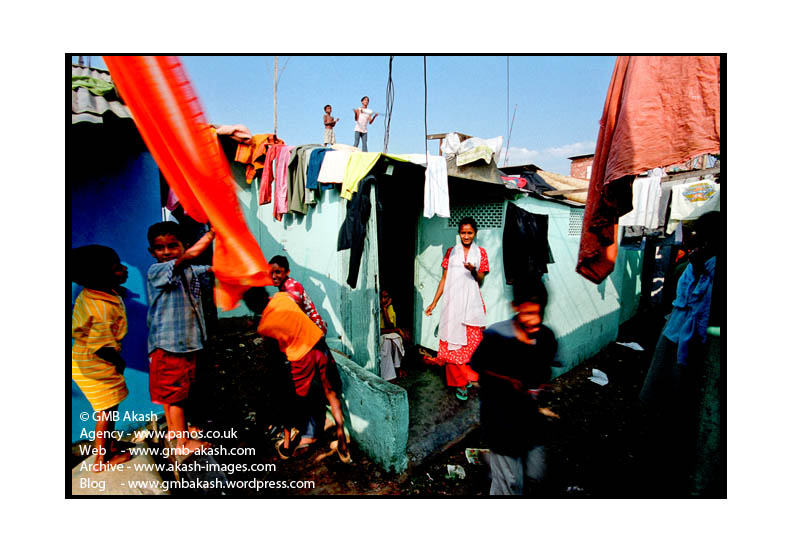
Here, the rituals of life, death, triumph, hope and misery of each family, packed into 8 x 8 little boxes. There are only 270 toilets for a population of 25,000 and the numbers increase daily. The living environment of the camp is very deplorable. It is unhealthy, dirty, damp and unhygienic. This condition exists in other camps throughout the country. The municipalities/city cleaners never enter the camps to clear the garbage. The Bihari camps have almost no educational facilities. Throughout the country, only 275 of the 19,000 children in camps go to school. Only six of the 77 camps have a school. Most of the people make handicrafts or repair cars to make a living. Into the filthy rooms – homes and workshops rolled into one – women and men were busy working on brightly coloured saris. From about 1,600,000, only 60,000 are thought to register in the voting system in 2008, but in reality, those in the camp are denied the right of applying for a national ID card. Without citizenship, they cannot even obtain legal housing, so most live in 66 camps packed with people and livestock scattered across the country, including Geneva Camp.
Geneva Camp was built in 1974 by the Red Cross to help assist the new generation of stateless people. The older generation complains more than the younger ones, who are better integrated and bilingual. Free of the baggage, the younger generations are far more ready to become Bangladeshis: 70% of the people want to stay in Bangladesh, 17% want to go back to Pakistan. Despite recent progress in voter and ID registration, however, 37 years of being unrecognized have left the Biharis living in abject poverty and vulnerable to discrimination.
“Geneva Camp turned out to be a bordered little inferno located next to fairly well-to-do neighborhoods and commercial areas. Human spirit, however, knows how to counter the forces of nature and history. Inside the camp, little Bihars had been recreated with the memories and longings that the migrants are well known for. Still the government does not know how to handle it. No one does. The government has not picked it up. Civil society has not picked it up. These people have been left to fend for themselves.”
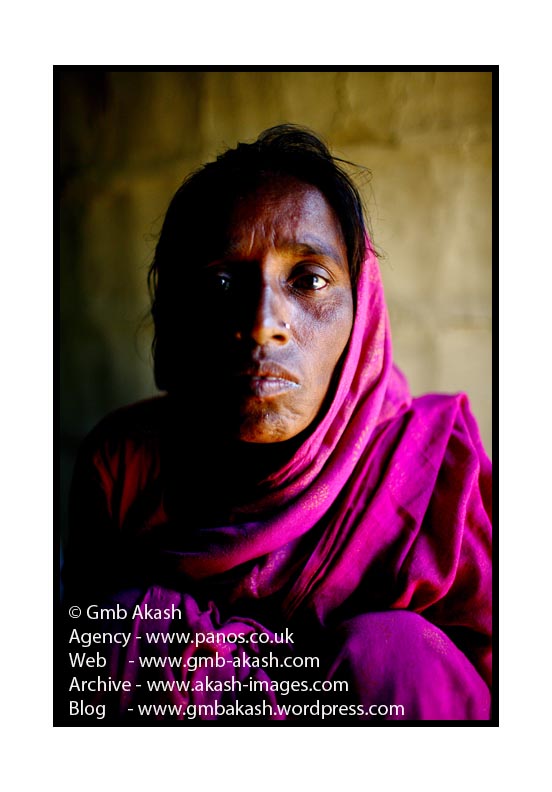
“I am fascinated to some faces, some characters who are incredibly important to me as a photographer or as an admirer. Many of these faces are invisible but their spirits for living life makes them invincible. Journey of portraying these invincible characters starts long ago when I find out there are certain people who are icons of heroism and enthusiasms. Over and over again I go back to them, find them out and by portraying them able to keep a part of these victors with me.” – Gmb Akash
Often get inspired by these faces I go to isolated group/people who are ordinary or I can say by having an urge to go to these people is my practice for understanding them. As an individual they are available around us, living life in troubled climate every day. But their willingness to over come difficulties titled them Invincible. My characters are raw, picked from a sticky street or from an isolated brothel or even from a dumped factory. Every face is passing a message of anticipation. I have learned to run my photography equipments; I have studied to learn to take portraits or getting a best environmental portrait. But when I concentrate beyond technical things, these characters become icons to me. I looked into them through the lens and I tried to pick the message of anticipation into the photograph. This is the biggest challenge which has no rules, which can never be taught, which can be only a self taught rule of getting invincible faces into photograph.
I emphasize the character. I want to present them vividly. I go to very close to my characters. Apart everything, I focused them. In spite of taking environmental portrait, often I try to present the environment differently. When the characters become focused, my concerns packed to represent these faces as a representative of their own environment. I would like to make imagine the audience – where these faces are come form, where they live in, what they do. Inviting questions can be way of portraying significant things which we mostly over look.
Most of the time, I have to work in very compact situation. Often I been located, where life is put in a box of measured 8 feet by 8 feet room or in a distressed noisy factory or even in an abandoned colony where I have to pass by three feet narrow road. I need to be patience and keep trying to work in these compact situations. Often I hardly get changes to use lot of lens. I am comfortable with 24mm and besides habituated I believe it is good to work with one kind to work fast and flexibly. For taking portrait I use 70mm. I do not like lot of distraction. My image should be clear and focused.
For taking environmental portrait, placement of the character is hard thing. I keep in mind environment should not disturb the character, I am taking in. It has to be supportive to each other. But I prefer to believe in my photos, character is presenting the environment; environment is not presenting the character.
– I always use natural light. No flush gun and no manipulation. Even in a bad light day I tried to use the available light into the character little differently so that it creates a different mood.
– Simplicity and be straight is my rule. Be focused, use simple background, experiment with color and get closer to the character.
– However near or far is my character, however intimate or distant the gaze my camera directs, I always keep in mind the elements of composition and the technique that will best help me to communicate what I am trying to say.
– I prefer to intimate with the character I am going to portrait. Relation and building trust is important. Many times people refused me to take photos, but I never gave up, I always make them understand what I am doing, telling the effectiveness of the shot. And if I failed I do not force but I never fail to try.
– It is helpful to get environmental portraits by finding out where they spend their time, what the rhythm of their life is like and observing their personality.
“I think the art of photography is to observe and document in your own personal way. On my way I found these invincible faces which are inspiring to keep my searches on. These insignificant characters are inspirations to win over all chances of life. Connecting these invincible souls in photograph has no rules. Besides photography, I learnt from them, we need never be hopeless, because we can never be irreparably broken. We should think that we are invincible because we are.”
“God is too busy, Can I help you?” stepping into the City of Italy, I first saw this hanging poster in a coffee shop. This is the ever lasting impression on me about the country. People are so charming, lively and enjoying every second of life. After arrival, by dropping my luggage, I lost myself with a tiny bag and my camera to explore the city which is new to me in every visit. My destinations were Rome and Venice. Where, Rome is a romantic city where couples are passionately showing their feelings of love that couldn’t be contained. The art and culture of the city has been admired worldwide for centuries. From Rome and Venice I took all the images which hit my mind to store these treasures in frame”
– Gmb Akash
Welcome in the city of illusions, and the city of yearning. Welcome to Rome, a place with so much art, so much history and so much beauty.
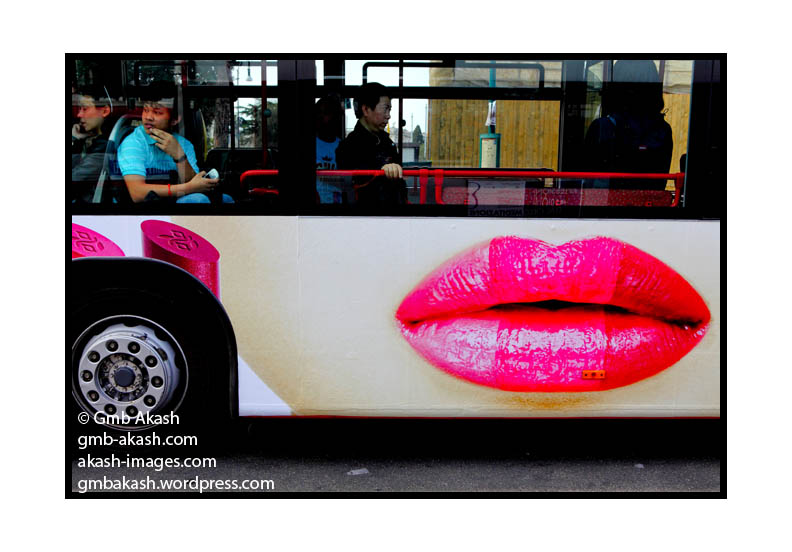
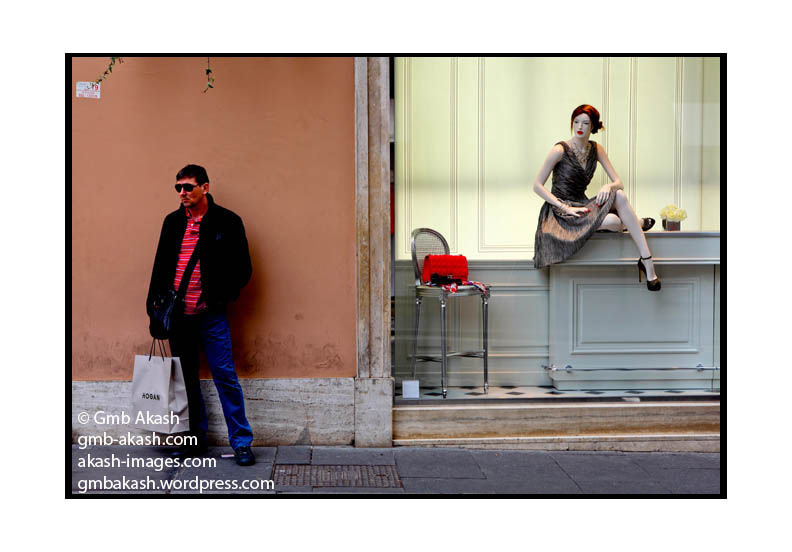
I discover Rome, as a silent and shiny heritage. Strolling in Rome means capturing its soul, amongst age-old buildings, splendid monuments and numerous churches that bear witness to an incomparable millenary history that will charms me. But for me as a photographer, wherever I go I try to see closely only people. So, I move from places to places and captured some human souls into my camera.
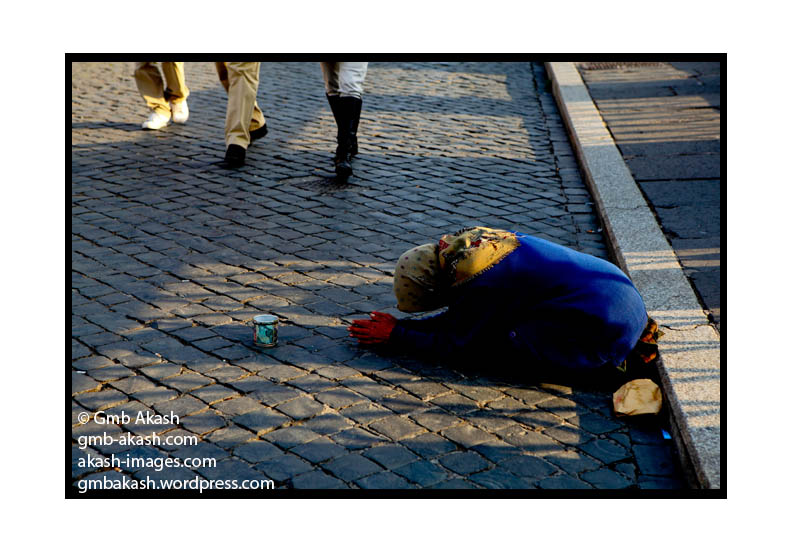
Walk the cobbled streets between centuries-old ruins, drink too much coffee, browse heritage markets and grand museums, and all together I passed time by eating too much gelato. I stopped by where I saw homeless people, who were tirelessly moving places from places. My heart poured with sadness to feel that in the advent world of Europe some people are still missing the minimum thing from this one of the best cities of the world.
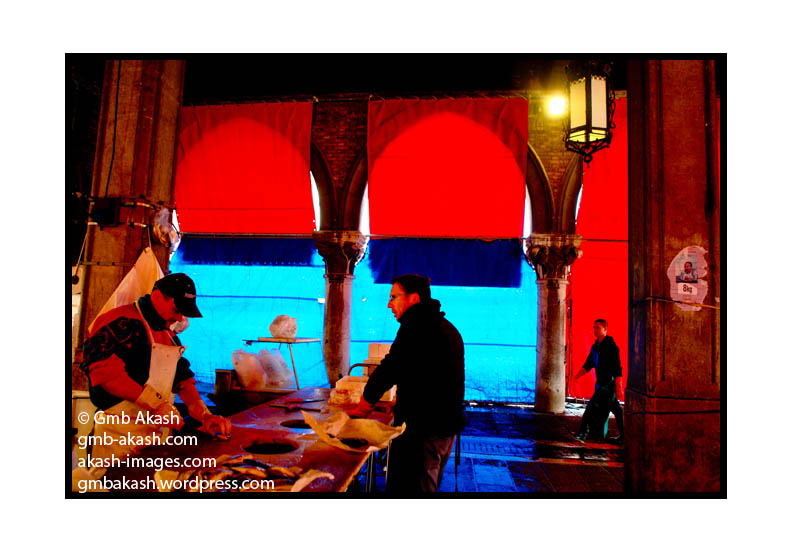
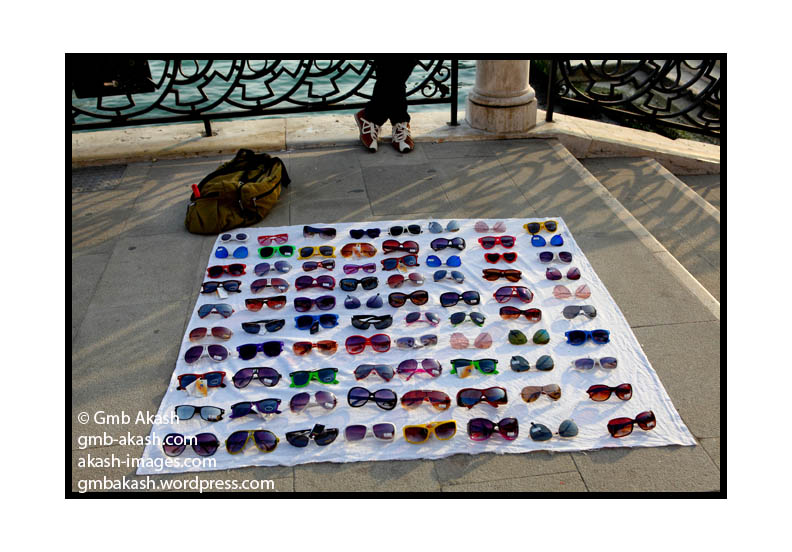
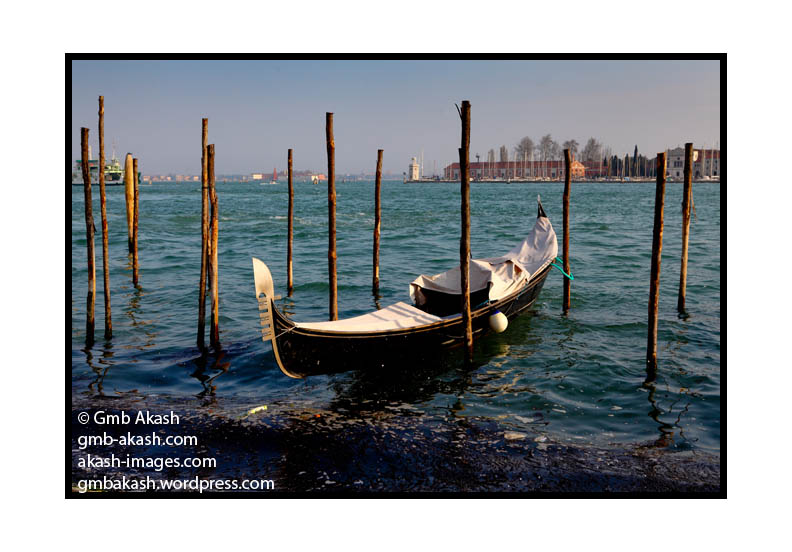
Venice is an extraordinarily beautiful city. When I came to Venice, that was a totally free day to revisit sites, shop or just sit in the square enjoying a Strega and watching the people and pigeons. I meet lot of Bangladeshi in Rome and Venice. People are doing different kind of business to survive here. By looking people all around me, my camera was not taking rest but even though I fill I didn’t take enough images. It seems as if at each step I encountered some aspect of the city worth admiring.
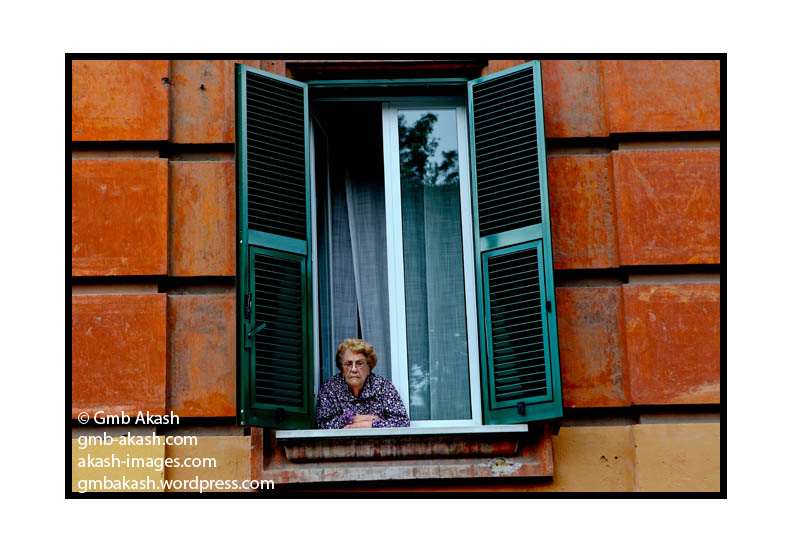
While I was taking few minutes break I met an old lady passing time with her dog. She was taking pictures of the dog and talking with her. The old lady and her companion leave a lonely feeling on me.
I treasured all these moments with me. I am a passionate traveler. Traveled has availed to understand depth of life. From this travel Junction I put a note in my dairy that: Do not take a single day for granted. Life is precious!
“This is an emblematic depiction of the agony of hard labor. For saving themselves from hunger they breathe in asbestos dust and toxic waste. Thus they are risking their lives everyday. On the verge of death they risk their lives in order to endure themselves. They are passing their days on one of the world‘s most unregulated and hazardous industries, leaving a trail of debris, disability and death in its wake. I spend 10 days in the Gaddani ship-breaking yard north of Karachi in 2005. I witnessed workers dismantling large ships, piece by piece using no protection, in absence of tools, where one wrong move could result in death, but they were continually depending in their bare hands. In a city of dying ships flames with smoke rising, tormented with ship body parts, metal residue, asbestos, and oil spills. Barefooted workers with little access to necessary tools are vanishing ships on the rusty sand of Gaddani and break down these steel giants coming from all the harbours of the world.”
– Gmb Akash
The beach of Gaddani, 50 miles north of Karachi in Pakistan, has become one of the two world biggest cemeteries of super tankers, cargoes and other vessels in the world.Thousands of men, mostly Pashto migrants, toil over the ships. They are seasonal workers, a large number of native and immigrant workers returning to their homeland near the Afghan border at harvest time. The group consists of perhaps from Afghanistan. They pen for their beloved, whom they get to see only during the year ends. For around USD 1.20 a day, thousands of workers labour to dismantle dozens of ships each year at the ship-breaking yard in Gaddani.
Rashed, a labourer at the Gaddani ship-breaking yard has worked for five years dismantling ships. He said: “Had we had any other way of earning bread, we would not have come here.” Workers are always under high risk of accident, though they hardly care to secure themselves. Under hitting rains of sparks, blowtorches split through the thick steel skin of a ship. As they are cut lose, the pieces of metal plummet to the ground with a roar. I saw workers, toiling ceaselessly, as though banished forever to an underworld.
Many workers operate in tight spaces where the air is thin, and in high temperatures caused by hot welding, which is widely used, not to mention that they are constantly exposed to flammable liquids like paints and solvents. The work carried well into the night shipyard in Gaddani, Pakistan. This is the ship graveyard that serves as the final destination for a significant part of the world’s fleet.
“Barefooted workers would take apart, bit by bit, the dying ships with their bare hands, shipyard in Gaddani, Pakistan. On their shoulders, workers bore great metal plates to their destination. People complain about their crappy lives working in an air conditioned work place, imagine having this as your only option in life.”
“Environs can explain much. You can feel the existence without presence. & sometimes absence is required to feel this presence more intensely. I started believing these things while I captured few moments of nonexistence. Yet these moments profound very much in exist of living being. I have taken these moments from various part of my world, however they are all alike. These are like footprints of a missing thing; you can assume the missing focus through edges. Welcome you in the puzzle. Fill in the gaps by your thought” – Gmb Akash
“Life – a one way journey….We should not regret any moment which make us smile…We should make our self happy with all little pleasure of our life ….even if we have everything, we haven’t had tomorrow…Lets fill our all gaps by our presence of love, appreciations & thoughtfulness. We may leave forever, & then our environs might tell our tale ceaselessly. Let the light lit our absence.” – Gmb Akash
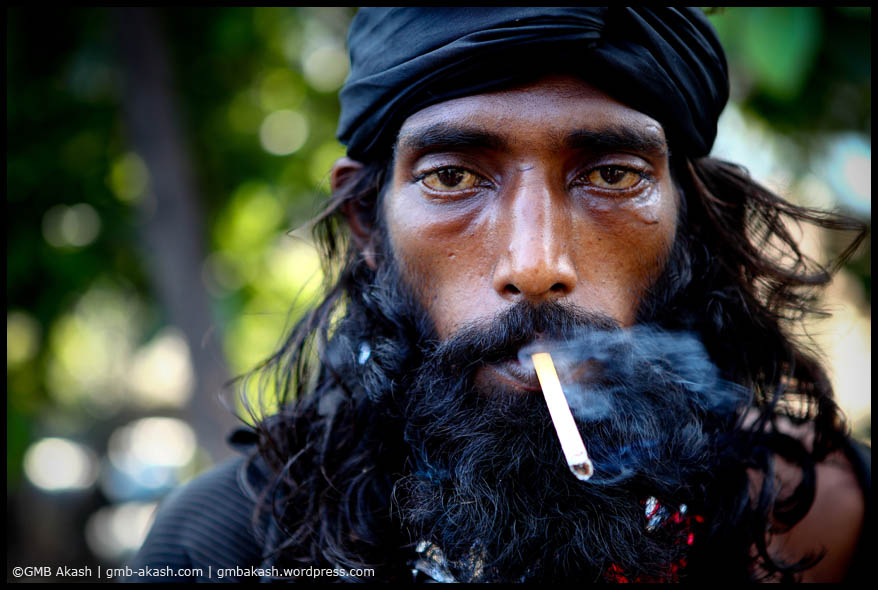
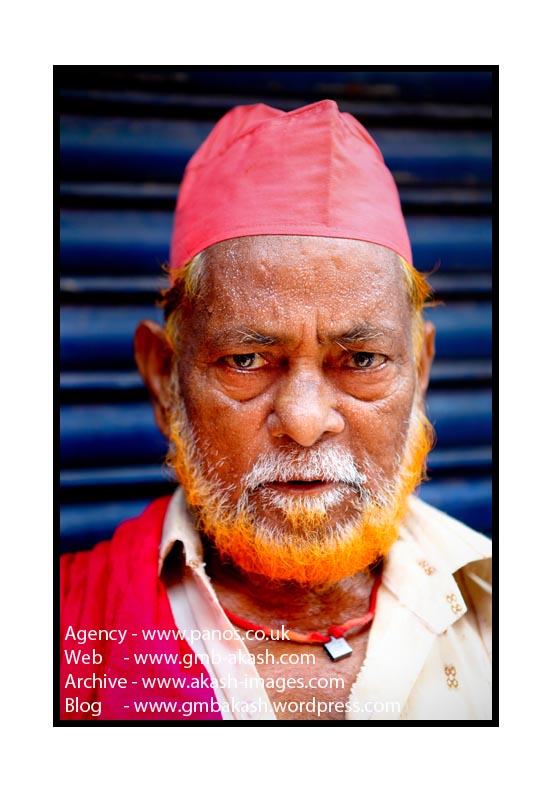
“Among all – Human faces are most attractive to me. Every face has a story. We as photographers reveal that undiscovered story through our lens. Faces tell stories, tell the situation of the person, and tell the story of the place the person lives in. Wherever I go somewhere I always come across to faces those are different and eventually try to find characteristic of the community; every place has its own perception, story of smell, a person bears these things in his/her appeal. I search for story behind the face, so faces are incredible to me. Through out searching the portrait we could find strange stories of lives of people from different places that we never recognize before. I am going to share my experiences during the journey of finding unnoticed faces”
– Gmb Akash
I search for getting an interesting character, a face that is unusual. I search such face in the middle of crowd. My first prior attention is the selection of the person, choosing the right character. Before I take any portrait I try to be familiar with the person. I talk to him/her and try to build a relationship with the person I will photograph. I give them time to be normal in front of my camera. I introduce myself to them. When the person gives his/her most natural expression to me, I take out my camera then start shooting. I believe it is the strongest factor which I practice so far to get a close snap of a human soul.
For me light is the most important element for getting an excellent portrait. I try to use different type of light; I try to shoot in different time of the day to get different colour and mode of light. Every light has its own appeal for creating different portraits of an individual.
Technically I use 35mm (f 1.4), 24-70 mm (2.8) lenses. But I take portrait with all kind of lens I have. Truly to say I do not care about my equipments much. For me the most important is – the person. Some times I also use very open aperture like 1.4 to get very low depth of field. So my eyes only go to my subject. As in some cases the surrounding environment is very important, so in that time I use aperture 8 to get all the elements in focus. But I do not like using very wide angel lens and I do not like a lot of distortion on the photo. I saw many people use wide angel lens for most of their works. If you use very wide thing, the picture look interesting because of the distortion. But in my opinion then the picture looks like it has taken by the wide angel lens not by a photographer. So I don’t use too much wide angle. And thus I try to make my images clean and direct.
I have strong affection for color. I am a color photographer and I believe color photography is more challenging so as complicated. When I can meet the challenge I feel relieved. I am always very careful for using light and color. I love shooting in the early morning and late afternoon. But while I take portrait in the mid day I try to shoot them in the shadow, indoor or under flat light. It creates mystical environment.
I try to use very simple background while I am taking close up portrait, so that the background might not disturb the subject and I try to use lot of – window soft light. Eyes have significance to me. One of the most important things in my images is eyes of the person. Eyes tell the story of that person. Eyes tell the unseen background of the person which I always hunt to discover.
– For me the most prior factor is the character of my portrait. The light, color, eyes & the person must have to be blend with me. I align four factors together for taking a special portrait they are – the person, the light, eyes & color.
– Attention is the most hidden factor to get a good portrait. The person need to be familiar with you and the camera, it will be your prior duty to make the person natural as well comfortable for getting a best shot.
– Several rules applied by photographers for getting experimental portraits. Every photographer has his/her own style of taking portrait. Often the most remarkable portraits are those that break all the rules, so it’s important to create your own rules to get a master copy which might never done by some one before.
– Expression indicating the direction of the person’s eyes which can impact an image astonishingly. For me it’s important to observe the right moment of the direction of eyes.
– For creating interesting images you need to give trial, for creating interesting placement of your subject. After Creative thinking, creative placement can sometimes create out of the ordinary images.
– There are almost unlimited possibilities when it comes to use light in portraits. Input of light could make a portrait more or less powerful, as well side lighting, back lighting, silhouetting can spot specific features.
– Never fail to align your mind, eyes & lens together to find the inner beauty of the portrait.
“Any Book or text or any experience sharing can not demonstrate “Portraits” practically. Pick your camera explores faces to get a good portrait. And you are welcome if my single practical example or feedback could uphold your knowledge”
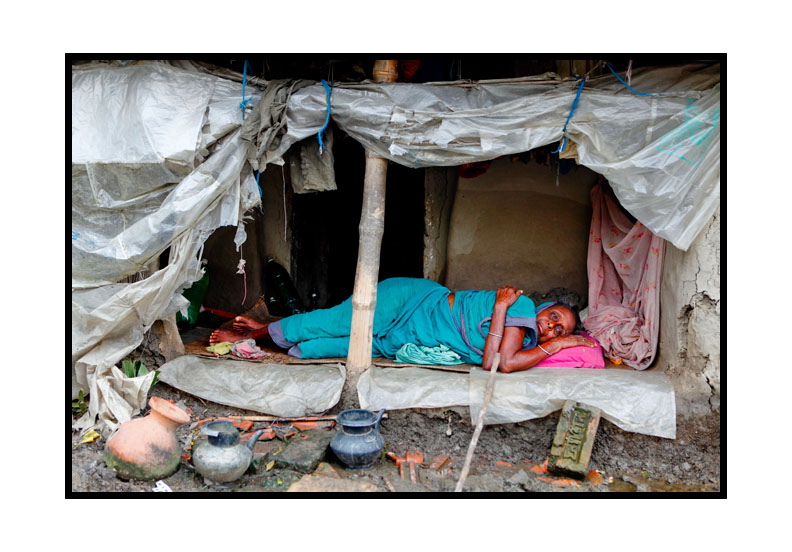
After Aila attack it has been two years Khadeza Begum sold her cattle & everything to rebuild her only shelter. Now it is another nightmare for her to stay under her destroyed house after facing another devastating flood. She has no idea how she will manage to pay back all her loans, besides passing nights in this smashed house with her husband.
Kadeza Begum said:
“We have nothing left, but we have to survive, so we’ve had to build our house again, twice in two year”.
Like Kadiza Begum It takes one year to Nobab Ali for building his house after Aila attack. Again flood hits on his all effort & left him in the flooded street. After all these devastation still he is trying to get some materials from the ruined house for covering his head in the road.
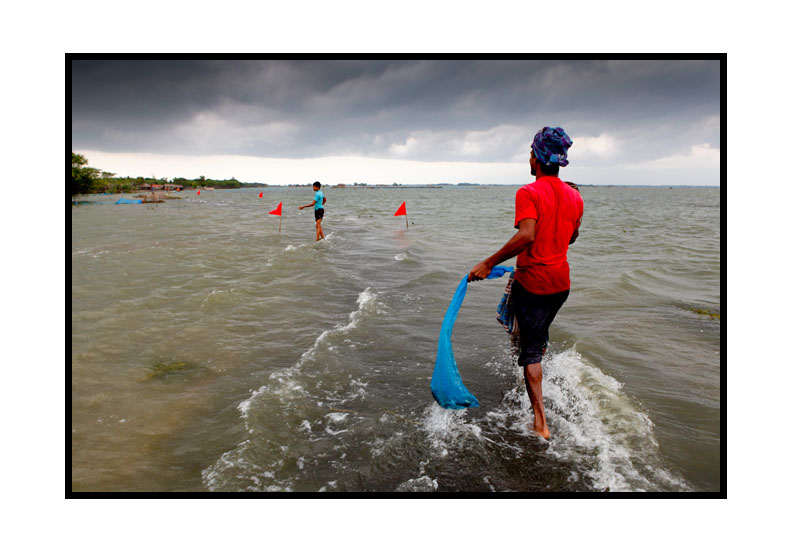
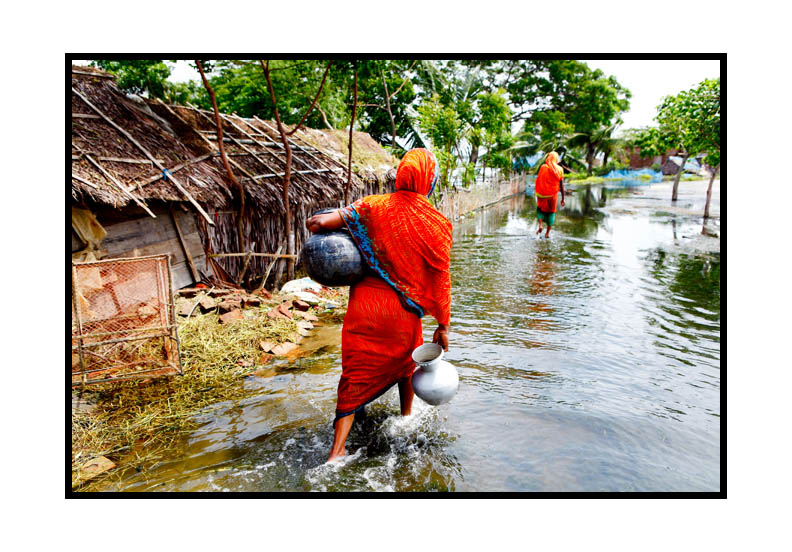
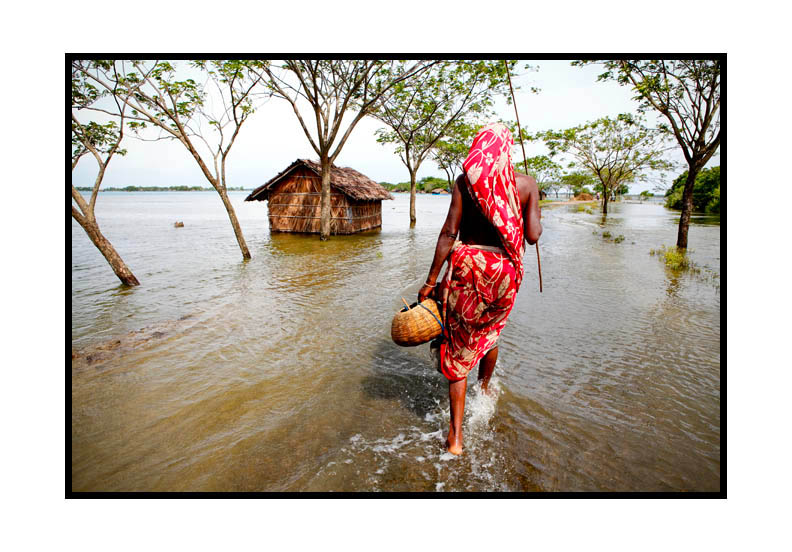
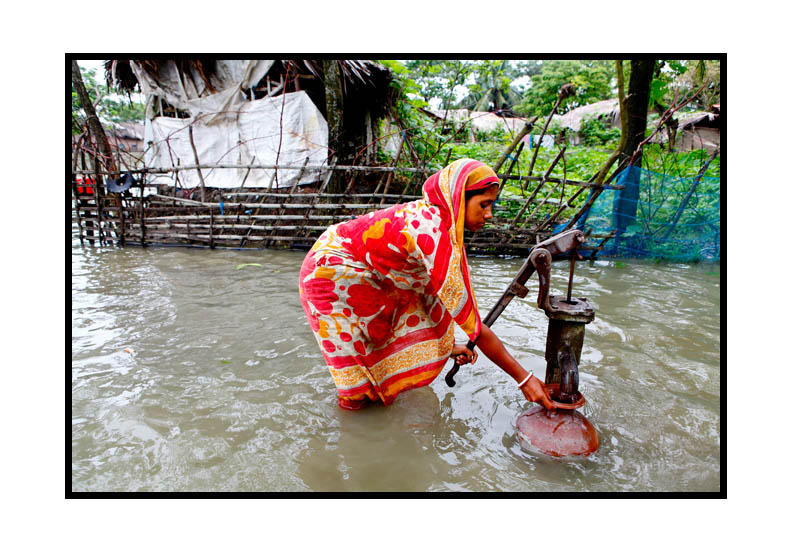
Alike them all inhabitants of Shamnagar are suffering like prisoner of devastating water kingdom. Helplessness & shouts are not getting into ears of rest of the people around the world & surroundings. In all places water & the destruction of water could experience in flood affected areas of Shatkhira. Inhabitants are collecting water after walking 3 Km. as all tube well are under water & badly affected by salt.
Amina begum told:
“Here water in everywhere, even in my house there is no sign of house only water. But we are such cursed that we have no water for drinking”
After facing devastating flood every year, they are fighting to live apart loosing shelter for existing. Still they are fighting to live. They are collecting all destroyed pieces of house to shed their head. Women go for fishing. They are healing pain of each other set aside from the remaining world.
I headed to the flood affected area of Shatkhira when all those villages are under water within three days & was out of communication. Evidentially when I reached to Shamnagar sun was setting down. I was surviving in a boat & could not see surface to stand a while. With the drowning sun the village was drowning under water. People were sheltered above in roofs of their houses. Moaning of old people & shouts of children were making the atmosphere miserable.
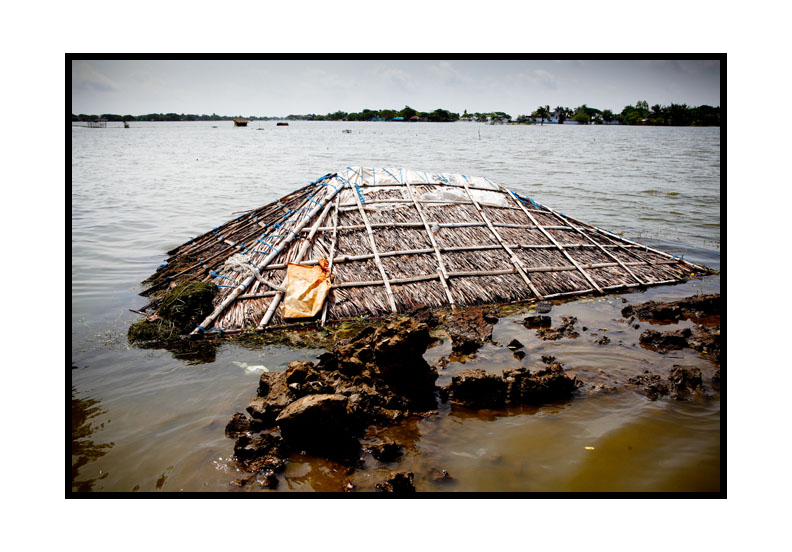
The southern part of the country is mostly affected by rain-fed disaster. There was heavy rain all over Bangladesh but flood has affected 14 of the 64 districts in Bangladesh. In Satkhira Kobodak, Betna, Shalta and Morichhap rivers swelled abnormally over the last seven days overflowing their banks inundating 160 villages in dozens of unions in Tala, Kalarowa, Ashashuni and Sadar upazilas. Over four lakh people of 160 villages were marooned. Crops on several thousand acres land; thousands of dwelling houses, schools, mosques, markets and ponds were inundated. Over 2,000 shrimp enclosures were washed away. Families lost everything & staying night without roofs in wild weather. Incessant rain coupled with high tide triggered by depression in Bay in the last few days caused river water rising engulfing villages on their banks. No humanitarian support has been provided to the people in the most affected districts by the government, local, national and international NGOs even after 10days of water blockage. People are suffering like prisoner of devastating water kingdom. There helplessness & shouts are not getting into ear of rest of the people around the world & surroundings.
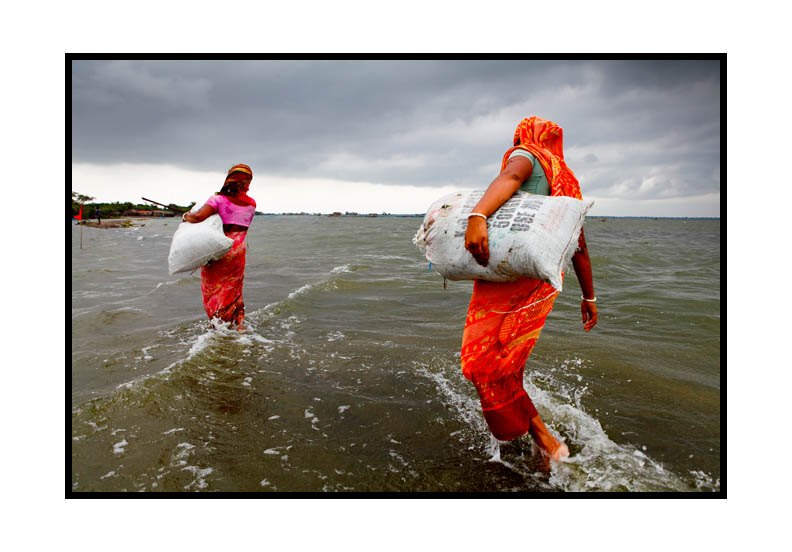
After the flood in Shatkhira, all ladies are moving for dry places by carrying their belongings. Families lost everything, passing nights without roofs in wild weather. In such a situation open air in field of water can not accommodate them for healing pains. Leaving behind everything they are moving to the city. . Hunger, helplessness & calamity force these climate refugees to the city. City welcomes them to face the uncertainty of living for their entire life time. Rootless people suffer here & there. Their tears evaporated by thirsty street of Dhaka, the capital of Bangladesh.
Bangladesh is the most vulnerable country in the world, the frontline state of climate change. Mostly to say Bangladesh seems the leader of climate change. With 140 million people, Bangladesh is one of the world’s densest nations and also one of the most vulnerable to the impacts of climate change. Like much of the delta region, it floods each every year, but the flooding has been getting worse, the waters are staying longer, and contaminating the fields and the wells with salt. People in Bangladesh live precariously close to the risks of cyclones, floods and droughts and more than 100 million people live in rural areas. Two-thirds of the country is less than 5 meters above sea level and in an average year, a quarter of the country is inundated. Bangladesh has experienced severe floods every 4 to 5 years that may cover more than 60 percent of the country, resulting in significant losses. United Nations’ Intergovernmental Panel on Climate Change predicted that rising sea levels could submerge 17 per cent of Bangladesh by 2050, creating 20 million “environmental refugees”.
Here is a short film on this concern – how people are facing the calamity by living their normal life behind:
Still images of this devastating flood could reveal people’s straggle & endless helplessness.
The lady is going inside her house. The flood has broken all her hope to pass a single night in serenity. After facing devastating flood every year, they are fighting to live apart loosing shelter for existing.
“I headed to the flood affected area of Shatkhira when all those villages were under water within three days & out of communication. Evidentially when I reached to Shamnagar sun was setting down. I was surviving in a boat & could not see surface to stand a while. With the drowning sun the village was drowning under water. People were sheltered above in roofs of their houses. Moaning of old people & shouts of children were making the atmosphere miserable. When I reached to the house of Khadeza Begum I closed my eyes. It took two years to rebuild the house of Khadeza after selling all her cattle as well taking huge loans after Aila attack in 2009. I was standing in front of her ruined house. The house which has been rebuilt these two years by the bravery of Khadeza. I could not answer when she was hitting me by asking why I come to take photo of her ruined house again after Aila. No one come to ask them ever how they are fighting against the will of nature. She cursed all those happy people who seat silent after hearing their news”
In 2009 Aila attacked Shatkhira area, after two years when that pain has not forgotten this place again faced the ferocious attack of flood. While in these two years affected people managed to build their destroyed home but again flood has taken last hope from them. Over four lakh people of 160 villages were marooned after the striking of flood in this 2011. Crops on several thousand acres land; thousands of dwelling houses, schools, mosques, markets and ponds were inundated. Shrimps in over 2,000 shrimp enclosures were washed away. Families lost everything & staying night without roofs in wild weather. No humanitarian support has been provided to the people in the most affected districts within the affected time of 13 days.
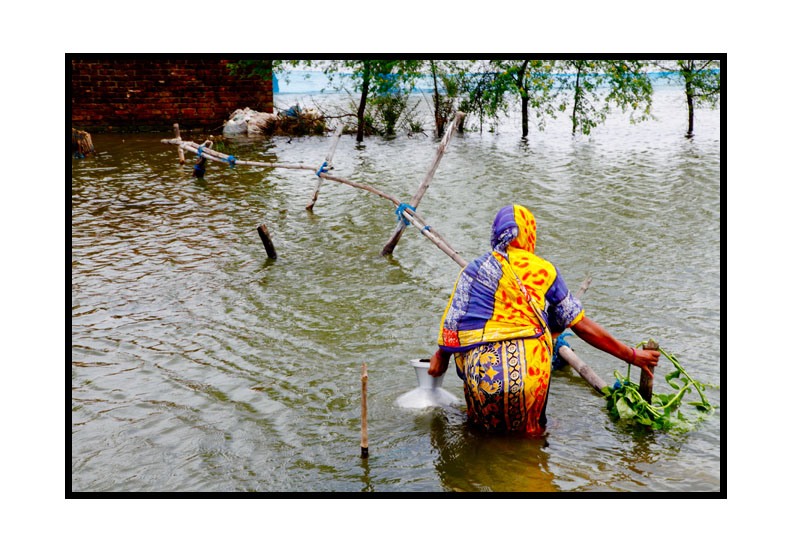
People were suffering like prisoner of devastating water kingdom.Helplessness & shouts are not getting into ears of rest of the people around the world & surroundings. Still they were fighting to live. They were collecting all destroyed pieces of house to shed their head. Women went to water for fishing. They were healing pain of each other set aside from the remaining world.
Hunger, helplessness & calamity force them to the city. City welcomes them to face the uncertainty of living for their entire life time. Rootless people suffer here & there. Their tears evaporated by thirsty street of Dhaka.
After discovering the insanity of nature & bravery of these sufferers I realize these people are stronger to rule their own live. If these brave people could get support of a shoulder to cry, rest of us could claim us as “Human”. I recall the statement from Helen Keller & focus my lens to capture some brave moment.
“I am only one, but still I am one. I cannot do everything, but still I can do something, and because I cannot do everything I will not refuse to do the something that I can do”- Helen Keller
Homeless people float near in the street of the city. By few road sides families are allowed to build their homes. Still climate refugees can not gather enough wasted digital prints, papers & bamboo for making plastic houses. Those who can not manage helplessly sleeps in open air by not letting the place empty. Everyday they collect papers for dwelling beside street.
Dhaka, the capital of Bangladesh is one of the most densely populated cities of the South-Asian countries. Due to rapid urbanization process, the city is emerging as a mega-city and this trend generates numerous economic and social externalities and social cost such as deterioration of environmental quality, increased pollution and congestion. 30 to 50 percent of total Dhaka residents are Slums dwellers. Slums of Dhaka city are beset with a number of socio-environmental problems specially ‘water’ crisis.
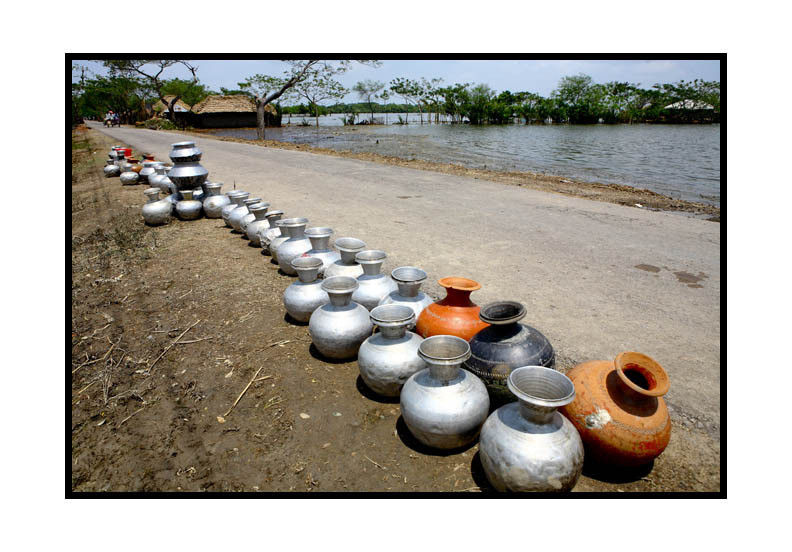
“In slums from early morning hours passed & water pot gathered gradually. Queues of water pots & lines of people are regular scenario of the slum. Government van comes once in a day with drinking water. They have no idea exact when the van will come, so they line up their water jars & sit beside. Most of the inhabitants of these slums are climate refugees. Most of the slum dwellers stand in lines before the sun rises. After passing the long queue, knowing that this impure water causes sickness, they feel that they are fortunate. Their consolation is that at least they don’t have to leave with empty pots” – Gmb Akash
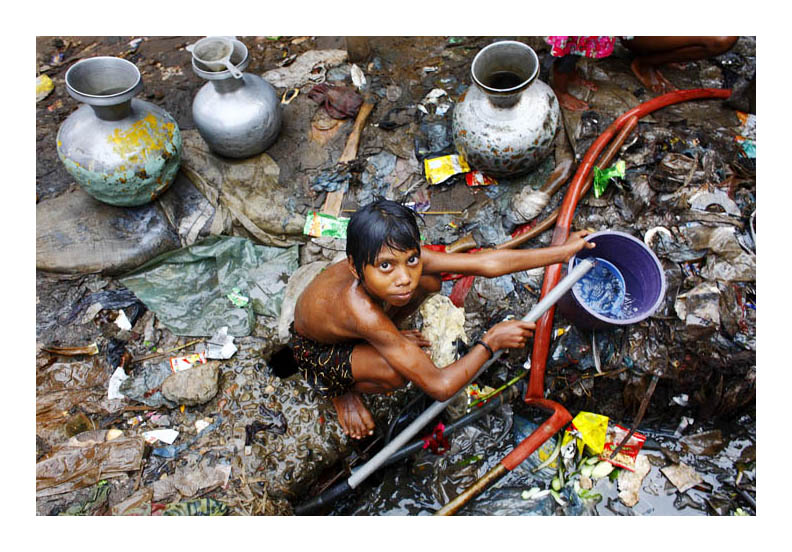
Apparently the place seems like garbage, though this is the most desired place of the inhabitants of Mirpur slum in Dhaka city. For water, in this thirsty zone queue stars near midnight. After an immense time of patience they got quiet impure water which often makes them sick. In spite of all they give a cheerful smile when they touch the water after passing the long queue. No dirty water can kill their hope & smile.
In Mirpur slum, slum dwellers have to waits hours & hours in queue for water. Children use to drink water whenever they got chance to get the pipe. Slum dwellers of Mirpur hardly get drinkable water. Bad smell & impure wastage made the water high-risk. Dhaka. Bangladesh
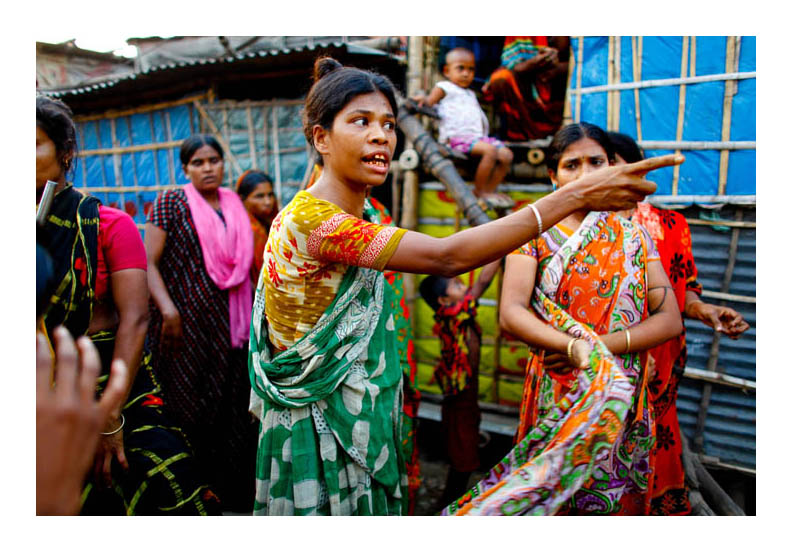
A woman is fighting for water. Children & ladies stand up in queue before the sun rises. Slum dwellers of Mirpur hardly get drinkable water. Bad smell & impure wastage made the water high-risk.
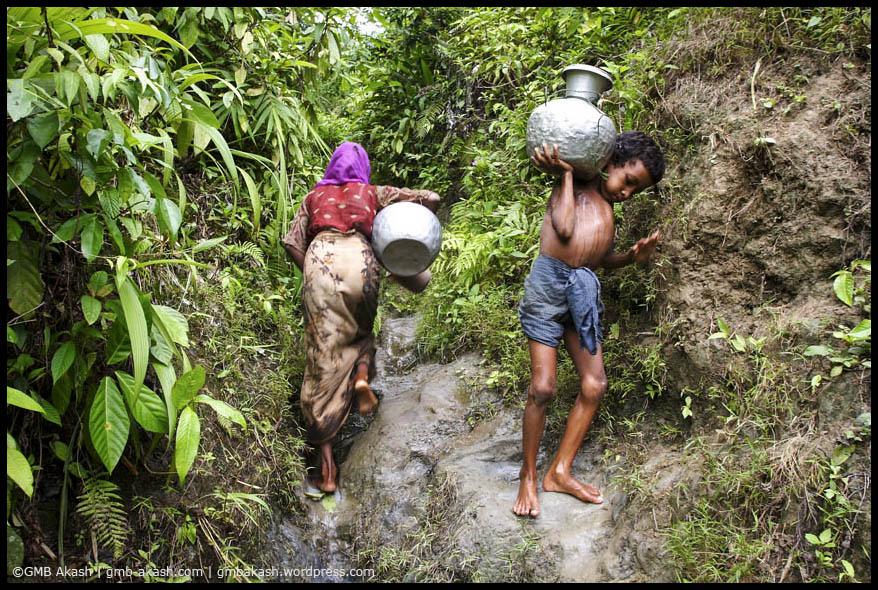
Rohingans living in Burmese refugee’s camp has no facilities for drinking water. A Rohingan woman is collecting drinking water from rain source. Water fall of mountain is the only source of water for them. Else they have to travel 2kilomiter for collecting that impure water.
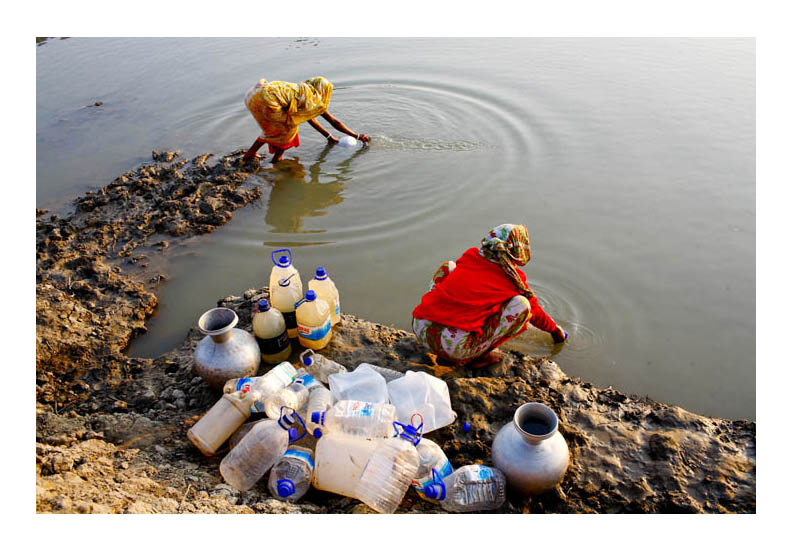
Women have to spend several hours & travels long everyday for collecting drinking water. In Shatkhira, they have to go long distance, they usually collects water from ponds. After boiling water hardly removes salts & thus they make the water drinkable.
Children & women have to spend several hours & travels long everyday for collecting drinking water. In Shatkhira, they have to go another part of the river for collecting water. After boiling water hardly removes salts & thus they make the water drinkable.
Satkhira District is in the southwest coastal area of Bangladesh. Cyclone Aila hits 14 districts on the south-west coast of Bangladesh on the 25th May 2009. The cyclone caused 190 immediate deaths, injuries to 7,103 people, damage to 6,000 kilometers of roads, more than 1,700 kilometers of embankments to collapse, more than 500,000 people to become homeless. Because of this calamity all fields got salted & farmers become helpless. As well in Shatkhira people are not getting clean drinking water, as the water is salt affected.
Children & women have to spend several hours & travels long everyday for collecting drinking water. In Shatkhira, they have to go another part of the river for collecting water. After boiling water hardly removes salts & thus they make the water drinkable. Farmers can not produce crops because of salinity. In such a situation inhabitants lives become itself a calamity living by every day’s straggle.
The woman is going to collect water from a Tube well, which is the only tube well for seven villages. The inhabitant of char in Noyakhali has to travel 3-4 kilometers by walking to collect drinking water.
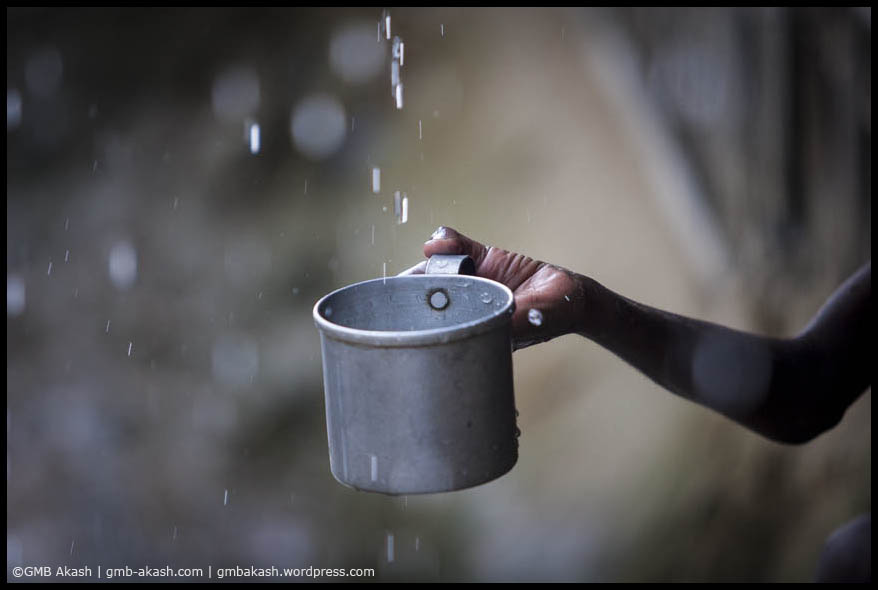
“In this corner of the world people are fighting to get a pot of drinkable water. Their lives have collapsed in need of getting a pot of fresh water. People are experiencing severe thirst which may never come to an end if “Water”- could not save by Human” Gmb Akash
‘The Vanished Native’ – Existence of Rohingya refugees in Bangladesh is tale of those people who lost their freedom of living and identity now just tagged as refugees. For living decades here we still the same plastic rapping shelter that has uncountable holes. They everyday travel miles to drink mud water. Those people are struggling to get back their honour as human not as any nation. They are considered as most unwanted people in both of the zone. Still their way of living is a message that they are just suffering well –Gmb Akash
An old Rohingya lady is taking nap in her shelter. They are not allowed to do work outside or move freely. Old people like her are struggling hard for passing their last days by doing nothing.
Decades refugee families are suffering well having only a plastic shelter. If the refugees manage to get outside the camp, they are then vulnerable to harassment by the residents of the villages surrounding the camps.
In the early 1990s, more than 250,000 people belonging to the mostly Muslim Rohingya minority escaped persecution in Myanmar by fleeing across land and river borders into Bangladesh, where most were housed in 20 camps. Their living conditions are sub-standard and they are uncertain about their future. They are living without freedom of movement, permission to work or basic human rights.
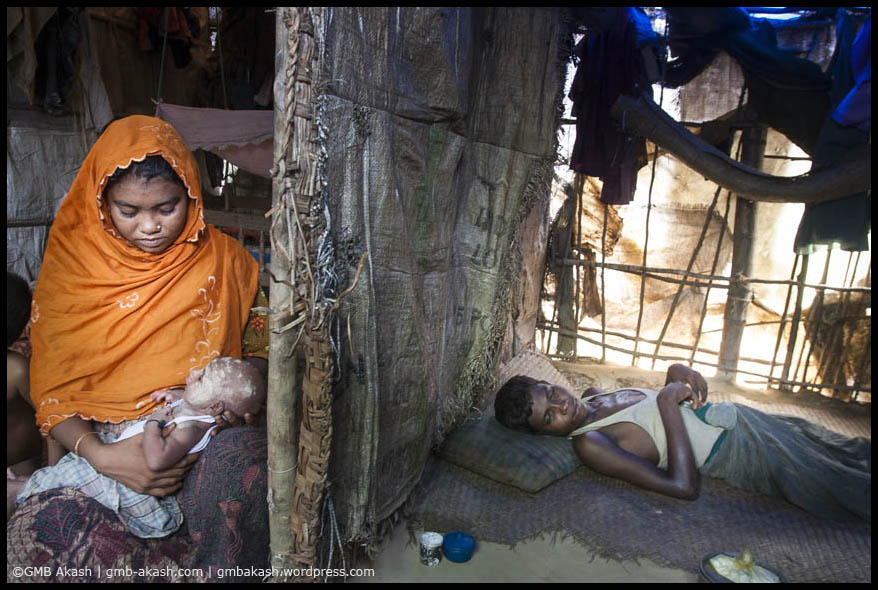
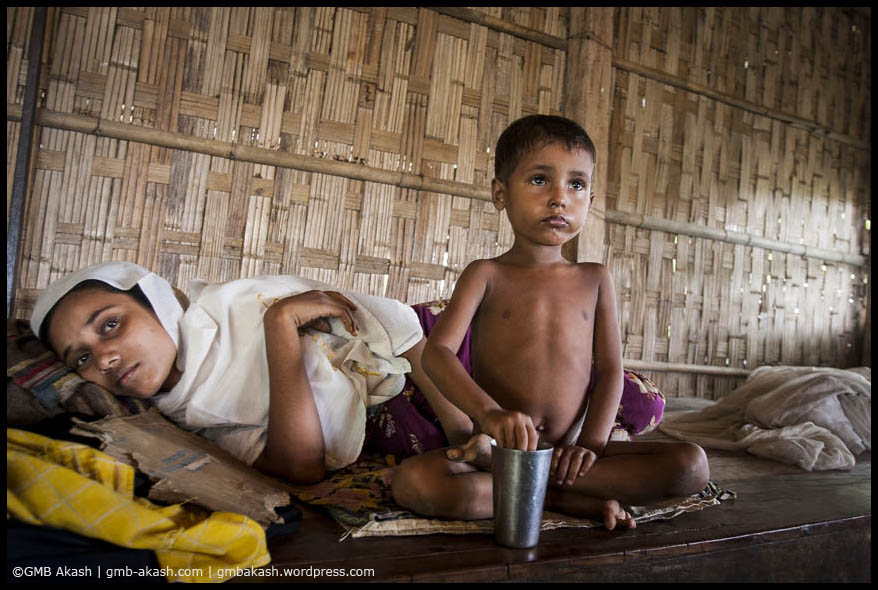
A Rohingya mother seating idle with her child. Most of the new born and children suffered from massive Malnutrition.
The experiences of violence and coercion over the years have inevitably fostered a climate of fear and distress among the refugees. They are not permitted to work. They have nothing to do to live their lives. They have no money, their husband or wives are not allowed to do any work. They are like prisoner of an open field of limited activity.
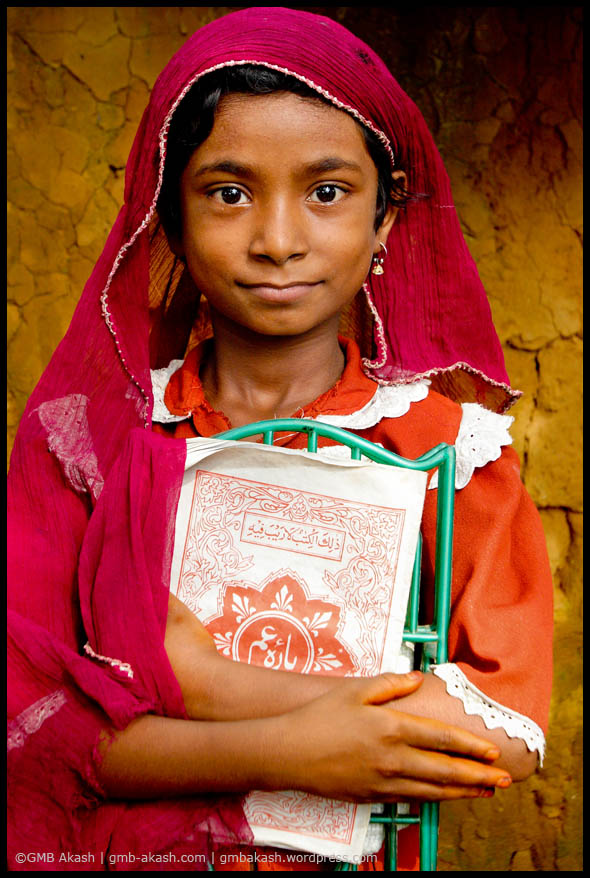
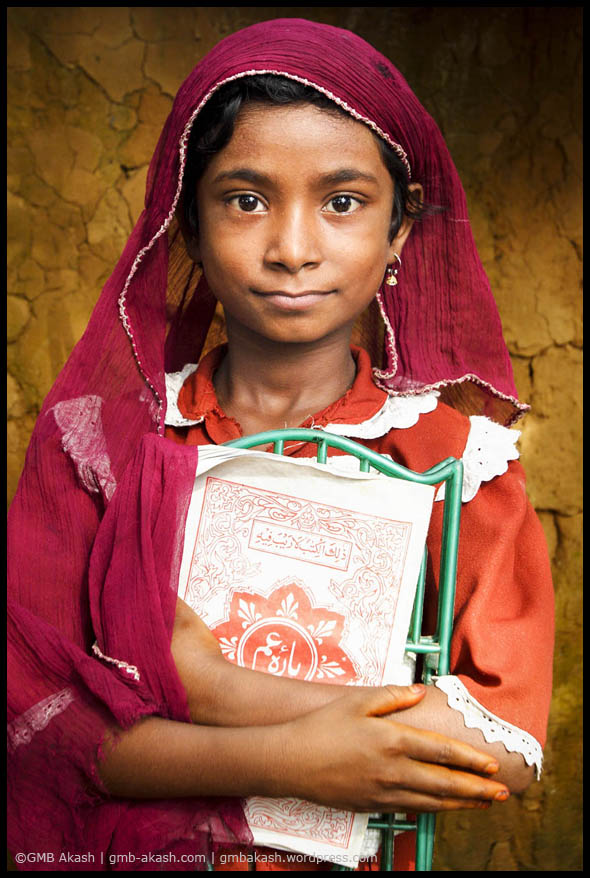
The girl belongs to the refugee group who are living without freedom of movement, permission to work or basic human rights. Besides she dreams to study, go regularly for taking part in Madrassa.
Children study the Koran (Qu’ran) in a makeshift Madrassa (Islamic school) in the Dum Dum Meah refugee camp.
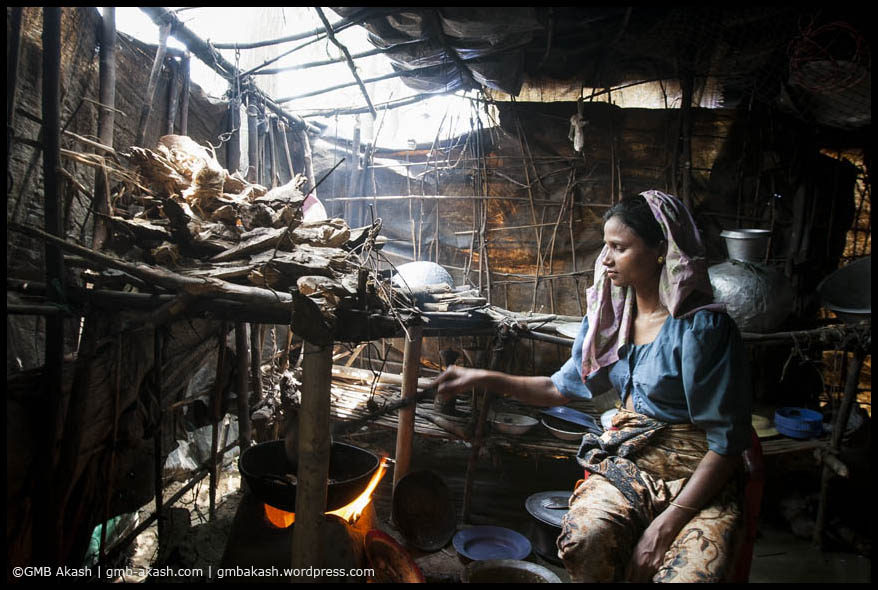
The living place displays the most unprotected residence for living as human. The rapping plastic sheet which have uncountable holes surround them generation after generation. In a small place where hardly two people can live, ironically they are living more than eight people.
Two young men are making a new house in the Dum Dum Meah refugee camp. There is no change in their accommodation scenario instead of getting only holes in every rainy season.
Rohingya refugee families have to depend fully on ration. The refugees are totally dependent on the weekly distribution of food. For many, food is the only source of income, as employment is prohibited.
A Child in the Dum Dum Meah refugee camp. Here everlasting hunger, heightened vulnerability to disease, and hampered growth will only be overcome if the Rohingya refugees get enough to eat everyday. But still it is a dream to these refugees.
“Sometimes I bathe only two to three times per month because I have to save water for other member of my family”- A woman of seven member of the family were telling about the water condition.
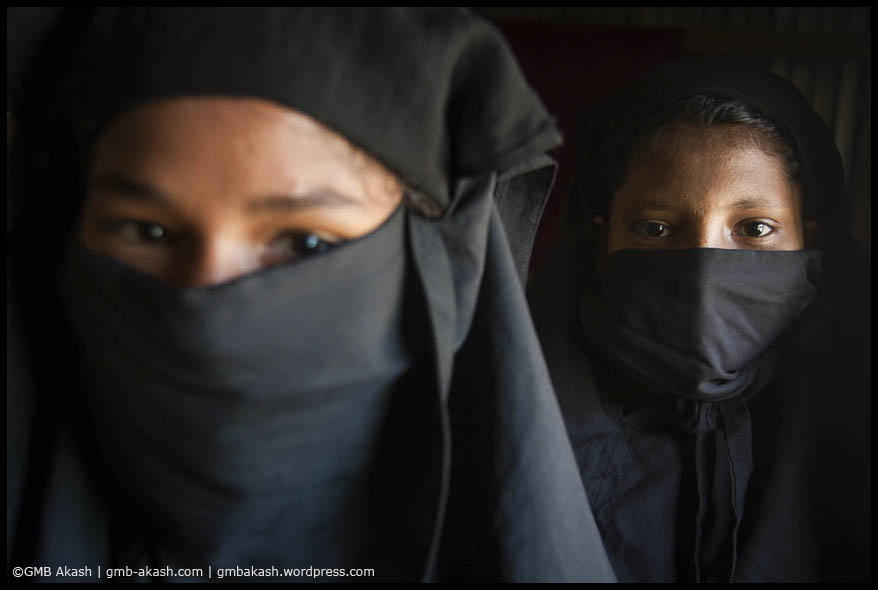
There is just one toilet between every 10 families. Teenagers hardly go to toilet in day time. As the toilet is visible from outside because of broken doors & holes is plastic rapping areas.
“Through the damaged door everything is visible when we go to toilet. In spite of danger we young girls go to toilet when it is dark that no one could see us”- young girl of the camp named Mya
Water fall of mountain is the source of water near the Burmese refugee’s camp for Rohingyas. Rohingya families are collecting water from mountain as there is no facility of water in their camp. After 2 kilometers walking they can collect drinking water however they got sick often by this impure water source.
Besides them thousands wait, unregistered, and unsure of what their future holds. People are stateless and hopeless. They have nothing in their hands.
Rohingya families have to totally depend on ration supplies. This generates an endless cycle of food shortage as no food enters instead of only rations for them.
The boy representing the third generation of one Rohingya refugee family. They do not have any identity as nation. Despite losing everything they are fighting to get the honour as human.
“Many lives have begun in these camps in the last decades. Many will end here, too, without a birth or death certificate to prove that they ever existed. There straggle will convey message to all people who are unknown to the fact of living no where, belongs to no nation and not aware of searching identity everyday” – Gmb Akash
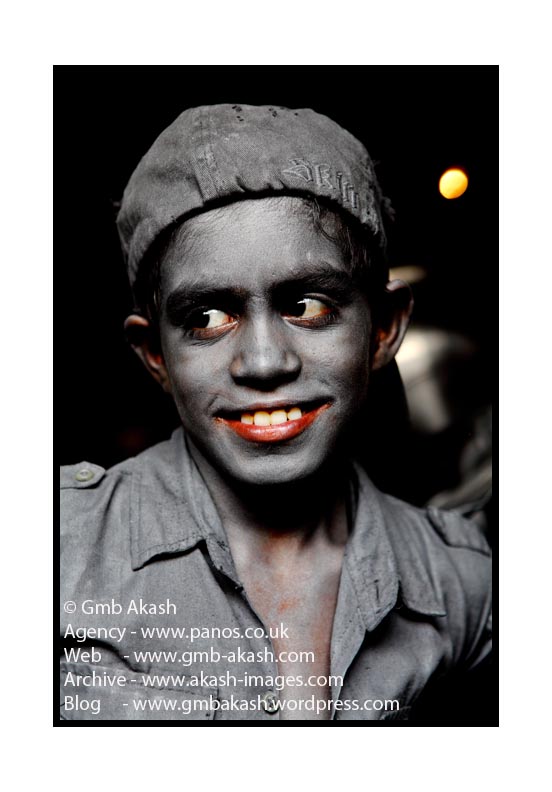
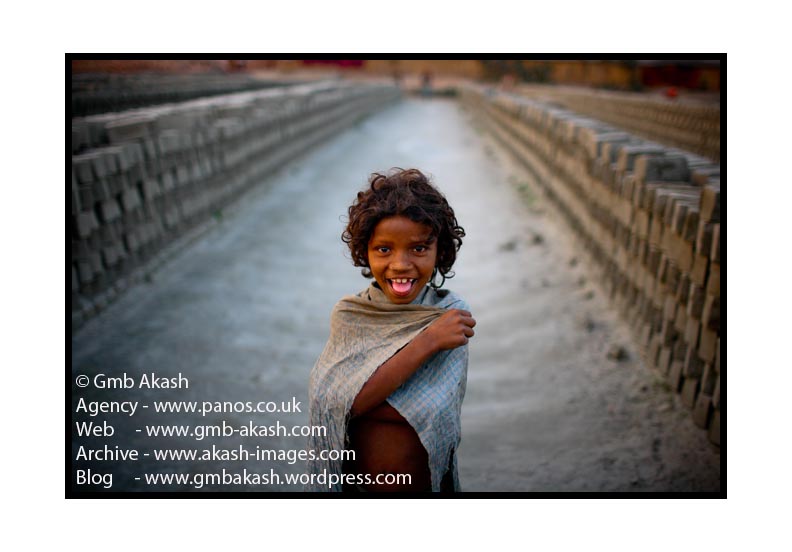
“Survivors” depicts the invincibility of the human spirit to survive against all odds. People who live on the edges of society have had a big impact on me and have been a great inspiration to me as a person and in my career. The existing social hierarchies have made me realize that those who live at the lowest rank on the economic ladder are the true survivors. These people are deprived of even the basic necessities of life, yet they manage to live each day with a smile on their faces. As a photographer I feel it is my task to show the world those unseen realities and to shed light on what most of us never see with our own eyes.
I have been doing my project “Survivors” for the last 10 years. In these years I tried to bring changes in some lives. But now, I moves to work on it highly by bringing the project “Survivors” in light. & lend hands to some miserable souls. Munna is one of them. Here I am revealing life & straggle of Munna – which many of you may never seen but heard many times, which many of you may imagine but never feel. Welcome to the world of a – little soldier ‘Munna’
“Born to work – A Battle of a Survivor”, First video made by me & a documentation on ‘Munna’ from the project ‘Survivors’.
‘Integrity with innocence’ this is the concrete of Munna’s character portrayal. Five years ago I first met Munna, he was same like now. He was a seven years old shy boy who never complains to anyone. At the age of five he comes to the factory. Two years he did nothing & got no money. At the age of seven, he learns & starts working. When I took his first picture his hands remarks his experiences.
Five years have passed fates of Munna & his father brings no change in their lives. Only difference is, with his five years experience Munna is getting 1600 taka ($1=72taka) per month. Moreover 12 years old Munna is running his younger sister education with his extra income of Friday overtime. His dreams confine to get more experience of hard work & made a big factory. He dreams to give good food to his family, he dreams to take them in a better place. The boy speak too less, stand always like a shadow. Whenever I took picture of him, he tried to clean his torn cloths as well hide torn areas. These little doings, little words earn respect.
20 years ago Munna’s family had come to Dhaka for better living. Time never brings any happiness in their lives. By a little donation Munna’s father bought shoe sewing materials & now he is working as cobbler. They pray that rainy season may never come. As people does not come to do shoe polish in rain time. Munna & his family are surviving in the race of life.
Like Munna around 7 million children are straggling in our country. May be it is difficult but not impossible to give hope to these 7 million children. If only every capable person lend their hands for one family.
My project “Survivors” aims to help Munna & his family. This project designed to help ten families from ten backgrounds. By little collection – a fund will hand over to Munna & his father. Munna’s father will utilize it for lifting their fates. 25% of the selling price of my book “Survivors” will give to these kinds of 10 selected families. You all are invited to stand beside Munna. Won’t you lend your hands? If your heart is moved to do so please visit “Survivors” by Gmb Akash at : http://emphas.is
“Our little help, little words, little recommendations could bring light in some dark places of this earth. ” Gmb Akash
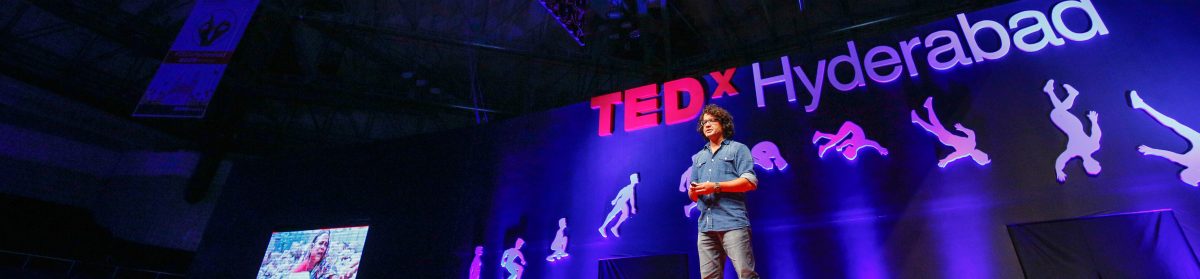
































































 GMB AKASH