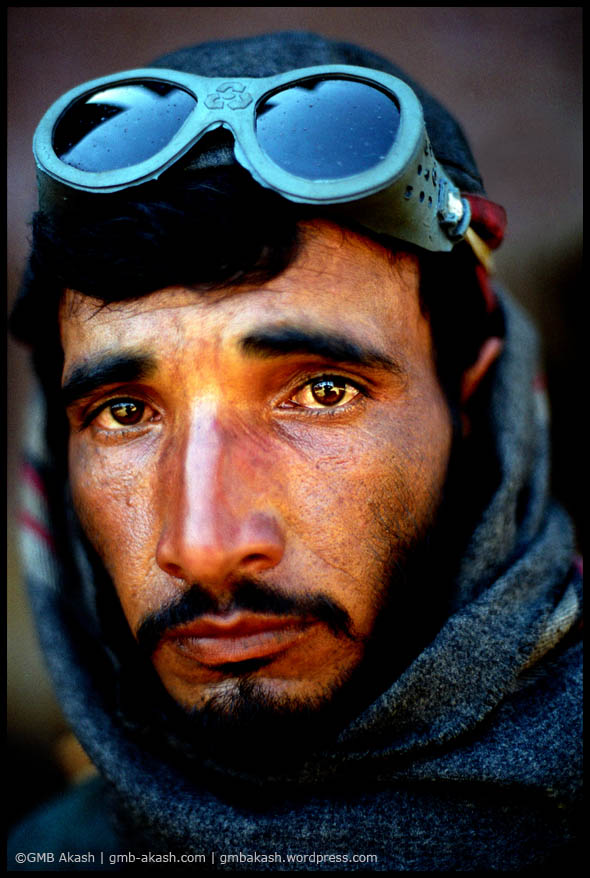
“This is an emblematic depiction of the agony of hard labor. For saving themselves from hunger they breathe in asbestos dust and toxic waste. Thus they are risking their lives everyday. On the verge of death they risk their lives in order to endure themselves. They are passing their days on one of the world‘s most unregulated and hazardous industries, leaving a trail of debris, disability and death in its wake. I spend 10 days in the Gaddani ship-breaking yard north of Karachi in 2005. I witnessed workers dismantling large ships, piece by piece using no protection, in absence of tools, where one wrong move could result in death, but they were continually depending in their bare hands. In a city of dying ships flames with smoke rising, tormented with ship body parts, metal residue, asbestos, and oil spills. Barefooted workers with little access to necessary tools are vanishing ships on the rusty sand of Gaddani and break down these steel giants coming from all the harbours of the world.”
– Gmb Akash


The beach of Gaddani, 50 miles north of Karachi in Pakistan, has become one of the two world biggest cemeteries of super tankers, cargoes and other vessels in the world. Thousands of men, mostly Pashto migrants, toil over the ships. They are seasonal workers, a large number of native and immigrant workers returning to their homeland near the Afghan border at harvest time. The group consists of perhaps from Afghanistan. They pen for their beloved, whom they get to see only during the year ends. For around USD 1.20 a day, thousands of workers labour to dismantle dozens of ships each year at the ship-breaking yard in Gaddani.


Rashed, a labourer at the Gaddani ship-breaking yard has worked for five years dismantling ships. He said: “Had we had any other way of earning bread, we would not have come here.” Workers are always under high risk of accident, though they hardly care to secure themselves. Under hitting rains of sparks, blowtorches split through the thick steel skin of a ship. As they are cut lose, the pieces of metal plummet to the ground with a roar. I saw workers, toiling ceaselessly, as though banished forever to an underworld.


Many workers operate in tight spaces where the air is thin, and in high temperatures caused by hot welding, which is widely used, not to mention that they are constantly exposed to flammable liquids like paints and solvents. The work carried well into the night shipyard in Gaddani, Pakistan. This is the ship graveyard that serves as the final destination for a significant part of the world’s fleet.

“Barefooted workers would take apart, bit by bit, the dying ships with their bare hands, shipyard in Gaddani, Pakistan. On their shoulders, workers bore great metal plates to their destination. People complain about their crappy lives working in an air conditioned work place, imagine having this as your only option in life.”
– Gmb Akash


 GMB AKASH
great photo set.
LikeLike
Thanks a lot!
LikeLike
Excellent post ! All the pictures are really great and the information is also just perfect !
LikeLike
Thanks for penning you thought my friend.
LikeLike
Very nice concepts, you are really a great photographer,go Ahead, Allah with you brother.
LikeLike
Another heart touching story Akash. There are very few photographers who do this kind of work. I want to know or see someone from India doing this. I’m sure there will be someone but I still have to discover him/her.
LikeLike
Ryan Lobo
LikeLike
Reblogged this on 10th Village.
LikeLike
Great socio-political photo journalism you’re serving here. Thank you very much! These workers are being exposed to different poisons and they wear no protective gear as helmets, gloves etc.
It’s cheap for the multinational corporations to send the ships here, instead of chopping them up in the West where the expenses are bigger when it comes to salary & security measures creates extra costs.
LikeLike
it is my duty as a photographer and artist to point with my pictures at every aspect of existence in the society and world I live in, to show what can be shown, to go deep into every milieu and also into every aspect of poverty, deprivation and hardship that I encounter – because the only sin for a photographer is to turn his head and look away.
LikeLike
very informative and touching…..
LikeLike
Thanks for sharing your thought dear. You all inspiring me s lot!
LikeLike
OI clean shit toilets in a shopping centre where lazy dirty people leave paper nappies stuffed to clog the loo. That is how I exist. Thank you all the 1,000s a week of dirty people i clean their shirt up.
I’m a “CLEANER” that’s my job. I empty the med bin. Oh it’s left for the cleaner. Abbot wants to pay for lackies to look after kids for white Oz Mums. Slave trade coming up for boaties and Muslim Packies and a few Indians. DON’T FORGET THE ON LINE LABOUR AT THE BLACK MISSIONS…..
LikeLike
It is frustrating how people have to suffer in so many ways. My sincere hugs for you to continuing a very important work for this civilized people, who will understand one day to give right and respect to workers of all horizon.
LikeLike
Another heart touching story Akash. There are very few photographers who do this kind of work. I want to know or see someone from India doing this. I’m sure there will be someone but I still have to discover him/her.
LikeLike
I will feel little if I cant put their hardship properly. Glad to know that, I able to do that. India, Bangladesh has similar subject and mostly suffering in same way.
LikeLike
Aydee Fic Allah be with you brother..
LikeLike
You are so kind.Thanks from heart.
LikeLike
I m a Pakistani and Thanks to you for your outstanding work ..
Gadani Ship Breaking industry is playing very important part but their workers should facilitate …Thanks.
LikeLike
Yes, Bangladesh and India also suffering in the same topic. We all wish all workers gets their rights and securities.
LikeLike
Nice concepts, nice picture. May God bless you.
LikeLike
Thanks a lot! May god bless all living souls.
LikeLike
Dear brother, what can i say……………….Great work.You are the proud of our country.
LikeLike
Thanks for the appreciations. Best wishes to you.
LikeLike
god bless you brother GMB
LikeLike
Thanks a lot! god bless you too brother.
LikeLike
Thank you again for your enlightenement. You are giving us a telescope to look at the world … we are forced to see the harsh realities of many … Dare with look. Easier to watch the fantasies of TV … yet I think we all know we can no longer avoid the truth. Despite the danger and hardship, I see the will in the soul’s you photograph … how inspiring.
Sheila – Canada
LikeLike
thank you for your kindness and visiting the blog
LikeLike