
Incredible Humans are extraordinarily beautiful. And the most beautiful people we have known are those who have known defeat, known suffering, known struggle, known loss, and have found their way out of the depths. These persons have an appreciation, a sensitivity, and an understanding of life that fills them with compassion, gentleness, and a deep loving concern. Beautiful people do not just happen.
Welcome to my blog to meet 10 incredible humans : ten workers of all time who were previously featured on my Facebook page: GMB Akash
Undoubtedly their views on life will fill us with awe and leave us in wonder. Let’s have some inspiration to celebrate May Day.

‘We do everything a man does, our working hours are same. But when I went to take my wage the manager gave me 50 taka less than my male coworker. I asked what my mistake was. He shouted on me and said, ‘You did more work than him. But you don’t wear shirt. You are a woman. You will get always less.’ The next day I came to work by wearing a shirt. All the men laughed at me. I ignored them and asked the manager to pay me equal as I wore a shirt after listening to him. I clearly saw he was hesitating and was afraid of my bravery. But again he said, ‘He will pay all women equal if all of us could wear shirts.’ He gave me a smile like a fox. I lost hope, knowing no one will wear a shirt. The next day when I arrived at the field all women were wearing their husband’s shirt on the top of their saree. I never could imagine the manager would be this much afraid of seeing us together. He paid all women equal to men for the first time during his ten years in the brick field’s history. From that day girls call me, ‘Hero’. I don’t mind!’ – Taslima

‘I lost my mother when I was very young. I always tried to please my stepmother. I do not know but why she never tolerated my shadow. She had beaten me a lot. I used to stand silently the times she was beating me, I could not cry, as she told me that if I cried she would throw me out from the house. After tolerating all these, one day she finally threw me from my home. I cried loudly all night by standing in front of the closed door, but not even my father came out to take me back. I came to Dhaka from Chadpur. I used to roam around all the streets and sometimes ate from dustbins. Then one day I got this job, a job as a sweeper. But the sad thing is, everyone hates us, no one talks to us. Today I am very happy, brother, nobody ever took my photo, no one ever wanted to know if I have something to share. When you tell my story to people please tell them not to hate us. If we stop cleaning, you will die. We are servant, we go into your rubbish and by becoming dirty we cleanse you. Please do not look at us with hatred’
– Md. Rabbi (18)

‘One day madam bought a girl of nine years old. Her stepmother sold her to a brothel and then spread the news that she had been lost. The stepmother was satisfied to get rid of a stepdaughter for a life time and 3000 taka was just a bonus of selling a human being. My madam gave the little girl to me to prepare for clients. She was a doll, her pink chubby cheeks and big brown eyes melted my heart. When she cried and cuddled me at night I felt like that baby was made of milk. I went through forced abortions two times; for me Putul was my lost fetus. I bought her a doll to play with. After seven days she was able to speak, her first question was, ‘will that madam cut my hands and send me for begging’? I closed my eyes and whispered, ‘they will do much worse than anyone’s imagination’. Madam was impatient and gave me one week to teach her all the tricks of the business. And I planned something else by putting my life at risk. The day before they fixed a client for Putul, I communicated with one of my old admirers to talk to an organization who was working with orphans. I knew they would kill me if they found me while or after transporting the girl to the orphanage. But that time I did not care about my life. I was able to get her free from this hell. She left her toy doll for me as her memory. I know there must be thousands of such hells waiting for the girl but at least I was able to save her from the biggest one. Please pray for my baby; may she get all the happiness and love in her life; may her chubby cheeks always gets rosy from laughter.’
– Purnima, a sex worker

‘I am trying hard to love the job I am doing. But it seems impossible to be happy with my work life. I am giving my one hundred percent. Not a single day do I arrive late at work nor ever overlook any of my mistakes. My job is to help passengers on the train. After giving my best, so many times people have misbehaved with me. It really hurts. People behave miserably to such an extent that I lose control over myself but I never utter a single negative word against passengers. After returning home, many nights I tried to understand why everyday people are becoming aggressive; why educated-socialized people are uttering ugly words against someone they do not even know. Maybe now-a-days we all are going through so much stress and anxiety; who knows? But behaving well to people is not only my job responsibility, it’s my moral value. I only earn 5000 taka monthly; it’s very difficult to run a family with the amount of money I am receiving. But that does not mean I will only perform according to my salary scale; I want to perform my best.’ – Pappu (22)

‘I was very happy when I got a job as receptionist. I only went up to class eight so I was surprised when I got the job while I actually went for a peon post. I belong to a poor family and I have little brothers. My mother was very happy by the kindness of my boss. How lucky was I to get a respectable job with my little education! Things were okay at the beginning. But then I started feeling what only a woman can feel with her inborn senses Many things happened and I could not drop my job and tried to adjust as much as I could. One day when I was showing the appointment list to my boss he touched my hand and asked if I had I heard about Sunny Leone. He would be happy to watch a film of hers with me. I just said, ‘no’ and ran from his room. I cried my heart out while returning home. But I decided to speak up. The next day during lunch sir’s wife came with lunch. I entered inside the boss’s room and with a brief greeting boldly said, ‘Mam, do you know Sunny Leone? Sir wants to watch a movie of hers with me.’ I could never forget their faces. That was my slap to the most educated man. I am very happy with my textile job, I am a worker, but I have dignity, which I will never compromise for money and a reputed post.’
– Nilu, Textile worker

‘I am not living with my husband and in-laws anymore. I was fed up living with a drug addict, who sold everything I had: my saree, sandals, even the bucket of the bathroom. My in-laws kept taunting me as they believed I was the one who could change him but I failed. I realized it would be very late if I did not leave him at that point. But I loved him entirely. It was not easy for me to leave my husband and start a life with my only child. My brothers shut their door in my face. My grandmother was the only one who gave me shelter and helped me to find work. What more could I accept from a ninety-year old woman? She did not turn off her love while the rest of the world kept blaming me by saying what an awful woman I am who broke up her own marriage. But I know my suffering, my fights, my fears and my limits. No one else felt what I had gone through. Yesterday, my child cried all day as I cannot breastfeed her in the work place, publicly. I know well how men gave nasty looks; women pass bitter comments and breastfeeding becomes a sin for working women. But today, when my daughter started crying, I said to myself, if I can go against the society for the betterment of my child, then I can breastfeed her too. There should be a stop to this limitation and I am no longer afraid of what society says about me.’
– Jesmin (28)

My wife died when my daughter was 40 days old. My daughter was my reason to live. I never thought to remarry. When she was a child I used to take her with me to work. Everyone used to laugh at me. I had not much money to send her to school. But at night I took her with me to the elderly school. Together we learned to read and write. When she turned fifteen a good marriage proposal came from a far away village. We are very poor. I could not give her anything. She took my writing book with her as my memory. I did not have money to visit her nor did her husband let her come to meet me. When she became pregnant I went to see her. She held my hand and said if she dies I had to take her child with me. I scolded her for her childish behaviour. She requested me to spend a night there, but her in-laws did not let me so I came back. My daughter died during her delivery. Her daughter is one year old. I take care of her.‘ – Abu Mia (65)
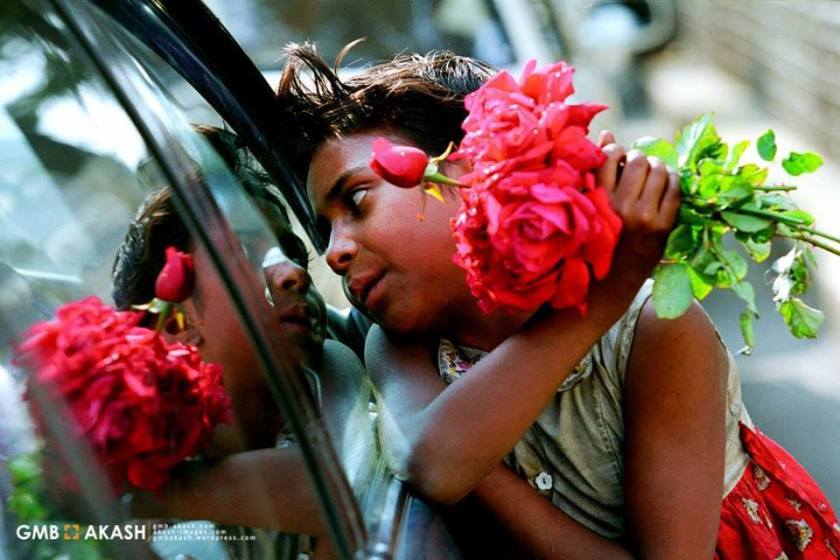
My mother flew with me when my father wanted to make me disabled after my birth, so that he could use me for begging. I do not know, what my mother actually does; she sleeps the whole day and works at night when I sleep. We live in the street. Our neighbours and the police call me the ‘whore’s daughter’. Mom told me not to reply to them as bad people always talk bad. I am a flower seller. I sell flowers; I do not beg. But people have no time to look at flowers. I pop into the windows of big cars and see beautiful children with their parents. Sometimes I wonder, didn’t their dad want to sell their organs or want to make them disabled for begging? One day a rich mom bought all of my flowers for her girl but when the girl wanted to give me the money, her mom said not to touch me, I might have a disease. The baby girl threw the money in the air and I caught it. That day made me the best flower seller among all.’ – Lutfa

‘I started working as a labourer a year ago. Including me only ten females are working at this site. The constructor does not like to employ women. There are fifty men working besides us. They always get break time to drink tea or smoke cigarettes. But we, the female group never get any break. For almost a year the strongest man of our group is making fun of us every day. Sometimes he says, he can carry more buckets of stones than the women, even when he sleeps. The contractor laughed loudly at his jokes. And sometimes after transporting all buckets of stones he showed us his muscle and the men laughed at us. A week ago I asked our contractor to give us at least half an hour break. He mocked me, pointed to the macho man and openly declared, he will give women equal break time, if I or any other woman can beat the man the next day. I looked at our women’s group and they were looking at the ground. On my way back home, my little girl was warning me never to challenge a man. I asked her why, then my five-year-old girl fearfully showed me her muscle and told me, ‘We don’t have this.’ The next day, when I came to work I told them I was ready to take the challenge. When I started carrying the stone buckets beside our macho man, everyone stopped working and started clapping. It turned into some kind of game. I had no idea how time had passed. When the contractor asked me to stop I looked at the man beside me. He was lying on the ground, already very much exhausted. Then I saw, I transported fifty more buckets than him. When every woman was screaming in joy, I looked at my girl, she jumped into my chest. I did not say a word. I had to prove to my little girl that, women too have muscle but they do not like to show it.’ – Aklima
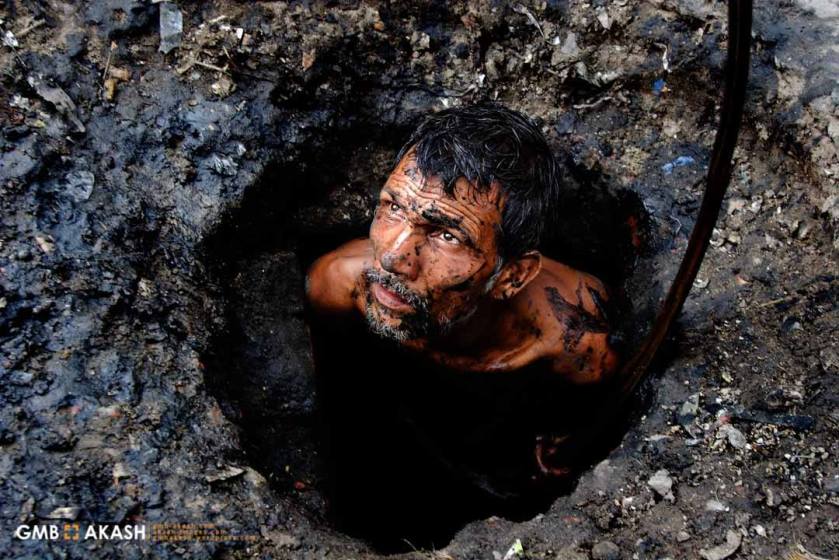
“I found out my daughter had an affair with a boy for five years. She never spoke about it as she is always afraid of me. Apart from that I assumed my children always hated me for the job I have been doing since my childhood. I asked her to bring the boy and his family to our house. I decorated the house like a new bride and brought the best food for them. I have been saving for my daughter’s marriage for twenty years. That day my daughter was the happiest ever. When they started the conversation they brought out a note of demand. They wanted all material things a family needs, I was calculating and nodded in agreement with every word they said. After all it’s about the happiness of my daughter. The last point was that they did not want me to be introduced in front of their relatives and I should never go to visit my daughter. The moment they said it my daughter screamed in anger and by surprising all she slapped the boy. She angrily said, ‘My father can do the thing that no one can do. Not everyone can clean others’ messes. I am proud of what he does and if you do not leave my house in one minute I will beat you all.’ She broke the marriage proposal and ended her five-year relationship in one second. From that day I knew what a fortunate and happy person I am.’ – Sweeper Monu lal





 GMB AKASH