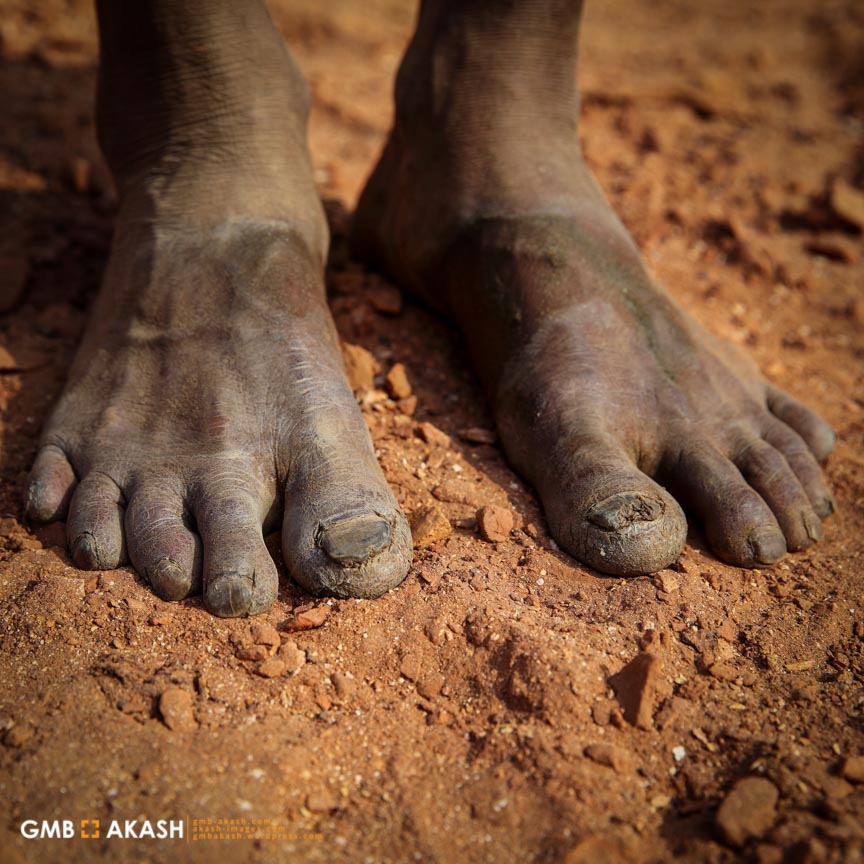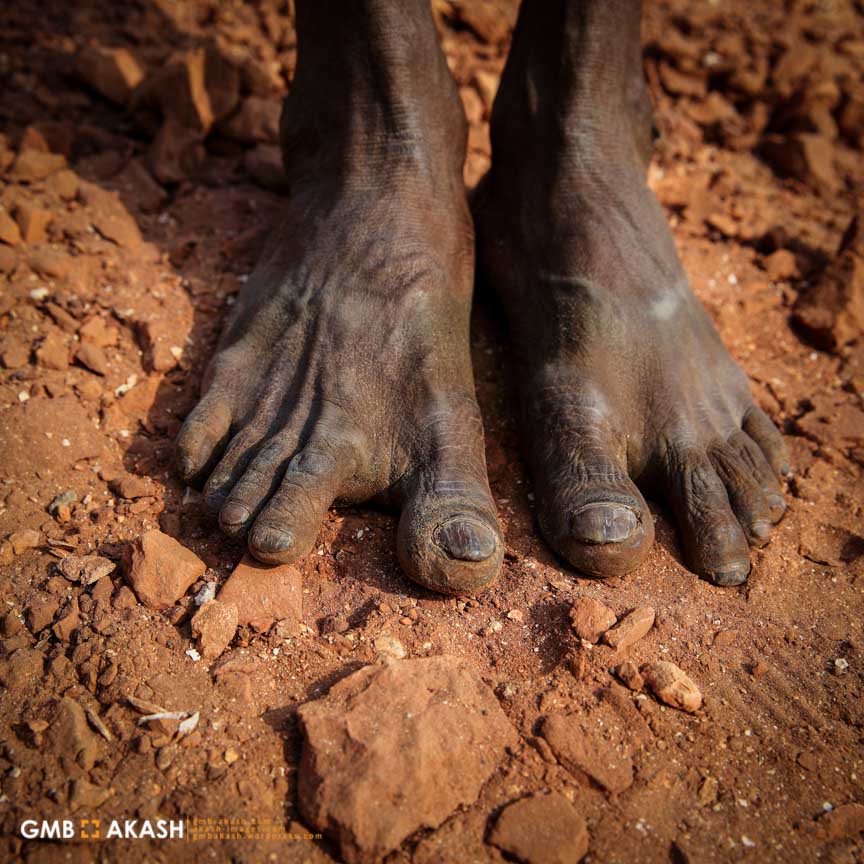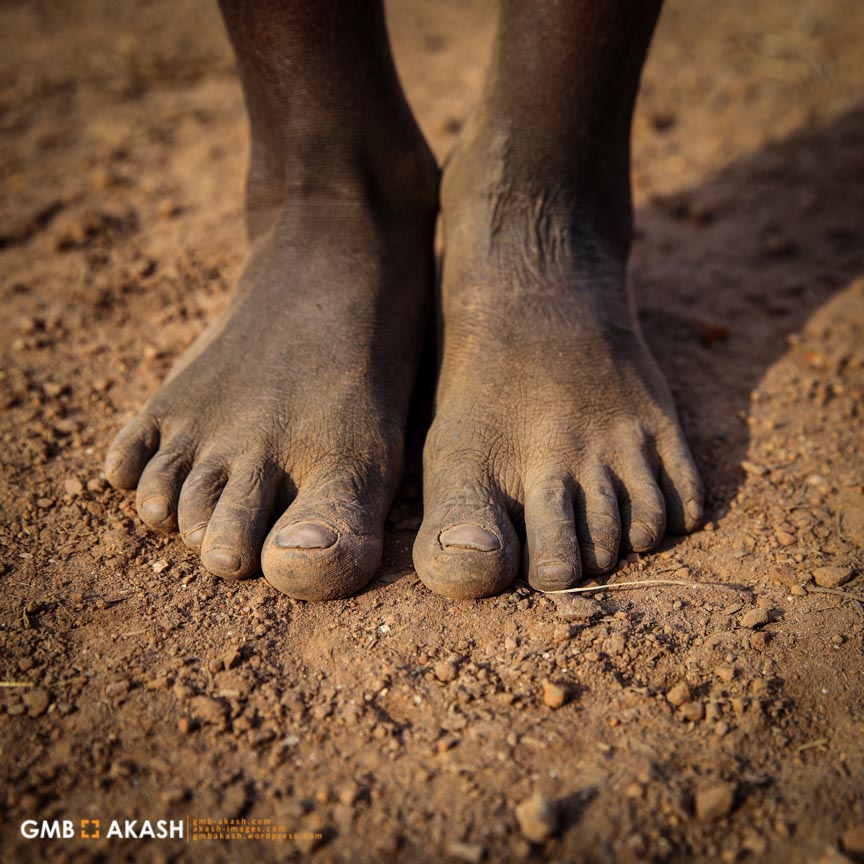
‘Feet tell stories’

Brick field (15)

Brick field (16)

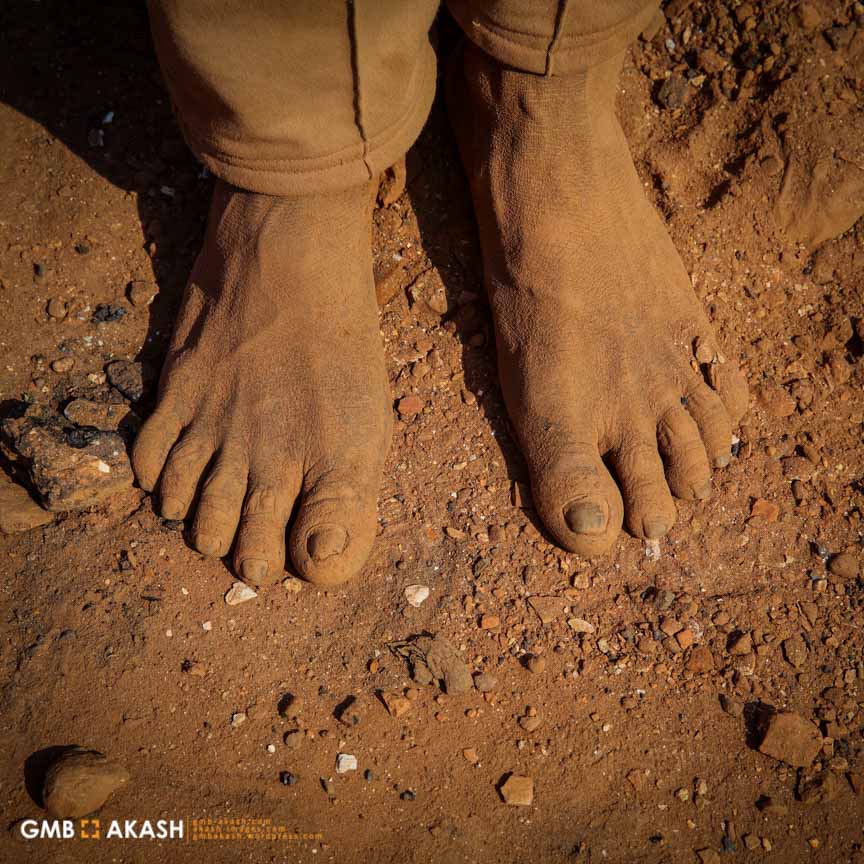
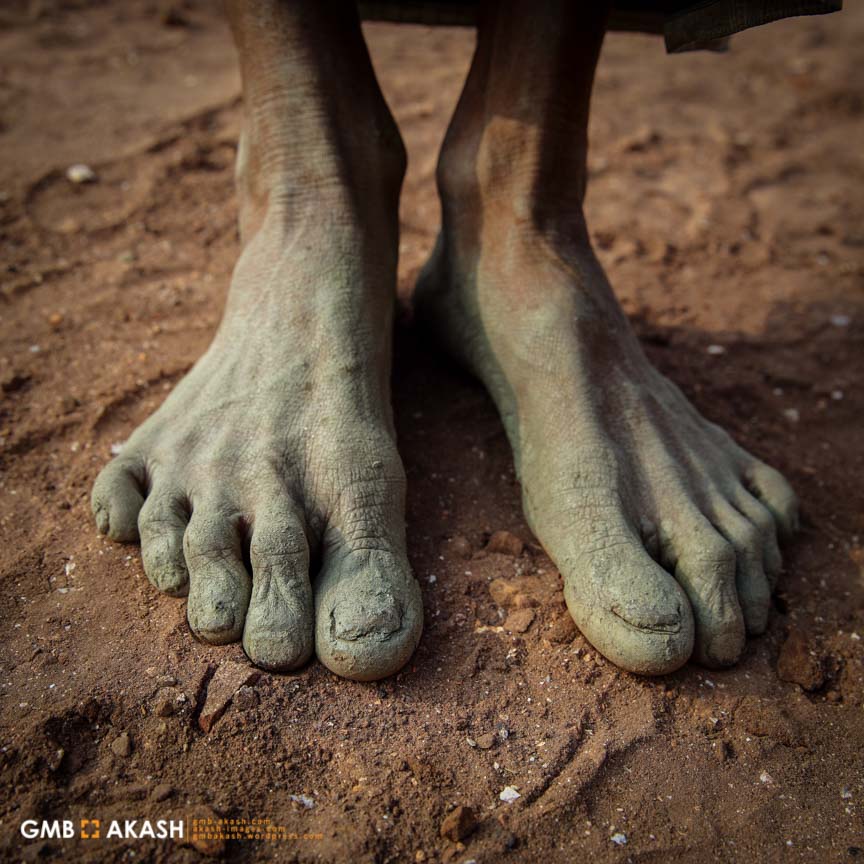
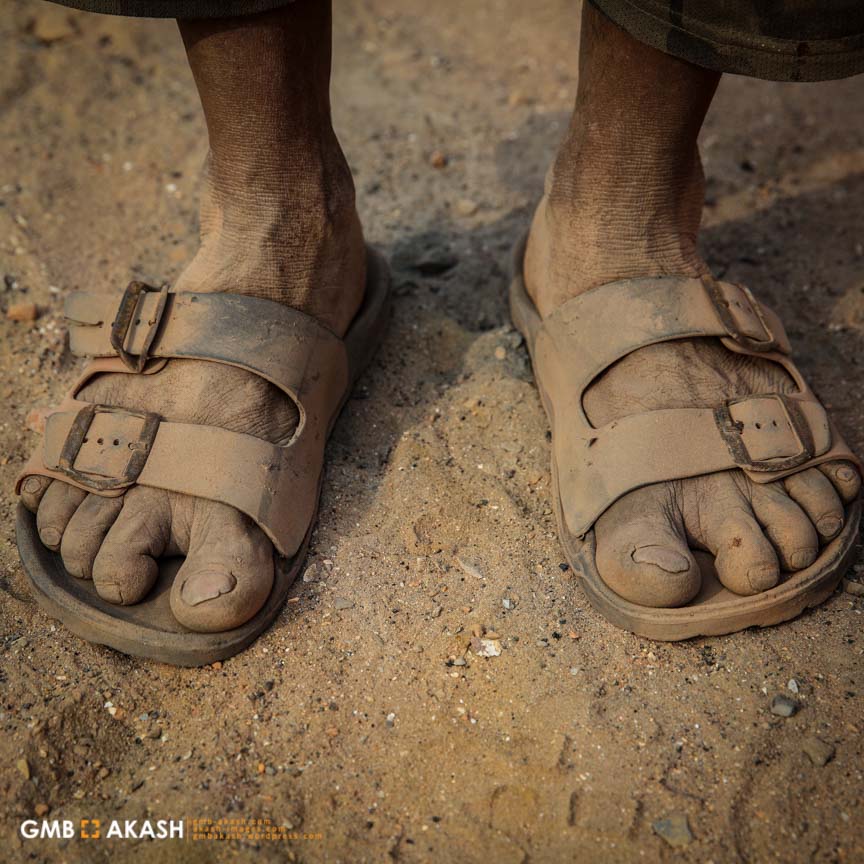
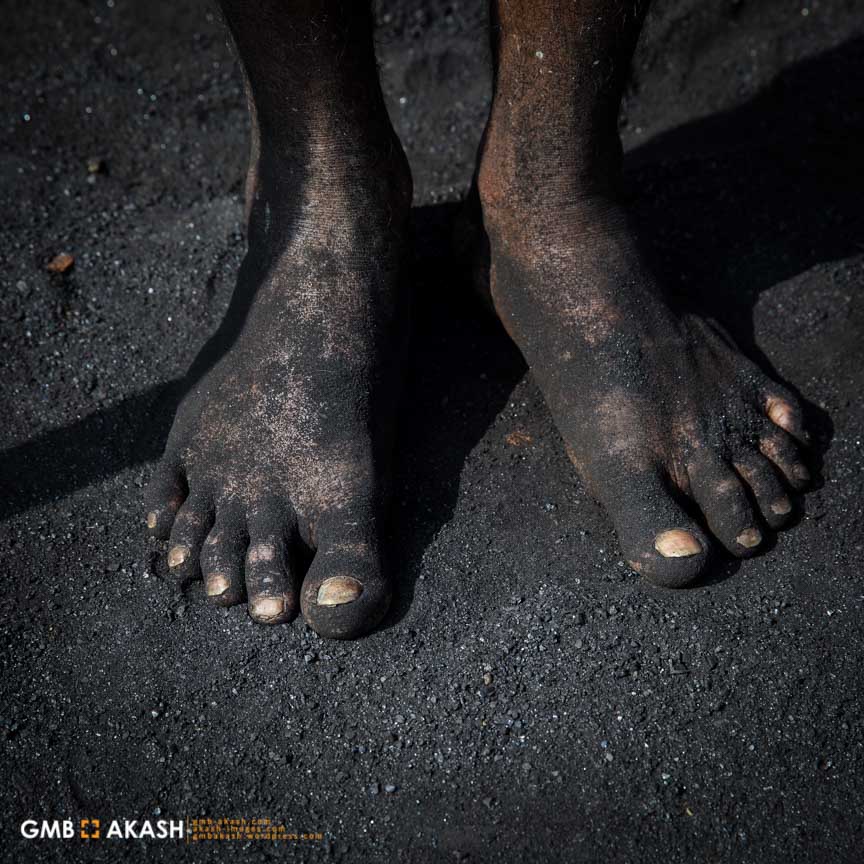
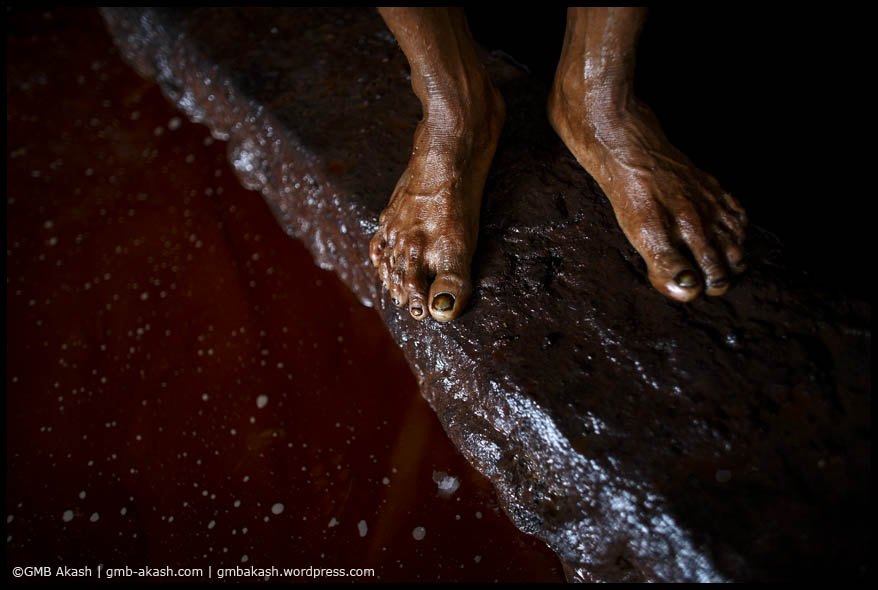
Brick field labouer’s feet tell their tales. Thousands of men, women and children continue tolling in the open brick fields. Their muddy clothes, smudged coal colored skins and bare feet tell the tale about how everyday they are fighting to live a life. I continue to search their stories of struggle about how their hope transform into despair. Once a labourer stopped me to take his portrait and asked me to take an image of his feet and said, ‘Show our feet. It’s enough to explain what we are up to.’

Brick field (1)

Brick field (2)

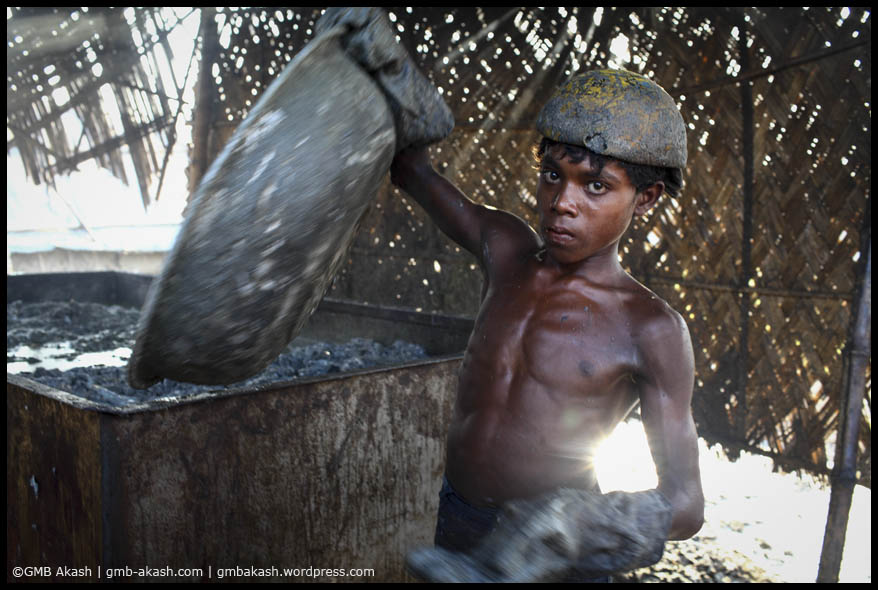
Under the baking hot tropical sun, Moriyum (7 years old) continues to collect coals in the most perilous conditions even though everyone goes to lunch. Just after shifting 1000 bricks to dry in the sun, Moriyum’s brother Mohsin (9 years old) also goes to lunch. But Moriyum continued to collect coal for her family.

Brick field (18)Brick field (19)

Working children are a common sight at the brickworks as they regularly employ entire families – who oftentimes make their homes on site. Education is a luxury for Bangladesh’s rural poor with children often earning their keep as soon as they can walk. Ranging in age from young children to grandparents, they work long hours to mix out millions of bricks to fuel construction boom that shows no signs of abating. The high chimneys of brick fields are snot only pouring grey smoke into the air but also blowing it into labourer’s lungs. All of the brick fields are located along rivers. Millions of bricks are burned here. Almost all bricks are made using a 150-year-old technology. Soil is mixed with water, formed into bricks using wooden forms, then left to dry in the sun before being burned in traditional kilns. The process is done almost entirely by hand.

Brick field (3)Brick field (4)Brick field (5)

Kohinoor who was balancing the heavy loads atop her head said, ‘We work like slaves. And we die like slaves.’ Kohinoor’s mother-in-law died last year while working in the brick filed. Another woman who has worked a decade in the field was badly suffering from tuberculosis and headaches. Kohinoor added, ‘We know we will die by working here, but we have no option.’

Brick field (6)

Brick field (7)

Brick field (8)

Brick-making provides a better income than agriculture or other jobs available in rural Bangladesh, but it is dangerous and often devastating to workers’ health. Accidents are common and workers have no protective gear except save for what they are able to cobble together themselves. 

Brick field (9)Brick field (10)

By balancing the heavy loads atop their heads, workers must carry the raw mud to the brick making area are where skilled artisans shape it using brick moulds filled by hand. However, the millions of workers who make the bricks face harsh and uncertain conditions. Brick field labourer Makbul said, ‘Everything tastes like mud. I taste mud in my mouth, tongue, throat everywhere.’ By showing the feet of Makbul’s friend, Jasim said, ‘We are brick human. We have feet like coal.’

Brick field (11)Brick field (13)

Like Makbul and Jashim, hundreds of men come with their families during the brick session in the brick fields. They made their temporary shelter near the brick field in the place given by the brick field owner. The mud house’s bed is made by brick after brick and then putting plastic over the bricks where they rest and sleep. They took loan from the brick field owner which and continue to pay it back by giving labour with full family. Small children of each family works to dry thousands of brick every day. For drying 1000-5000 bricks a child gets 25-50 taka daily. That also goes into the pocket of father for buying food for the family. The Father and mother of each family go to work before sun rise. They carry 12-16 bricks each weighting 2.5kg. For a twelve-hour workday during which an average worker carries about five thousand bricks, he earns Tk. 80 after his expenses are paid. This means toiling 12 hours a day for a daily wage of 120 taka (USD 1.70) for men and 100 taka (USD 1.40) for women.

Brick field (14)Brick field (17)

Still they hope for a better life and perhaps dream of happiness. During his break, after lighting a cigarette Motahar said, ‘My wife often asks me to take her to the cinema. We have no money left after basic shopping at the bazaar and paying loans. But she managed to save and bought an old phone for me. Now while I work, I listen to songs.’

Brick field (20)

(Brick fields are not only causing suffering for labourer but for the environment also. Bangladesh is hit harder than almost any other country in the world by climate change despite emitting very little greenhouse gases. But still the emissions from the brick kilns hurt the environment. Brick kilns are the leading cause of air pollution in the country. There are about 5000 brick kilns in Bangladesh, which are largely responsible for air pollution. Dust from the brick-making sites spreads in the wind to nearby towns and villages clogging the lungs of young and old and generates health problems that the country is ill-equipped to handle. The chimneys continue to poison labourer lives and as well as letting the environment to suffer in silence)


‘Today’s Slavery’

The sound of Monu’s footsteps compel us to look at him. It seems he is willingly trying to make the strange sound grab our attention towards his new gum boots. Before I speak to him, he shows all his teeth and enthusiastically says, ‘Bhaijan I bought them for 200 taka from the street. Bou (his wife) had washed them so well that I can see my face in them! Ha! Ha! Ha’

Before I compliment him something someone on my right side, Nibaron, who is Monu’s colleague of 15 years loudly said, ‘Hmm, does your new wife, still cry for you to drop the job, Monu?’ Monu recklessly replies, ‘Women are fools! She thinks tannery labourers die earlier. Allah is the one to decide. Women are crying party. Now I have these gum boots to protect me. She is happy and I am happy too!’

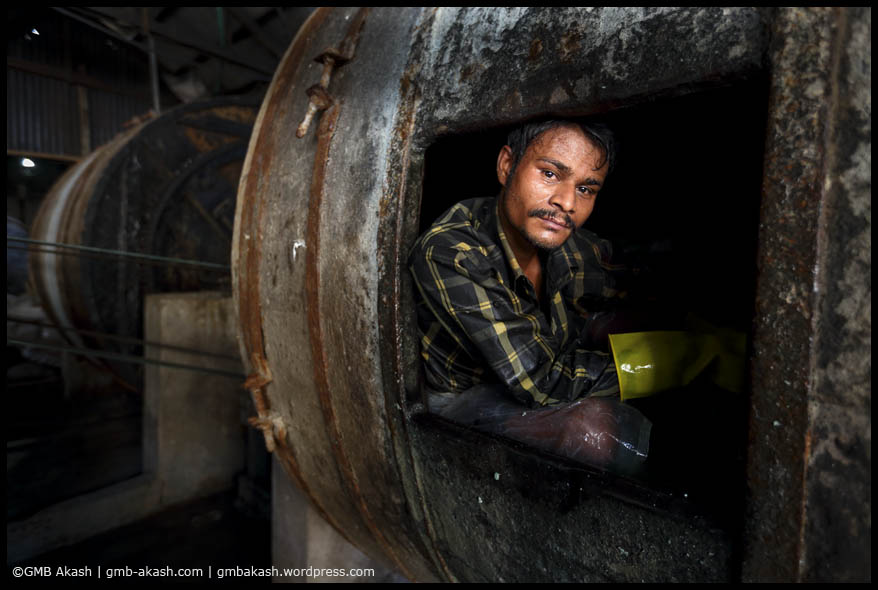
Monu got married to ‘Salma’ five months ago. Salma heard that tannery workers die at an early age, so she started requesting Monu to leave this dangerous job. But by doing this job for last 15 years, Monu, a 21 years-old man is surviving. He cannot imagine doing any other work than tannery nor is he capable of doing any other job.

The chronic cough he has or the rashes on his skin do not bother him anymore. Still he dreams of a better future with the 8000 taka salary. Now the dream is sweeter with his caring wife ‘Salma’.

Posing for the camera he said roughly, ‘By working in this hell, I am still alive. God might be giving me a long life bhai.’

Leathers (11)

Leathers (13)

Leathers (22)

Leathers (17)


I have been taking photographs in this factory for many years. I cannot find many of the faces I used to know. When I inquire about them the common response I hear is that because of illness they moved to their villages with their families.

The repulsive smell on my body or the sticky chemicals on my favorite jeans does not affect me anymore; Just like Monu. Only when I return from this work and the rickshaw puller turns his head several times and at last wisely says, ‘Sir, you came from tannery!’ Then I realize I am also polluting the air.


Leathers (1)

Leathers (24)

Leathers (2)

Tenary in Dhaka (123)_1

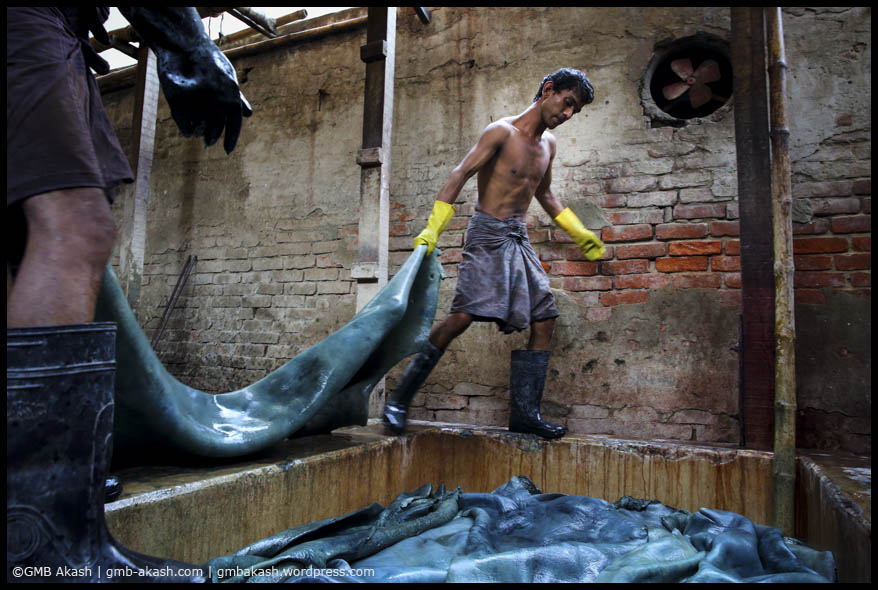
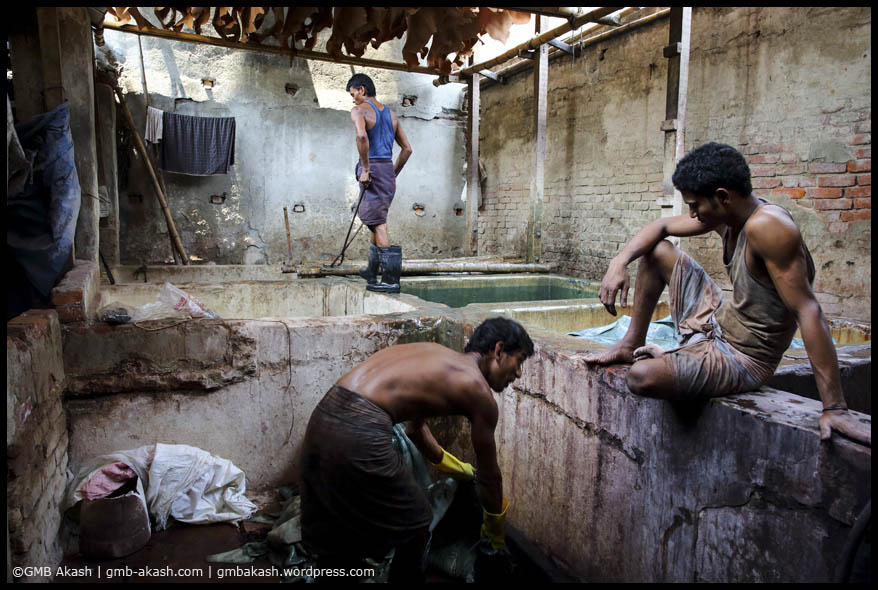
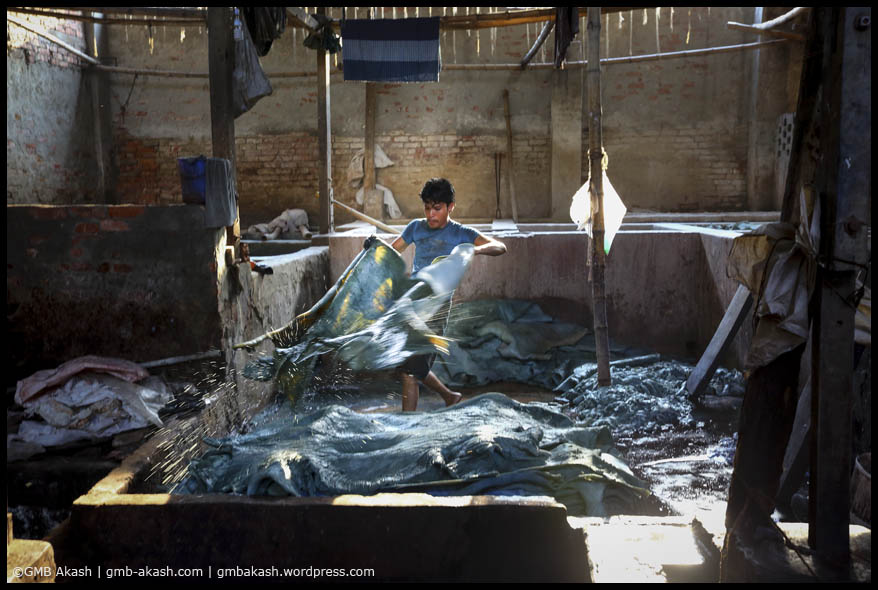
Like Monu many labourers believe that a pair of gum boots is their safe guard. Some of them tie gamsa (a traditional cotton towel) to save their lungi from the filth. But when they start working their sweat, factories chemicals, and raw leather shower them with poison and loathsome smells. A pair of gum boots and gamsa can not not save their hope to survive very long.

Leathers (16)Tenary in Dhaka (96)_1

Leathers (21)

Tenary in Dhaka (49)_1

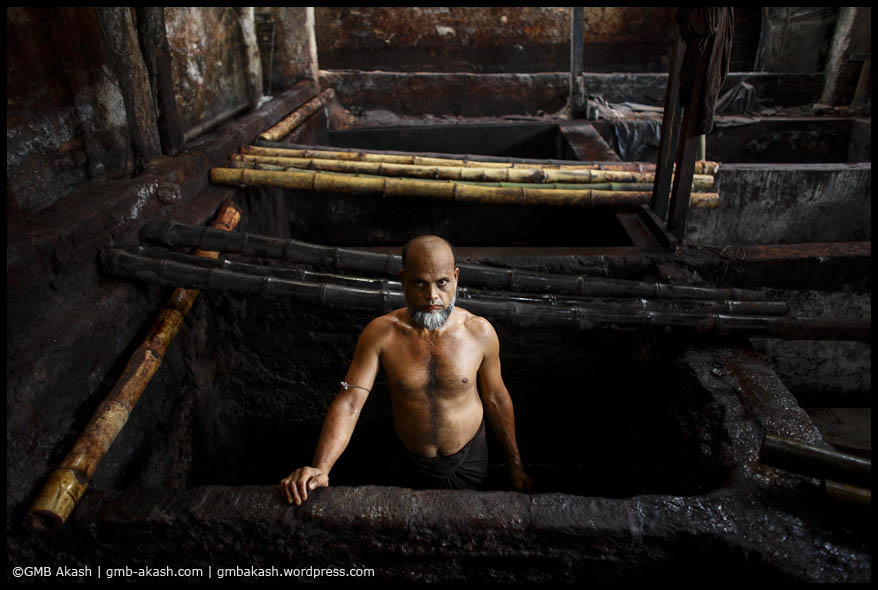
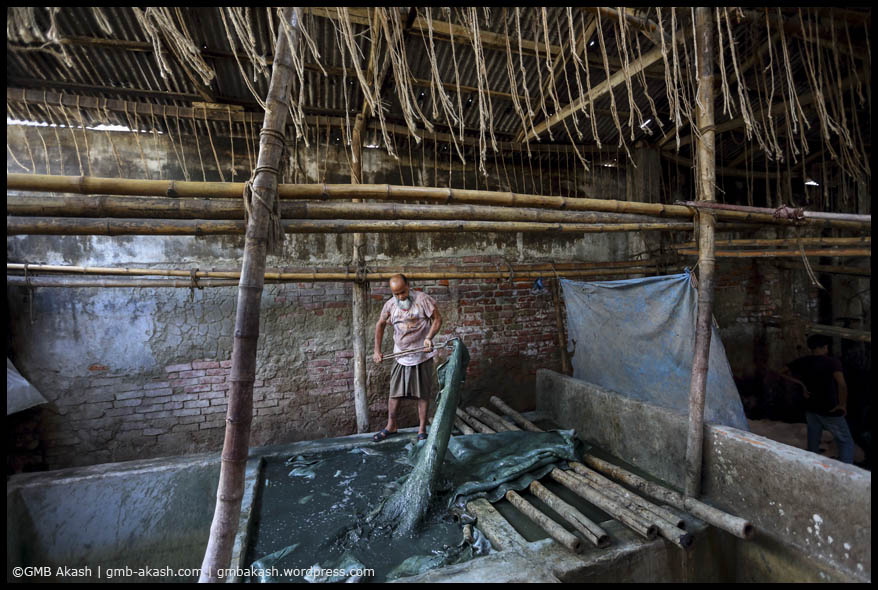
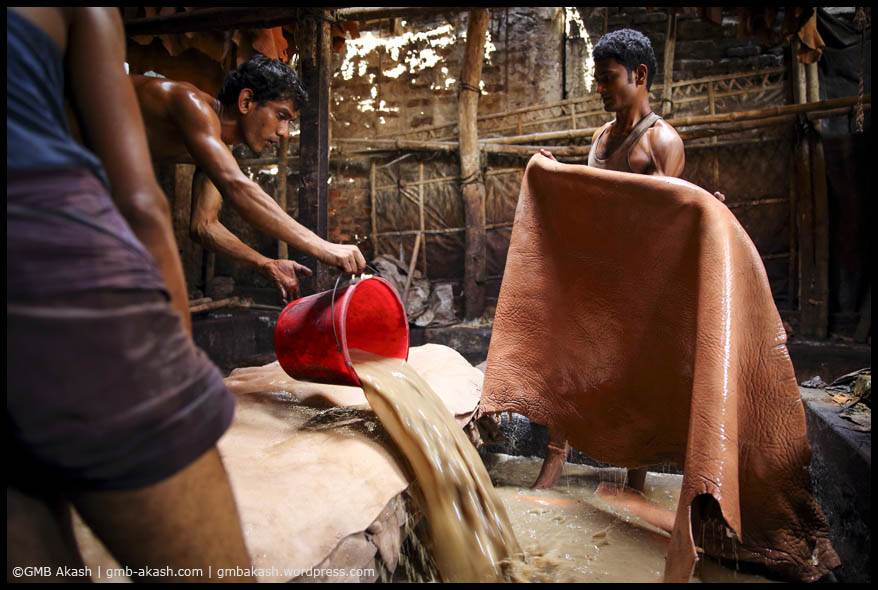
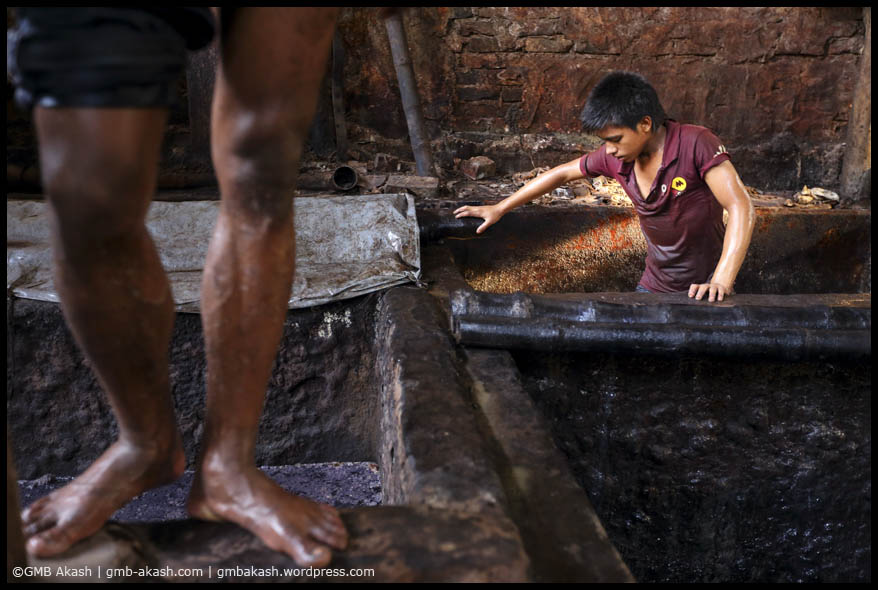
Every time I enter these deadly factories, I imagine that I am leaving the 20th century and have gone back 100 years in time. The ancient plan has neither fan nor any air circulation system. Thanks to those decades old broken bricks in the wall there ia a path for some fresh air. The leather hangs from the ceiling makes the air more toxic. The unstoppable giant drum keeps moving restlessly with raw leather pieces  and produces extreme laud noise. If fatigue overcomes labourer they fall asleep in the piles of raw leathers. Some labourers get a cigarette and take a break to see the sky outside. But the sky is dark and filled with smoke. The drain that is passing by is full of red chemical liquids that keep polluting the area and the mighty river Buriganga for 60 years now.

Tenary in Dhaka (54)_1


Leathers (15)

Leathers (20)

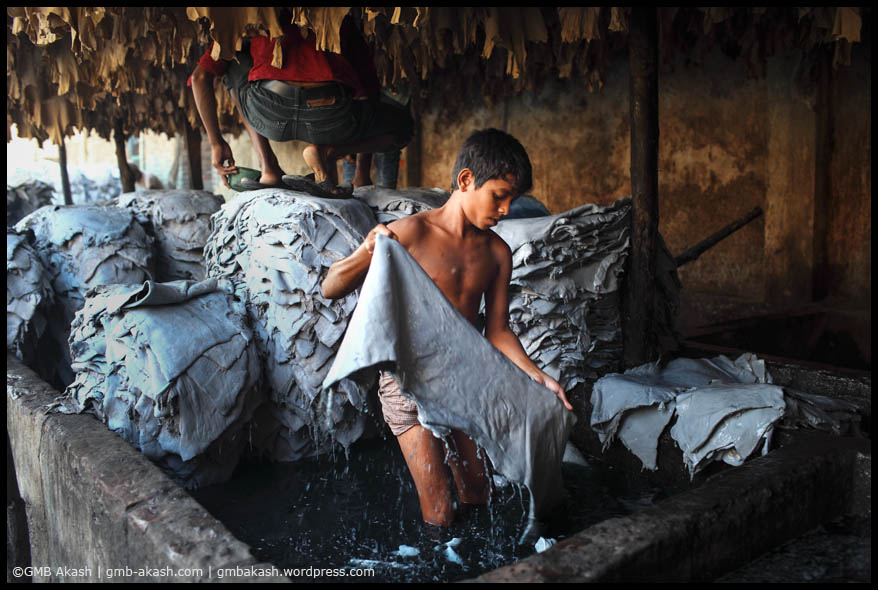
11-year old Rakib gives me the brightest smile and curiously asks, ‘What do you do with all these picture, sir?’ But he then rushes away before I can speak to him. Carrying uncountable leather pieces  in his shoulder he has no time for questions and answers. Rakib’s friend Monir (7-year old) keeps pinning up the leather at the yard. After the death of his father he got the job in his father’s factory. He had no idea what had happened to his father. He only knew he was suffering from an incurable disease. He feels good to work during the whole day and it is only in evening when his heart cry for playing.

Leathers (6)

Leathers (7)

Leathers (4)

Leathers (5)

Standing beside Monir I was trying hard to understand their miseries but laughter broke my concentration. I saw a group of workers cracking jokes outside and were laughing hilariously. Life goes on. These simple people risking their lives everyday in order to live the best they can. Society is not actually willing to know about their sufferings but they are nevertheless  willing to buy their processed leather which leather has a good worldwide reputation. However the savles of the toxicity and repugnant odors have no good reputation. In their way home to to their slums they cannot sit in any tea stall to relax. People shout on them for their repulsive odors which disturbs everyone. Only their produced goods get place inside a branded shop with a prestigious tag ‘Made in Bangladesh’. The makers only receive humiliation.

Tannery worker Omar Faruk sadly says, ‘If we travel by bus nobody will sit beside us. One day a man harshly said to me, ‘You must come from hell.’

Leathers (8)

Tenary in Dhaka (13)_1

Leathers (23)

Leathers (9)

(Almost all of Bangladesh’s 200-plus tanneries are concentrated in Hazaribagh, a densely populated, filthy neighborhood on the banks of the Buriganga River in southwestern Dhaka. You can smell them long before you can see them: an unbearable stench like bad eggs, rotting fish and harsh ammonia. It’s almost impossible to walk through the tanneries without a scarf pressed to your nose. At almost $1 billion a year in sales, the leather industry is one of Bangladesh’s most profitable sectors. The lives of more than 20,000 tannery workers are still at risk. After 60 years of tannery operations, no one knows what content of toxins have been poured into the river, only that it is incalculable and staggering. Chromium sulfate, lead, organohalogens, lime, hydrogen sulfide, sulfuric acid, formic acid, bleach, dyes and oils all flow into the river)


“Survivors” Part I

blog (01)

blog (3)

blog (5)

“It seems like a lost world, where standing in a quivering dark, where there is nothing but darkness, a place where you stand alone and shiver in fear. I experienced the same. Children who are inhaling pains within themselves every second make me feel small, their sweating smile flashes their innocent identity, touches of their dirt-oily little fingers interpret their presence in my life, their spoken or unspoken life stories makes me unrest. Since then, I am upholding them inside of me. A simple and small photograph’s emotions might inconceivable to you if still now you do not know any of such children who straggle each day to make a living from nothing. Till the day, I know I had to do and I have to do my bit, may be it could be major, may be it could be minor but that was the day, I open the door of my heart and take them in. I vow to fulfill their lost smile by refilling it in their innocent lips. The creation I am crafting in 10 years never give me such feeling , but then first I felt the tender of giving birth of the creation by dedicating it to the angles of hell, at least my first endeavor to bring them up from the darkest hell.   I celebrate my rebirth by expanding my arms, placing as more children as I can and thus my voyage begins.”- GMB AKASH
blog (21)

IMG_4359 (3)

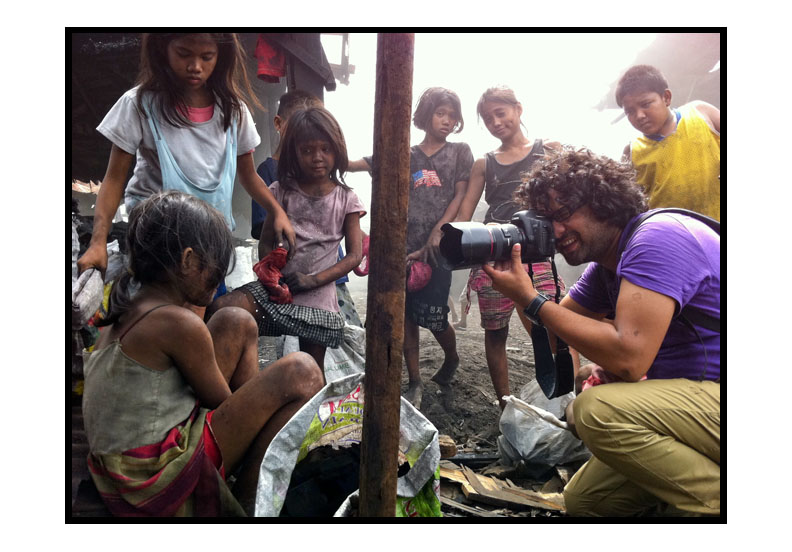
I cannot remain mute about the oppression that divides human beings — which is one of the reasons I commenced photography and it’s been 14 years I am doing.  And it is my duty as a photographer and artist to point with my pictures at every aspect of existence in the society and world I live in, to show what can be shown, to go deep into every milieu and also into every aspect of poverty, deprivation and hardship that I encounter – because the only sin for a photographer is to turn his head and look away. After 14 years, acquiring tons of awards and gaining access to all major media frankly I experience NO CHANGE in the life of people I photographed.

Despite knowing a photographer duty only tilted for showing and investigating reality but this simple rule does not bring peace to my heart. Once an 8-year old balloon maker told me, “I took some damaged balloons for my little sister; I have no time to play. I have only time to support my parents,” I realized at that point I should turn my lens on lives like them.
IMG_0408-1

IMG_0739

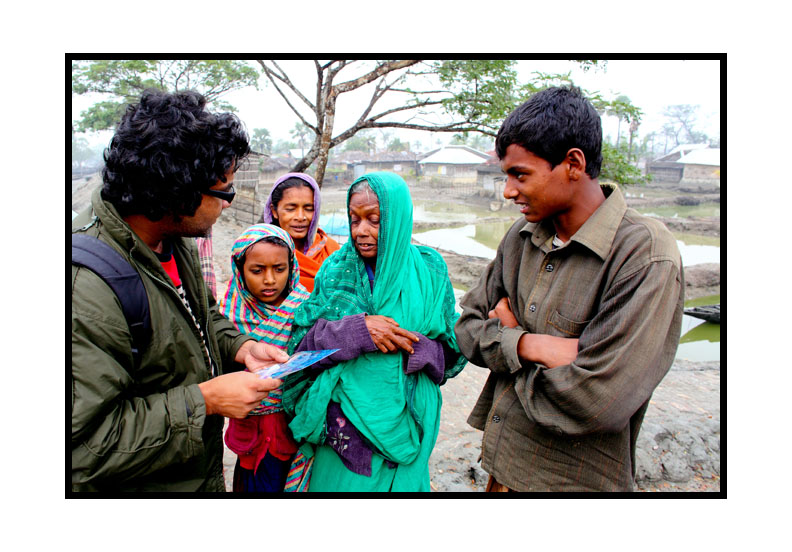
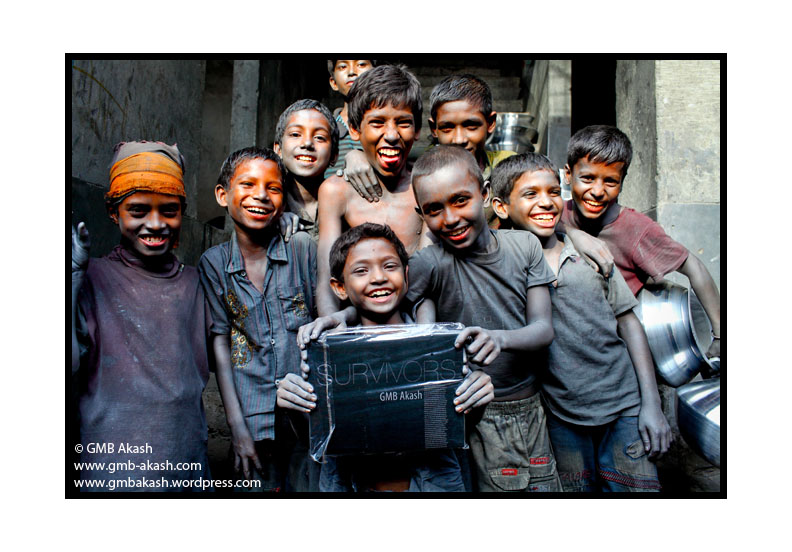
I decided to dedicate whatever fund I left after make a living of mine to give to these ‘Survivors’. First I decide, I will gift them opportunity which will come from my personal earnings, portion of print sells or selling portion from my book ‘Survivors’. In the industry I am a straggler yet my pursuits provoke me to make my first experiment before I publish my book ‘Survivors’. I started searching faces inside the book and outside the book, which I photographed and found in vulnerable situation. One year I compromise my time, my photography, my assignment and my daily life to search these faces, I started living with them, understanding them and keep finding what I can do to make them able to earn a better life together. My idea is, working with them within the circumstances, gifting them the opportunity which will come as advantage in their life, advocate them as an assistant, monitoring their changes in life in one word to do everything that I will do to change my fate if I were them. Searching a face which I shoot 10 years ago is not an easy job, a face can be invisible in a crowd but I am fortunate to find many of them and building trust on me. 10 successful families consisting of ave 60 members make my dream come true. I ensure their life better, much better than they were living. & this gives me faith to publish my book ‘Survivors’ which is and will be the source of finance and gifting business/opportunity/education/chance to these ‘Survivors’ whom I photographed past 10 years. It was the day when I finally face my eyes to these children and touches their hand knowing I can at least rescue few of them from their daily hell. I become one of them, I become their hope, I become their asset and thus I started valuing myself and understand the significance and purpose of my rebirth.
IMG_1492-1

survivors (7)-15

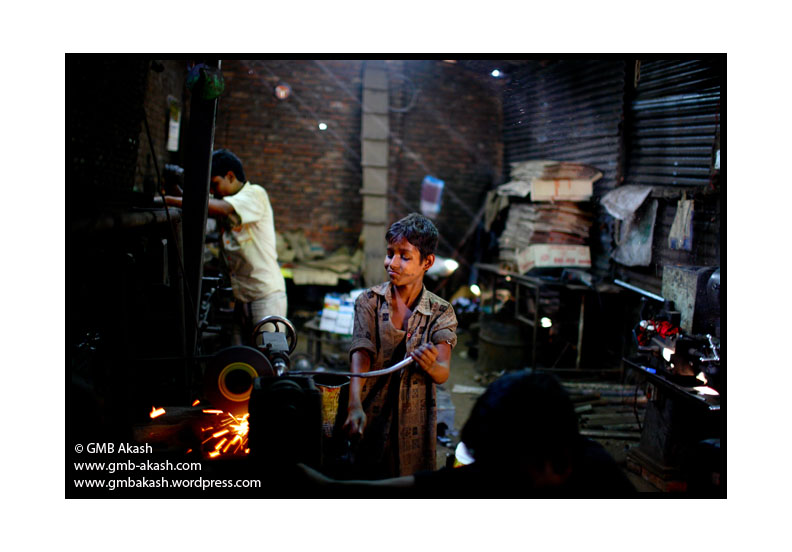
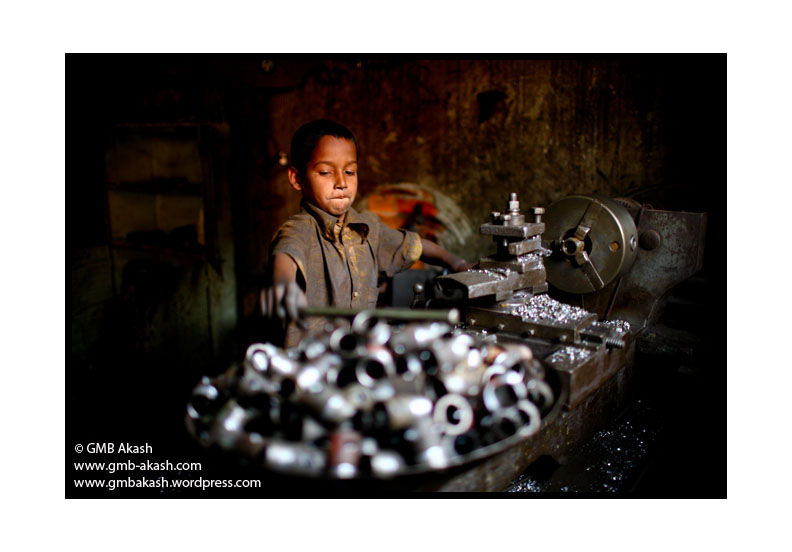
It was just one year ago when I again found out Munna, whom I photographed at 2006. ‘Integrity with innocence’ this is the concrete of Munna’s character portrayal. Five years ago I first met Munna. Five years have passed fates of Munna & his father brings no change in their lives. At 2011, only difference was, with his five years experience Munna was getting 1600 taka ($1=72taka) per month. Moreover 12 years old Munna was running his younger sister education with his extra income of Friday overtime.
blog (17)

blog (13)

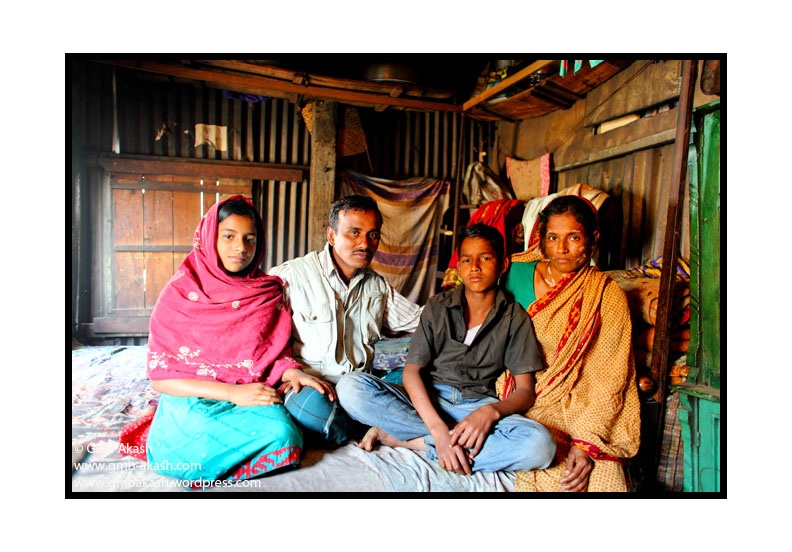
Munna’s father Alamgir was a cobber. Their family is consisting of five members who receive continuous negligence from their community as he works as cobber. Munna & his sister ashamed to say that his father is cobber and his little income cannot give education to his younger daughter Shathi and hunger forced Alamgir to send his little son to the factory which produces rickshaw particles. Alamgir elder daughter has to get married at early age because of poverty. They managed to eat hand to mouth, but without depending on Munna’s income their foods cannot be assured. Munna’s younger sister appeared to her class one final exam by borrowing pencils from neighbors, she had nothing without will for education. Munna works in a factory which produces intolerable noise during work. His 9am-7pm works ruined his childhood. His overtime income never allowed him to play. In fact he lost his interest for playing. A shy, unspoken boy whose whole body was covered with dust and permanent scratch on skins dull his brightness in an extent that he seems belong to the darken factory.  During working with him in his work time, I never saw his smile. He had no ambition, no dream and surprisingly had nothing to share with anyone.
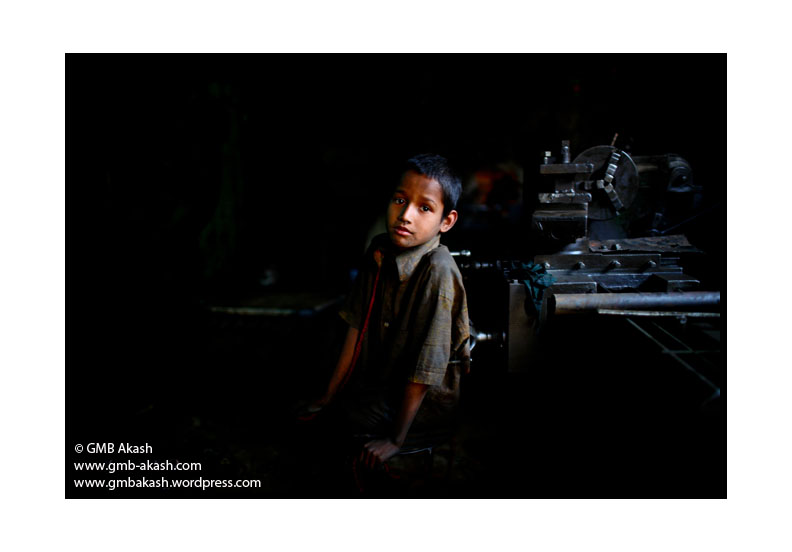
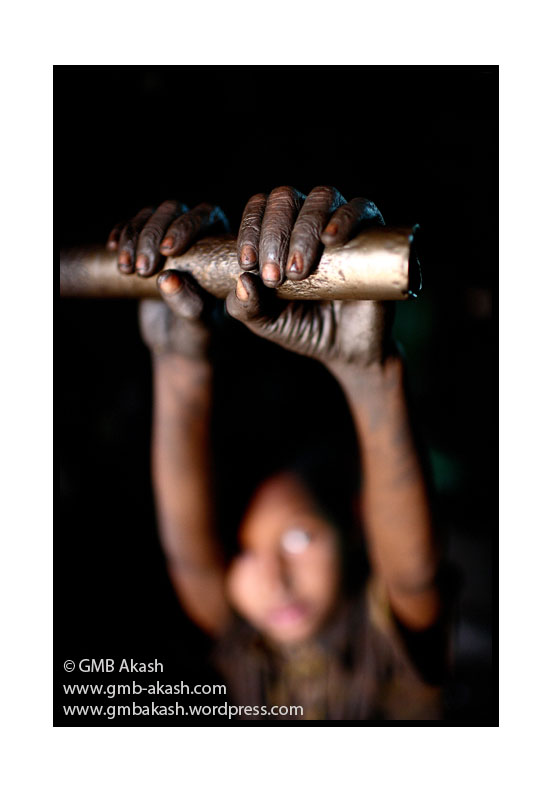
blog (16)

blog (12)

I aim to help Munna & his family. & my journey with them begins.

After seating several sessions with Munna’s family, we come to a decision that Munna’s father is the person who can be the financial in-charge of the full family and setting him in a business that he is capable to do will be helpful for the full family. After our market survey, by understanding the business chains he decided and I agreed with him to let him do business of cucumber. My logic is not to give money at their hand. I went with him and prepare everything; in short I assist him in every way to do the business. After one month of successful business Alamgir take out Munna from the factory. Their family started having three times food and able to provide rent of the house in proper time. He manages to make his capital triple in three months.
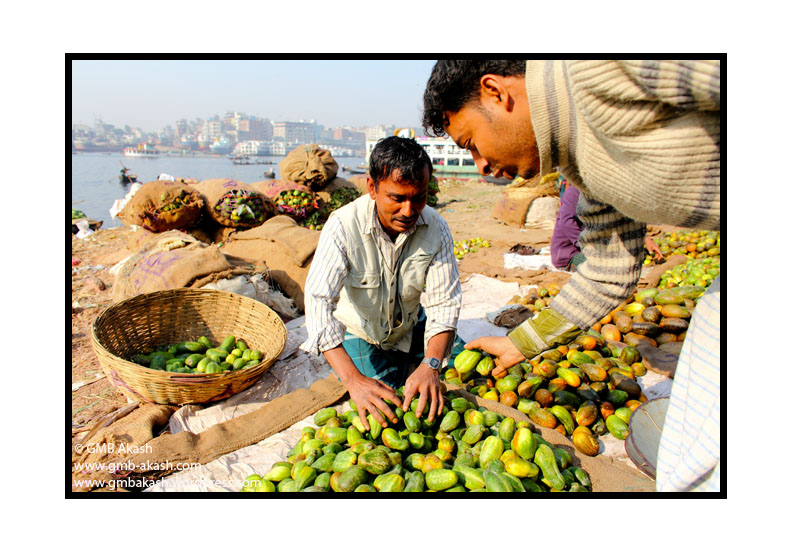
blog (11)

blog (10)

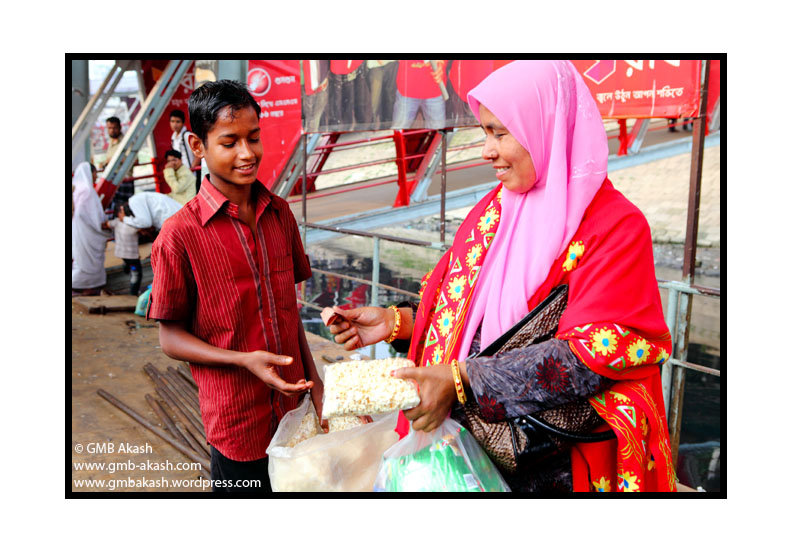
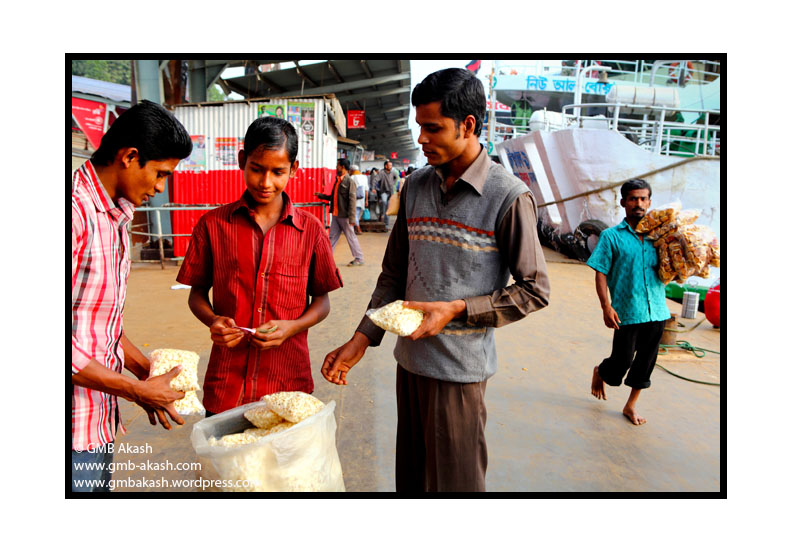
Munna’s younger sister running her school and did top in result. She will be in class four next year. Munna’s only one dream is to support his sister in education and fulfilling his family’s loans which are liabilities of their bad time. Still he wants to support his father by at least doing something. Within two months Alamgir tried to admit Munna at school but Munna told him in his spare time he will go to night school to get same age students like him and at day time he wants to do something he likes. As well Alamgir was afraid as they are living in slum and children who have nothing to do mostly get mixed with people who supplies drugs/engage in bad works. Again after seating with them, Munna expressed to me he wants to do popcorn business and he wants to establish himself independently. I realized I cannot take out him from the situation; I have to assist them to get a better life in their present situation. So I agreed with him and go to see first what will be his changes in life if he sells popcorn near his home at sadarghat.
blog (6)

blog (9)

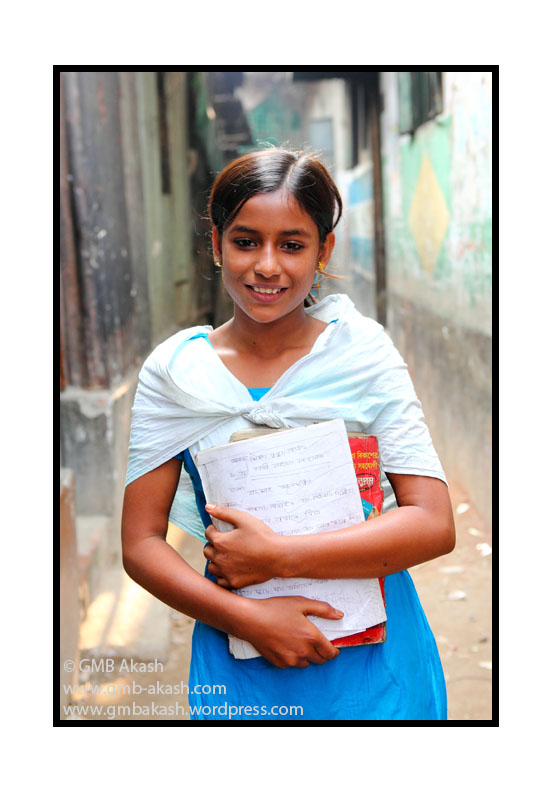
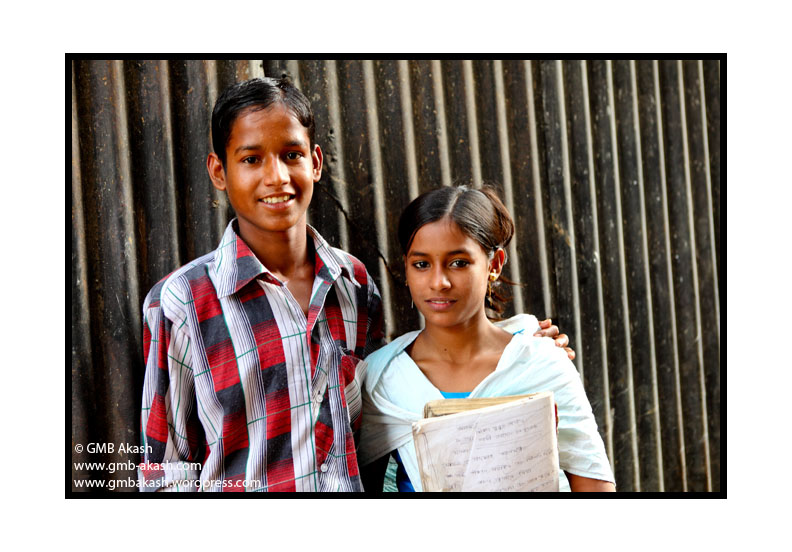
Now every day, Munna willingly wake up early morning after brushing his teeth he seats with his sister to learn from her. Then he goes to ghat and buys popcorn from vendor later he sells popcorn till afternoon in ghat and finishing his work at 1pm he came at home. Now within months his appearance has changes a lot, his face, hands, and legs, fingers scars are recovering and mostly vanishes. The best thing is that now he laughs, he is making friends in evening field, he is proud that he is doing his own selling and helping his family beside education. Munna who lost most of his childhood in blocked, dull factory now loves to spend time with people by selling popcorn. He becomes vocal and ambitious. He keeps savings from his selling profit of popcorn. Munna’s sister Sathi dreams to become doctor. With the income of Munna’s father and Munna they are happily dreaming for their future.
blog (15)

blog (7)

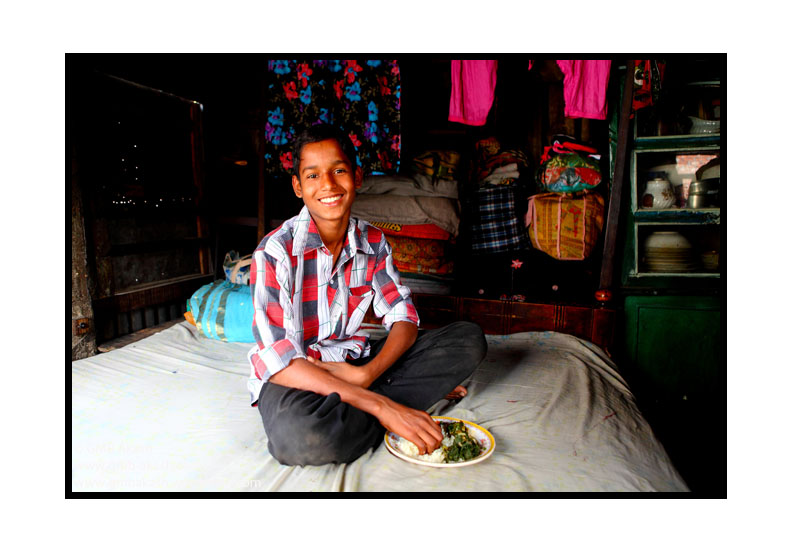
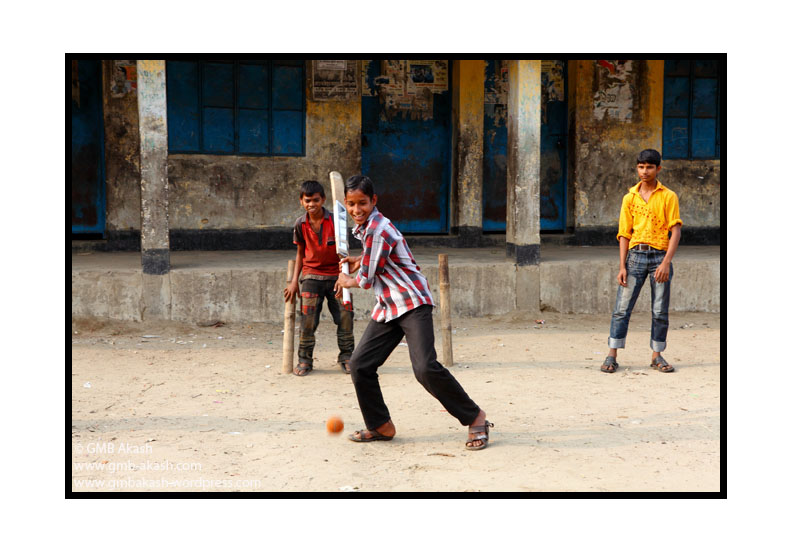
Every evening Munna plays cricket with friends. Within Nine months Munna is recovering his forgotten happiness. His few hours works, playtime, quality family time and private education changes his life visibly. A family who hardly once managed one time food now can ensure nutritious foods for their children. A pessimistic Munna is now very much optimistic about his life and future. His family is earning happiness by putting out of their mind about their past bad days. I dream to get hundreds of Munna in my journey and to refill their lost smile. I am happy that at least there are many munnas with me and I am able to make them a part of my life. I will share these stories of my life with you one by one. It’s my belief that if a single hand comes to hold a child miracle in their life can happen.
blog (8)

blog (14)

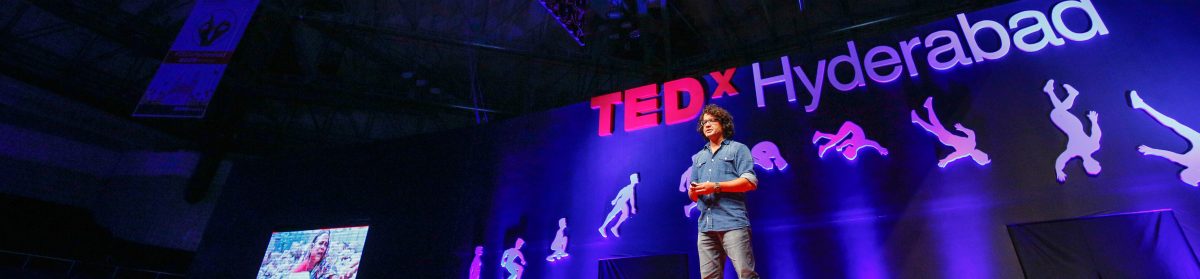
“I am a story teller, nothing but I steal emotions, this link me to those lives which wrapped me in sentiment. I am a simple human being; I do mistake and learn from it. But I like to do experiment and I hate to be defeated. I try and keep trying until I achieve. I will keep contributing magic in lives I face with my camera. I will do my part, I will do my bit. A quote from Helen Keller inspires my journey.

“I am only one, but still I am one. I cannot do everything, but still I can do something; and because I cannot do everything, I will not refuse to do something that I can do.”

If your heart is moved to do something do not make it complex, plan it, do it & do it right now. Stop dreaming in expectation of Superman. Within you there is a vast chance of opportunity spread your wings & bring humanity.” – GMB AKASH
blog (20)

Angel in Hell – Part II

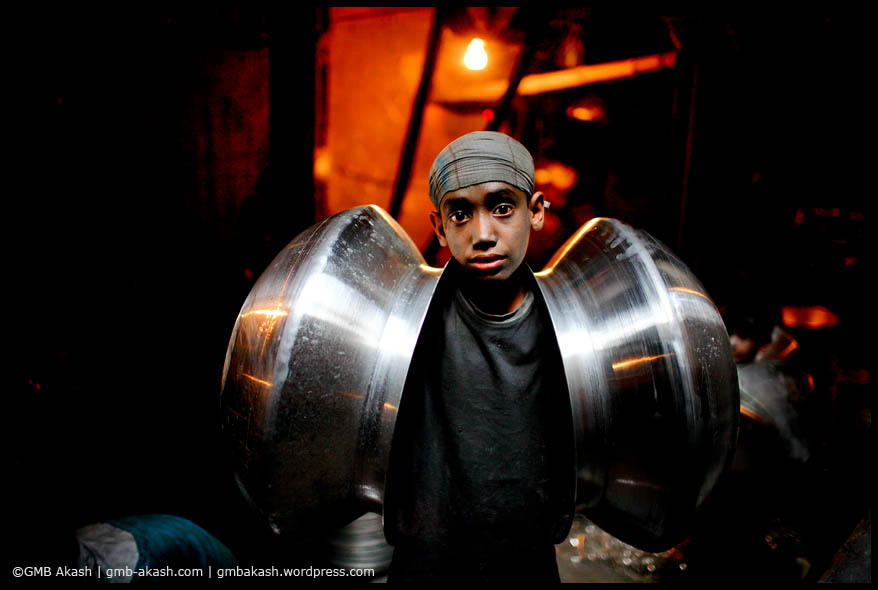
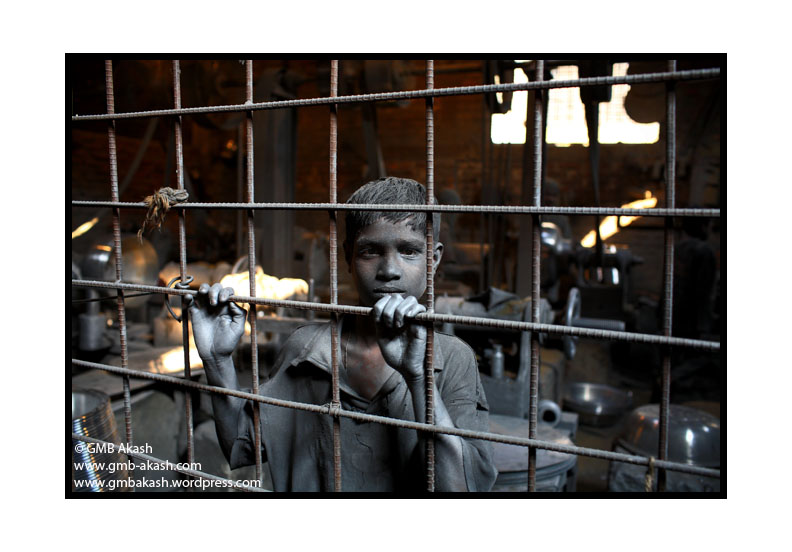
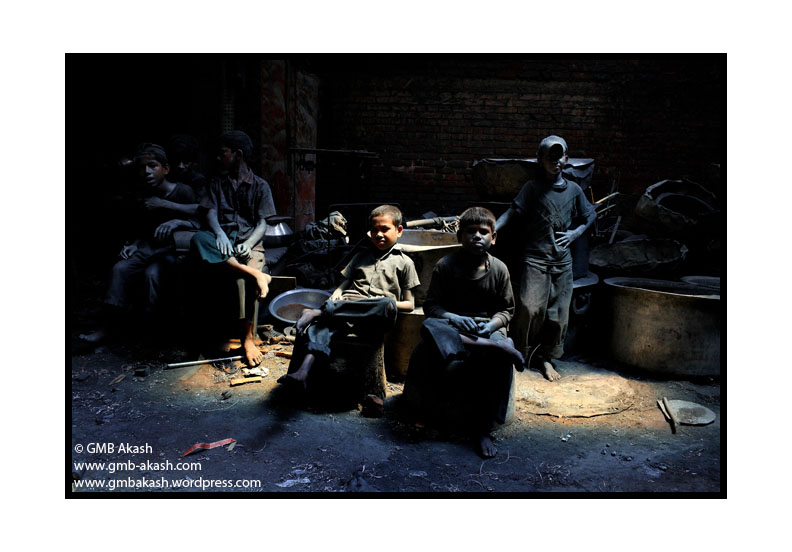
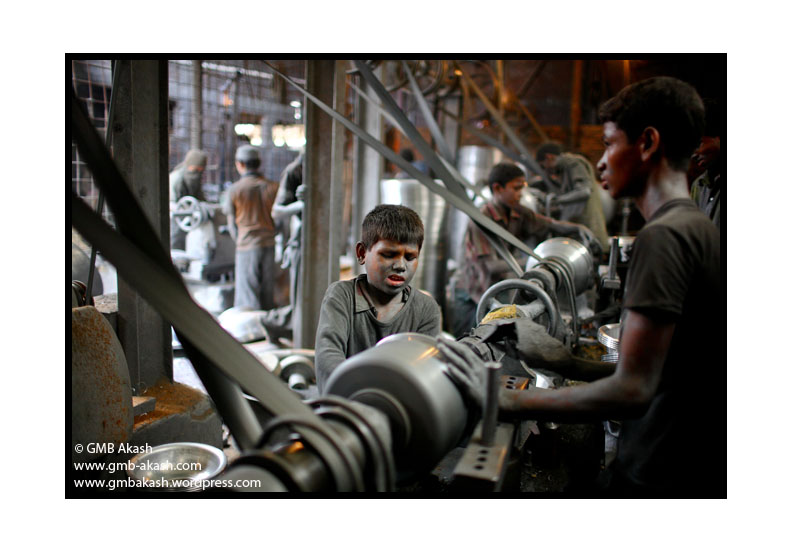
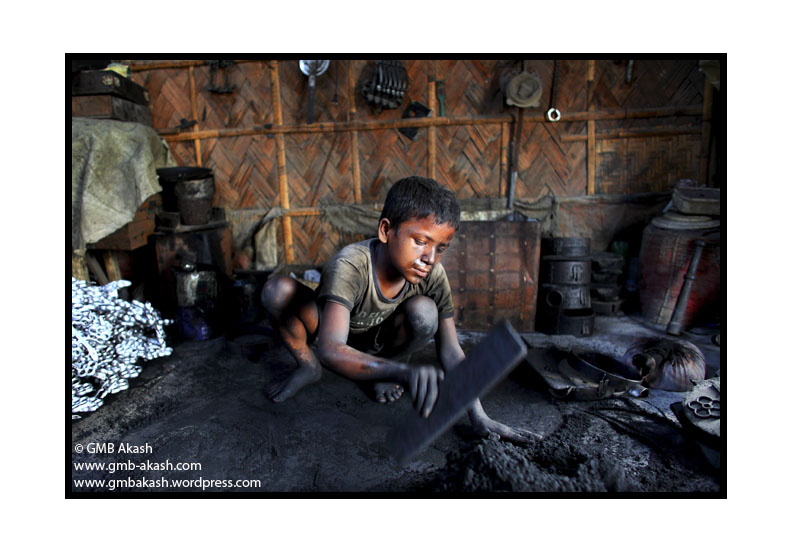
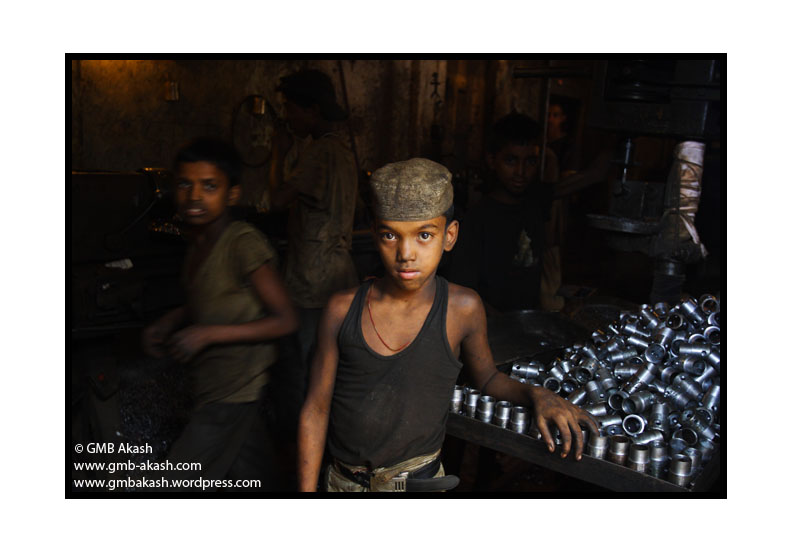
“Welcome you again in another season of Hell. Down in these dumps the name called childhood get matured for a few at the age of five. Their silent cry echoes from wall to wall of every hell which is considered as blessed place for them to earn bread.  Their compact workstation, fiery factories or even the dusty brick lands are the place where they brought up independently” – GMB AKASH

child labour (3)

child labour (2)

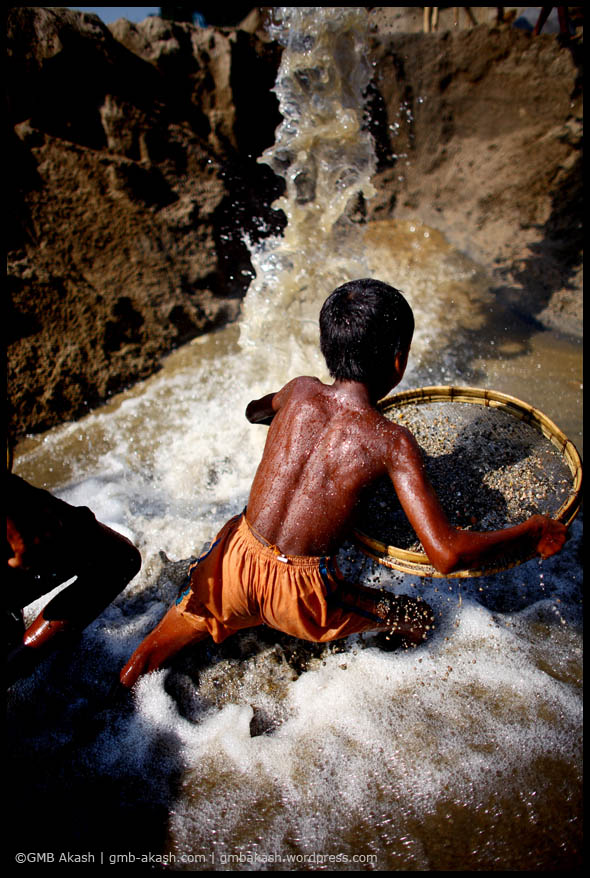
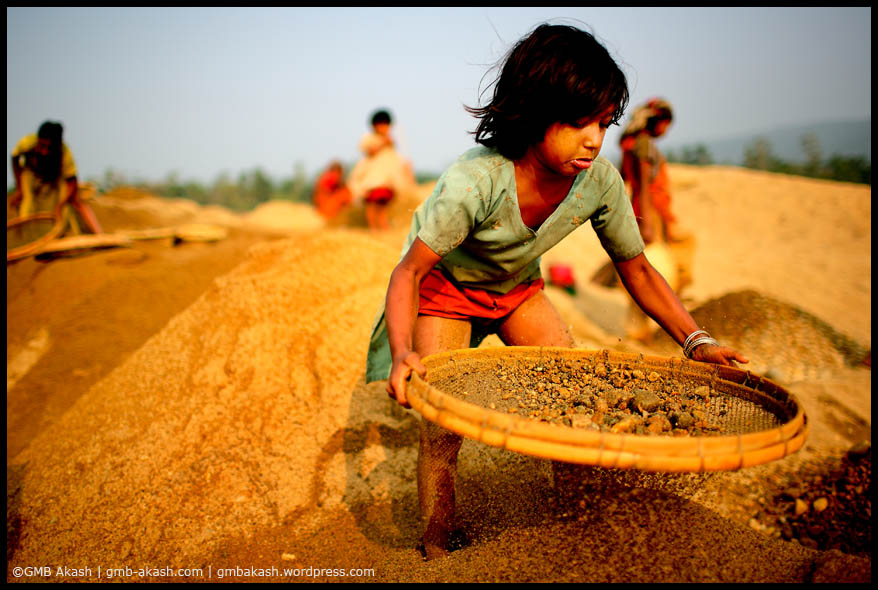
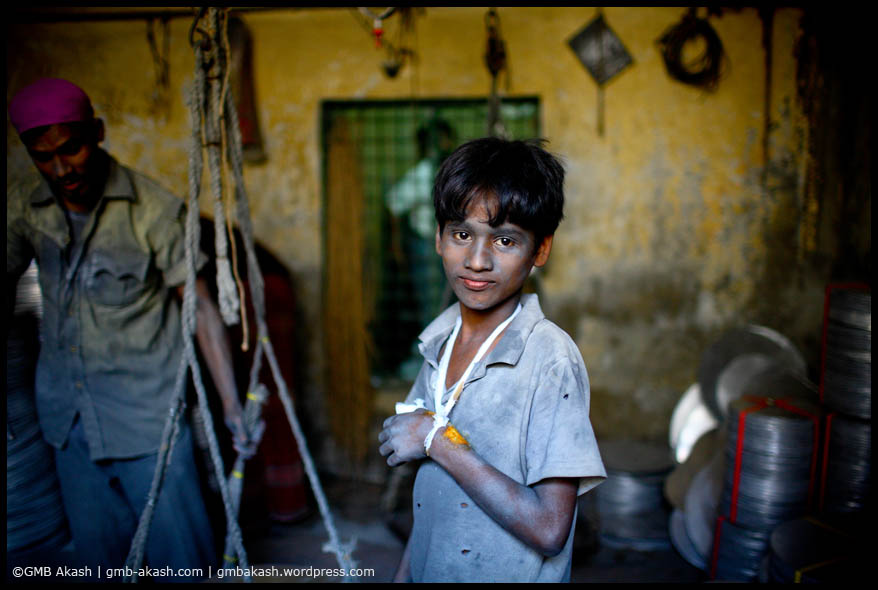
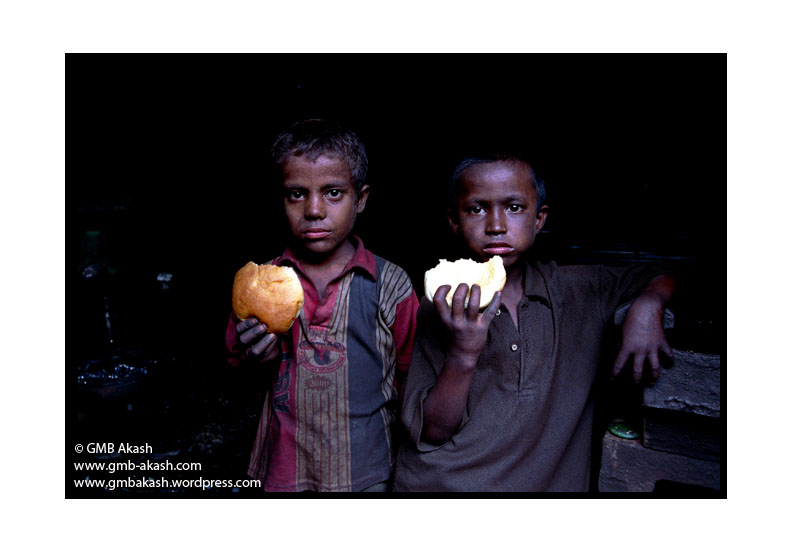
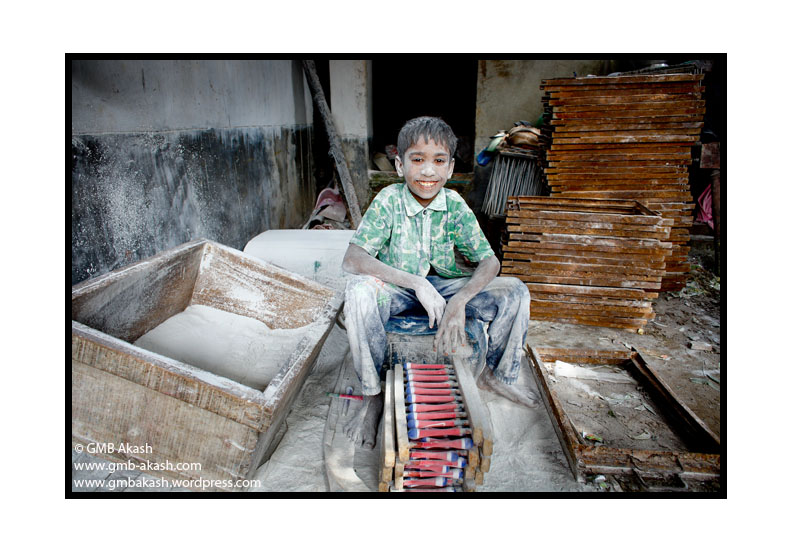
Telling about the working environment of these children is a heart breaking job. Factory machines usually produce an intolerable degree of echo in the working place of these children. For adding more strain on them excessive heat works as miserable factor. Textile factory workers start their day at 8am and finishes at 8pm. During these working hours they managed to heal the pain of sound and heat by earning 1200 tk per month($1=83tk). In the brick field scenarios are not different. In brick fields every day work starts at 6 am, carring head-loads of eight bricks from the furnace to the supply pile. Each trip back and forth is allotted a little over a minute. For a twelve-hour workday for each 1,000 bricks child at a brick factory in carry, they earn 80 tk (<$1) after meeting expenses. Other hand, on the construction sites, children must sweat and slog through the intense heat of the sun, working long hours for scant reward. Moreover same obscurity and hardship in balloon factory, rickshaw factory, tannery, dump yards, motor parts factory, mirror making factory, coal and cigarettes factory. There is no such a single risky job where a child labour cannot be found.  For many of them Jeans paint with a torn shirt is their everyday wear.  And banana with bread is delicious meal.

child labour (18)

child labour (1)

They are sincerely doing their job because of their family either to support them or for their helplessness. I admit human power is the incredible above all. Their spirit overcomes all difficulties to feed them and their family by any hardship.

child labour (4)

child labour (19)


Factory owners straightly said, ‘If we do not employ these children they will be one of the street-addict children. Can you give them three times food, education and a home? Few of these children are helping their mother to survive. Few of them are helping educating of their younger. We are assisting them at least to survive in life with this working training.’  This is the most common answer I received from the majority of factory owner who assigned children to their factory. 

child labour (12)

child labour (9)

Children can be a source of income, this insane thought still practicing among many part of the lower class group which leads them to give birth more children. Many families are dependent fully on the income of their 5-12 age children. But for many the stories are different.

child labour (7)

child labour (11)

I come to know these heart touching stories which are worthy to share. Many children are running their sisters education on their own income, many children efficiently managing three times food for their sick parents and many children still manages to spend one hour to study in night school. Many children touched me by saying they dream to have a factory with their savings! Even with this limited income! They are soulful and they have dignity which we should not let die. So I realize family is the root by which there must be a way to improve at least few of these children’s life. Helplessness of a family forces their children to work in a hazardous condition.

child labour (8)

child labour (5)

child labour (4)


“Escaping from a situation where 7.4 million children are standing to you for a solution is pretty shivering. I believe it’s a sin for me as a human and as a photographer to turn my head and look away.  I attach my life with them and thus the story starts” – GMB AKASH
To be continue…

child labour (14)

child labour (17)

child labour (16)