Train Track Life

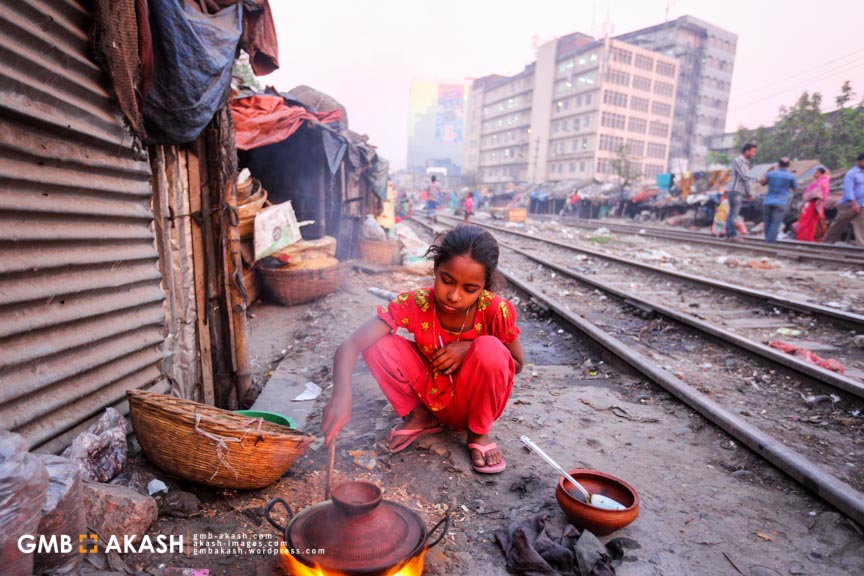
Suddenly the inter-city train appears rushing at them on the tracks with its deadly noise which is the only thing that alerts the people. The scene includes a train that seems to be traveling as if to arrive at the slum but then ruthlessly goes right through it. It watches and touches both sides of the slum’s tin-roofs. Who could have ignored such g-o-t-a-n-g, g-o-t-a-n-g sound that raises heartbeats of the inhabitants of the Karwan Bazaar train track Slum in Dhaka on a daily basis… at least fifty times a day?

slum (6)

slum (16)

People speculate that this train track-side slum had been built after the Liberation War of 1971. Though the slum does not seem too old, several inhabitants say that they have been living recklessly here for more than thirty years. Moreover, on both sides of the curvy train tracks that are lined with 1’000s of shanties, more than a hundred huts have been built in more recent times. Some of the smallest huts with only three foot high roofs rent for as much as 2000 taka (About $25). Those houses that are newly built with heights for standing-up cost 3000 taka (About $39) for a month.

slum (38)

slum (43)

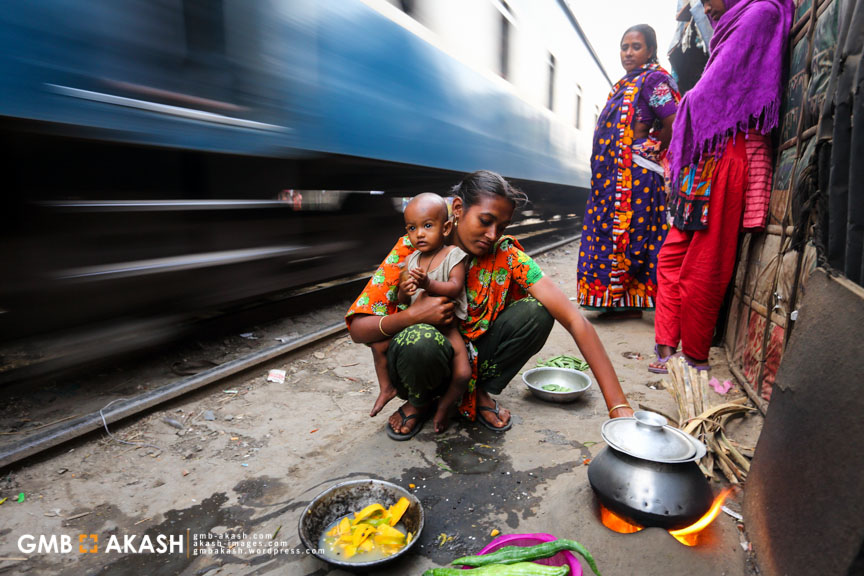
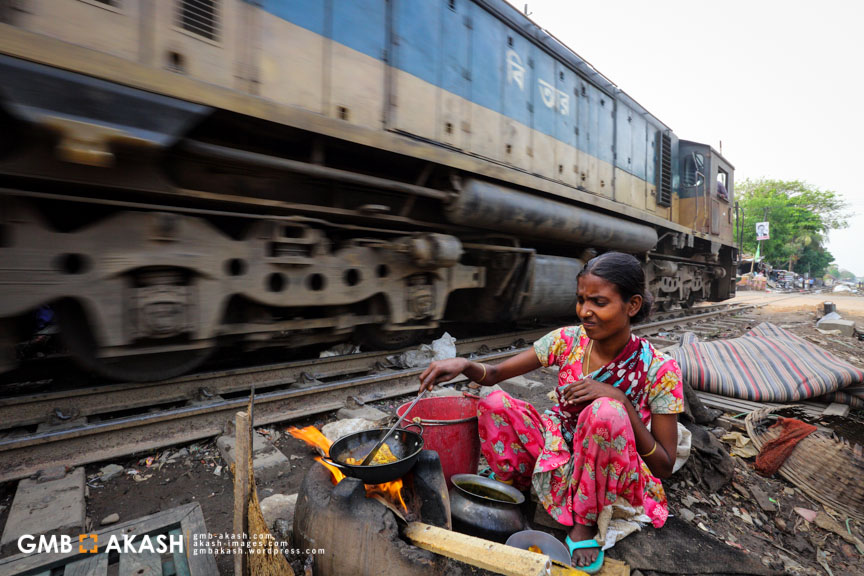
The muddy train tracks are loaded with wastage and leftover rotten vegetables. During an ordinary mid-day women are busy preparing lunch with difficulty trying to manage their mud clay oven cookers set up only one foot from the rail. When a train passes through anybody from the train could take away the potatoes that Marium Begum (35 years old) is frying in the pan. Marium says, ‘my eldest daughter is ten years old and I taught her how to save herself when the train rushes to our hut’. Marium clearly knows how much distance is safe for her two small kids. All children of the slum are well taught how to run away when a train arrives on the tracks. But a lot of times trains come simultaneously on both tracks and terrify the children. It happens many times from day to night without prior warning.
slum (14)

slum (27)

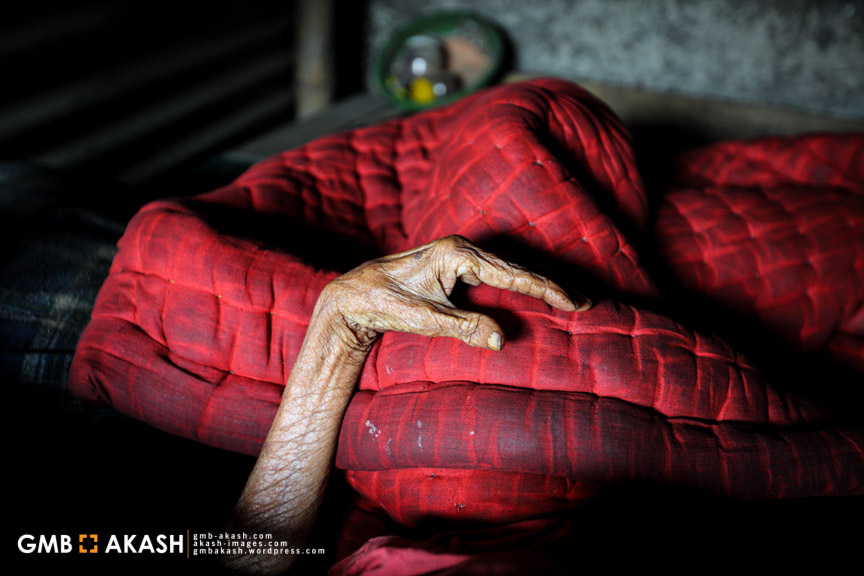
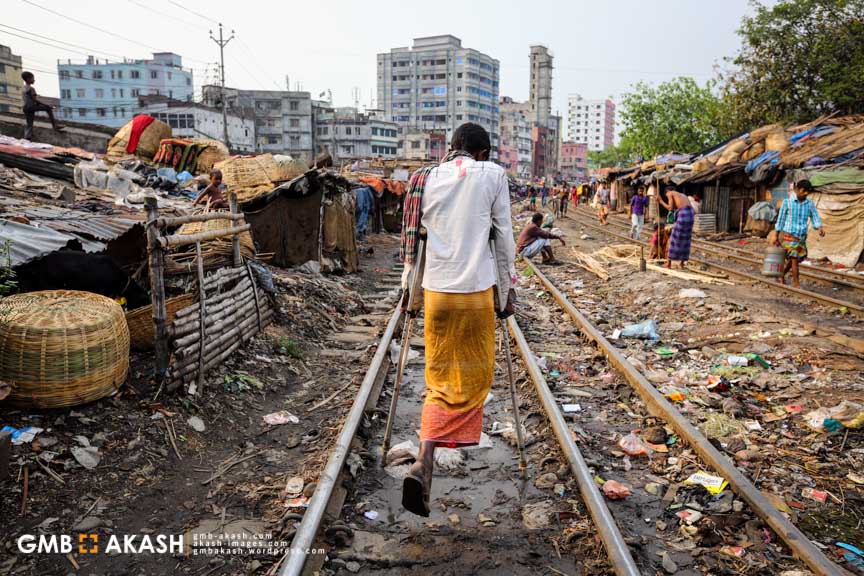
Accidents are common and dangers are unlimited. The banyan tree root that grows from the hut of Kahinur is losing its leaves because many passengers who are riding on the tops of the moving trains are picking off the leaves for fun. It also amuses the slum children who have little to do. In this impossibly tiny strip of living space a lot of children lose their legs, hands and fingers in train accidents that take place in front of their parents’ eyes.
slum (57)

slum (11)

Jaleha Kahtun says, ‘If we had something in which to live in the village, we would never come to live in this train track slum. In the village the river overflowed and took away everything and now here in the bazaar is everything we own.’ Jaleha Kahtun is a rotten vegetable seller in the bazaar. She has to go to work at 5:00 in the morning. So she lives in this slum that enables her to go to the bazaar as early as possible. All of the people who are living along the train tracks are climate migrants due to frequent flooding disasters in the country.

slum (18)

slum (68)

slum (56)

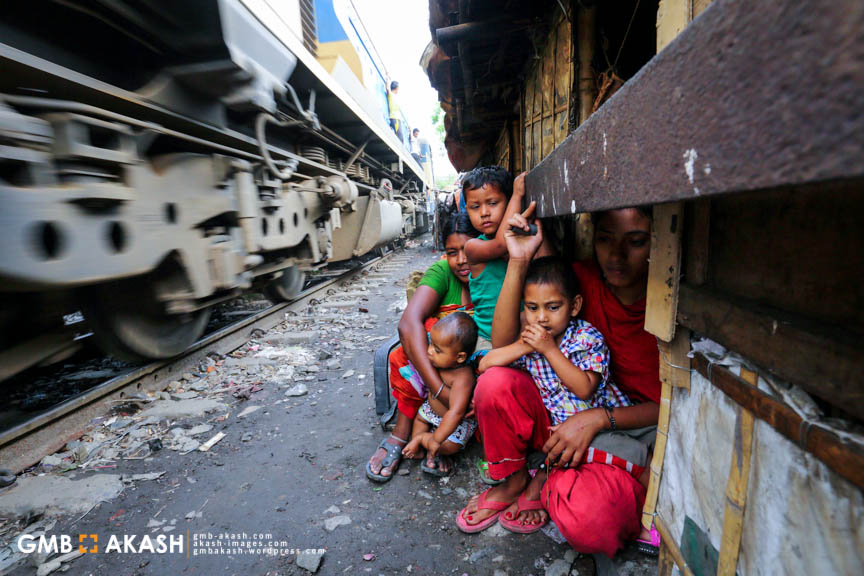
Nothing has changed in their lives since they left their villages, but now at least they can feed themselves better. Sriti (15 years old) who is sitting in the middle between the two rail lines says, ‘We now understand how to act when a train comes. If you were in my place you might die without knowing where to go after seeing a train three feet in front of you. It takes experience.’
slum (52)

When there are no trains all of the inhabitants are sitting on the train tracks, gossiping or arguing with each other. Children are playing here and there. To add some life to this atmosphere someone repeatedly turns on the music of popular Hindi songs. When Rasel (10 years old) starts dancing by waving his lungi and mimicking the song ‘Lungi dance’, Lungi dance,’ people near him also begin to move their bodies to the melody. But before Rashel shows his brilliant steps someone screams that the trains are coming on both sides of the rail lines. Nobody forgets to take their sitting arrangement away with them; children quickly move with their toys, a grandmother rapidly puts a pot over her vegetable curry to save it from the dust. Just like in a theater the trains get a stage upon which to perform for a few seconds and when they leave, all of the inhabitants return to their customary life on the tracks that have been occupied for more than 30 years.
slum (59)

‘Today’s Slavery’

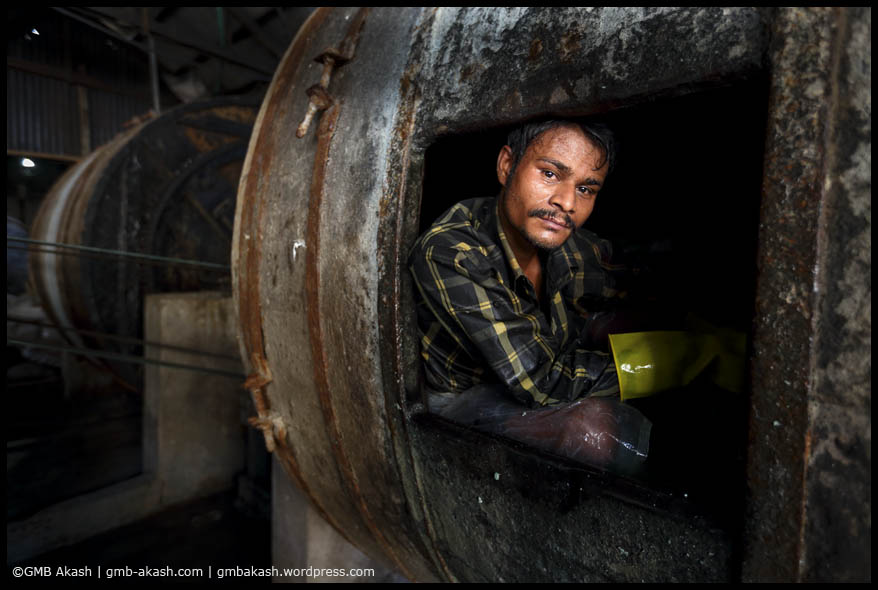
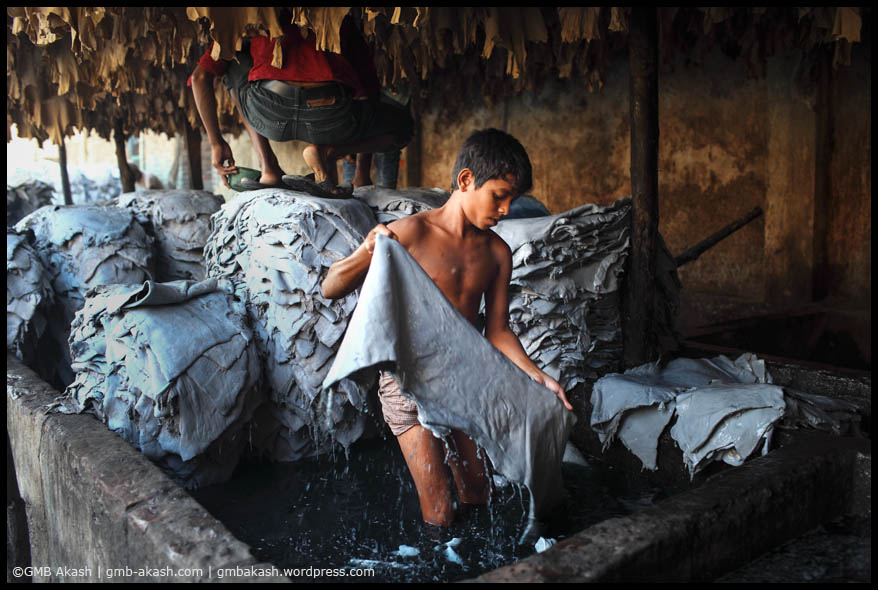
The sound of Monu’s footsteps compel us to look at him. It seems he is willingly trying to make the strange sound grab our attention towards his new gum boots. Before I speak to him, he shows all his teeth and enthusiastically says, ‘Bhaijan I bought them for 200 taka from the street. Bou (his wife) had washed them so well that I can see my face in them! Ha! Ha! Ha’

Before I compliment him something someone on my right side, Nibaron, who is Monu’s colleague of 15 years loudly said, ‘Hmm, does your new wife, still cry for you to drop the job, Monu?’ Monu recklessly replies, ‘Women are fools! She thinks tannery labourers die earlier. Allah is the one to decide. Women are crying party. Now I have these gum boots to protect me. She is happy and I am happy too!’

Monu got married to ‘Salma’ five months ago. Salma heard that tannery workers die at an early age, so she started requesting Monu to leave this dangerous job. But by doing this job for last 15 years, Monu, a 21 years-old man is surviving. He cannot imagine doing any other work than tannery nor is he capable of doing any other job.

The chronic cough he has or the rashes on his skin do not bother him anymore. Still he dreams of a better future with the 8000 taka salary. Now the dream is sweeter with his caring wife ‘Salma’.

Posing for the camera he said roughly, ‘By working in this hell, I am still alive. God might be giving me a long life bhai.’

Leathers (11)

Leathers (13)

Leathers (22)

Leathers (17)


I have been taking photographs in this factory for many years. I cannot find many of the faces I used to know. When I inquire about them the common response I hear is that because of illness they moved to their villages with their families.
The repulsive smell on my body or the sticky chemicals on my favorite jeans does not affect me anymore; Just like Monu. Only when I return from this work and the rickshaw puller turns his head several times and at last wisely says, ‘Sir, you came from tannery!’ Then I realize I am also polluting the air.


Leathers (1)

Leathers (24)

Leathers (2)

Tenary in Dhaka (123)_1

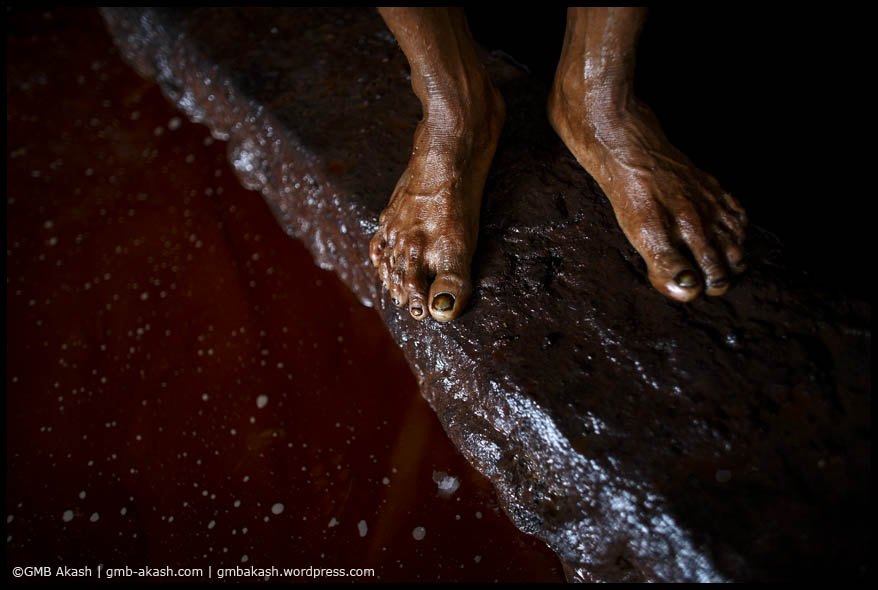
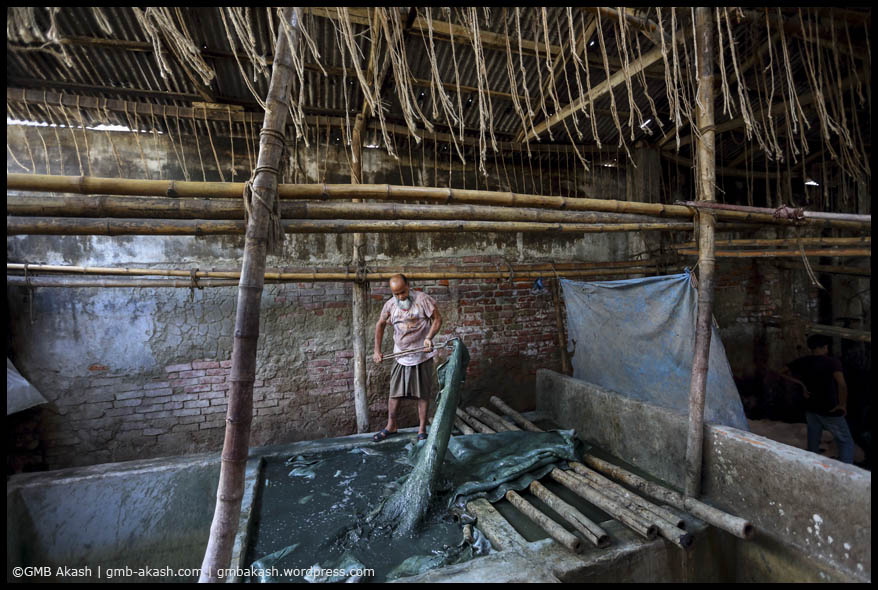
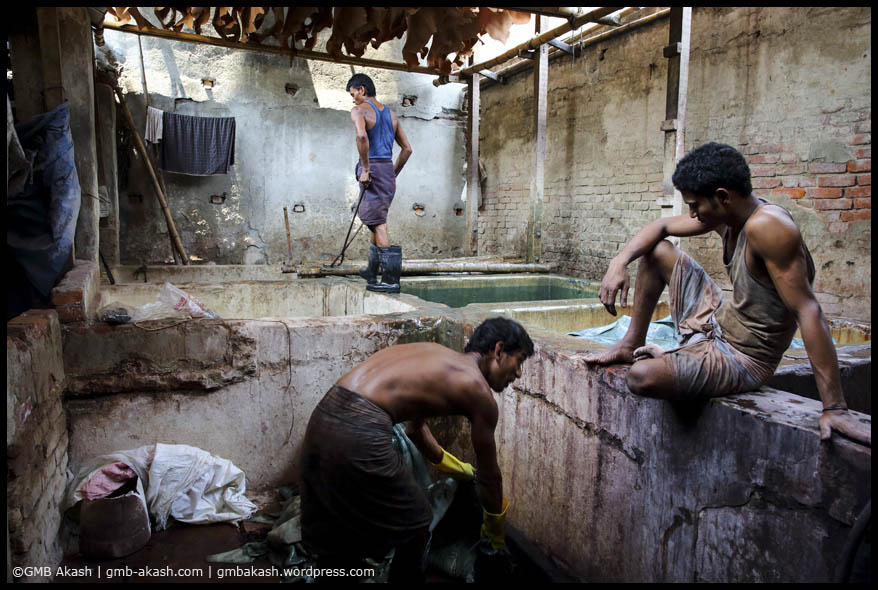
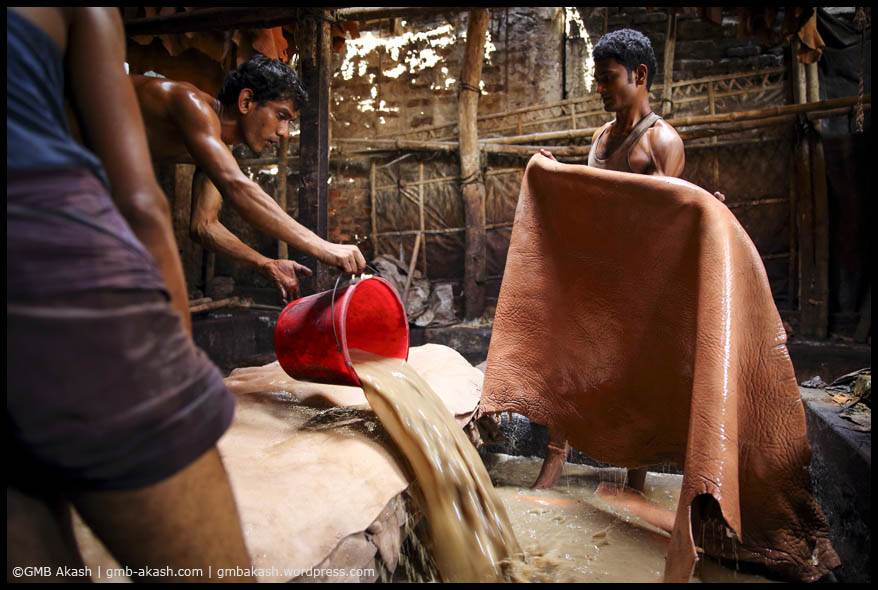
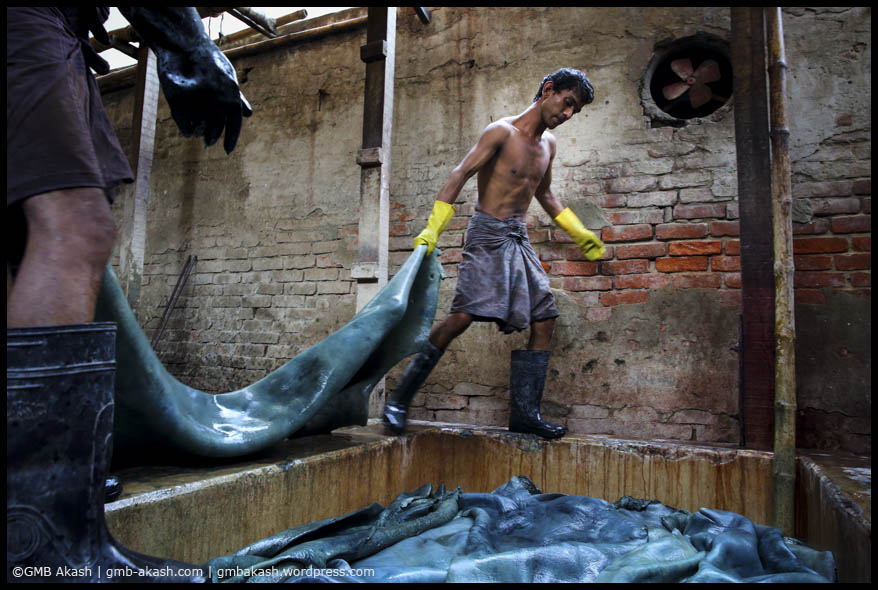
Like Monu many labourers believe that a pair of gum boots is their safe guard. Some of them tie gamsa (a traditional cotton towel) to save their lungi from the filth. But when they start working their sweat, factories chemicals, and raw leather shower them with poison and loathsome smells. A pair of gum boots and gamsa can not not save their hope to survive very long.

Leathers (16)Tenary in Dhaka (96)_1

Leathers (21)

Tenary in Dhaka (49)_1

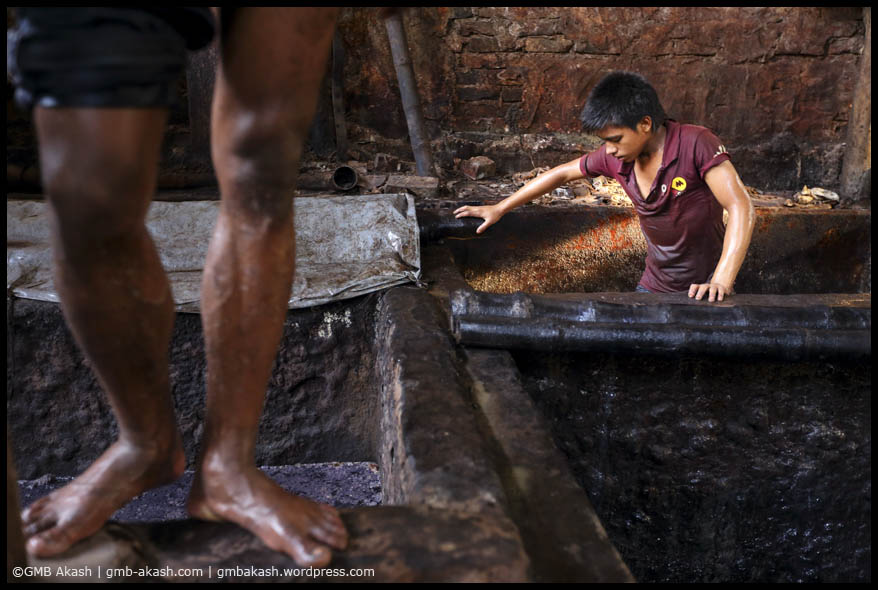
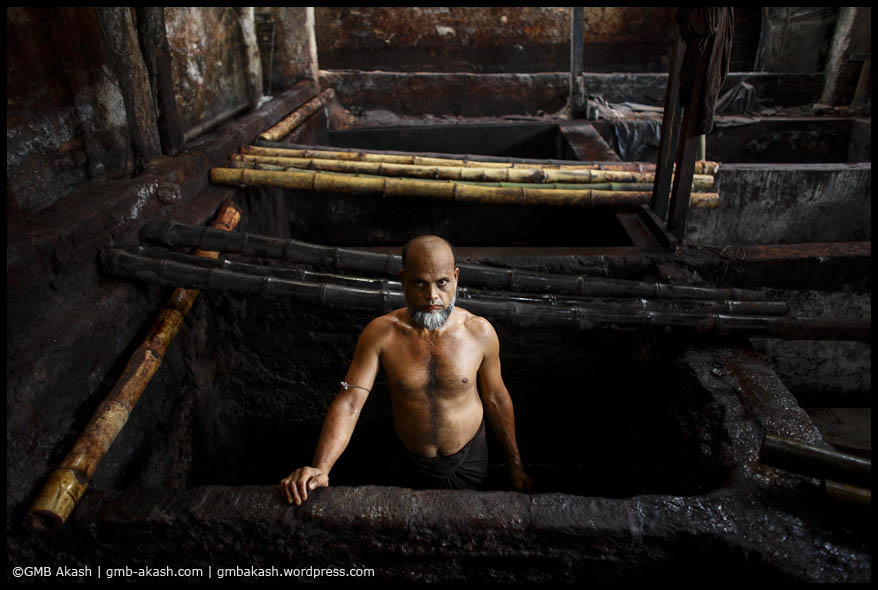
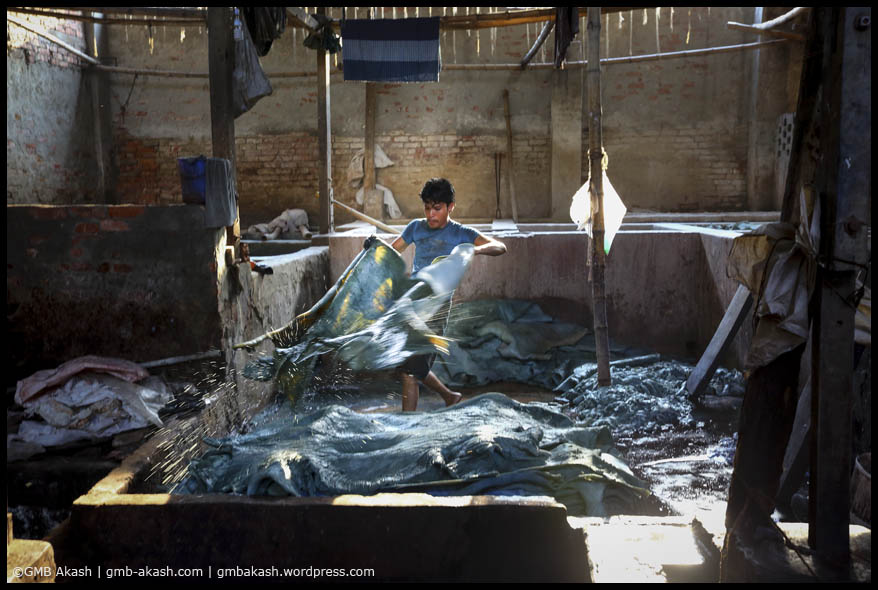
Every time I enter these deadly factories, I imagine that I am leaving the 20th century and have gone back 100 years in time. The ancient plan has neither fan nor any air circulation system. Thanks to those decades old broken bricks in the wall there ia a path for some fresh air. The leather hangs from the ceiling makes the air more toxic. The unstoppable giant drum keeps moving restlessly with raw leather pieces  and produces extreme laud noise. If fatigue overcomes labourer they fall asleep in the piles of raw leathers. Some labourers get a cigarette and take a break to see the sky outside. But the sky is dark and filled with smoke. The drain that is passing by is full of red chemical liquids that keep polluting the area and the mighty river Buriganga for 60 years now.

Tenary in Dhaka (54)_1


Leathers (15)

Leathers (20)

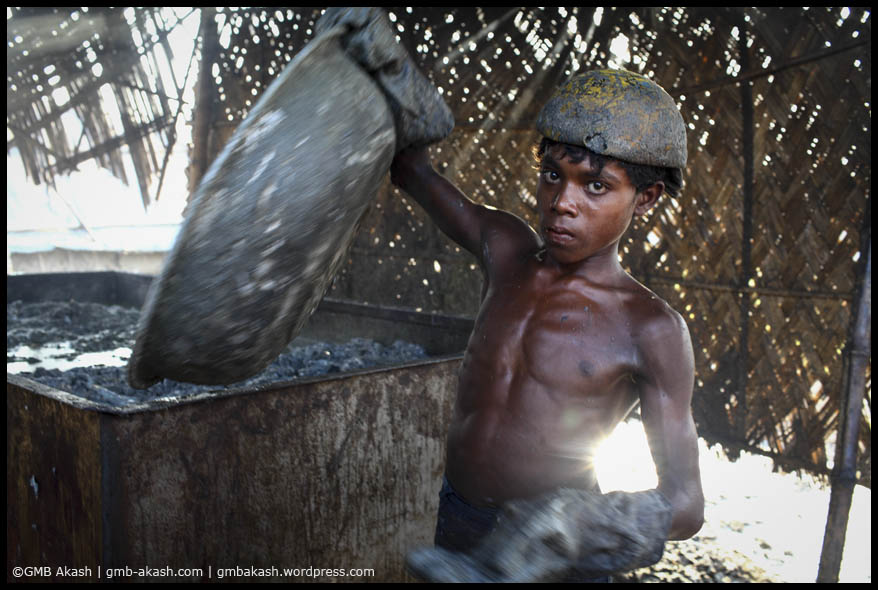
11-year old Rakib gives me the brightest smile and curiously asks, ‘What do you do with all these picture, sir?’ But he then rushes away before I can speak to him. Carrying uncountable leather pieces  in his shoulder he has no time for questions and answers. Rakib’s friend Monir (7-year old) keeps pinning up the leather at the yard. After the death of his father he got the job in his father’s factory. He had no idea what had happened to his father. He only knew he was suffering from an incurable disease. He feels good to work during the whole day and it is only in evening when his heart cry for playing.

Leathers (6)

Leathers (7)

Leathers (4)

Leathers (5)

Standing beside Monir I was trying hard to understand their miseries but laughter broke my concentration. I saw a group of workers cracking jokes outside and were laughing hilariously. Life goes on. These simple people risking their lives everyday in order to live the best they can. Society is not actually willing to know about their sufferings but they are nevertheless  willing to buy their processed leather which leather has a good worldwide reputation. However the savles of the toxicity and repugnant odors have no good reputation. In their way home to to their slums they cannot sit in any tea stall to relax. People shout on them for their repulsive odors which disturbs everyone. Only their produced goods get place inside a branded shop with a prestigious tag ‘Made in Bangladesh’. The makers only receive humiliation.

Tannery worker Omar Faruk sadly says, ‘If we travel by bus nobody will sit beside us. One day a man harshly said to me, ‘You must come from hell.’

Leathers (8)

Tenary in Dhaka (13)_1

Leathers (23)

Leathers (9)

(Almost all of Bangladesh’s 200-plus tanneries are concentrated in Hazaribagh, a densely populated, filthy neighborhood on the banks of the Buriganga River in southwestern Dhaka. You can smell them long before you can see them: an unbearable stench like bad eggs, rotting fish and harsh ammonia. It’s almost impossible to walk through the tanneries without a scarf pressed to your nose. At almost $1 billion a year in sales, the leather industry is one of Bangladesh’s most profitable sectors. The lives of more than 20,000 tannery workers are still at risk. After 60 years of tannery operations, no one knows what content of toxins have been poured into the river, only that it is incalculable and staggering. Chromium sulfate, lead, organohalogens, lime, hydrogen sulfide, sulfuric acid, formic acid, bleach, dyes and oils all flow into the river)


“Exhibition ‘Water’ By GAETANO PLASMATI & GMB AKASH”

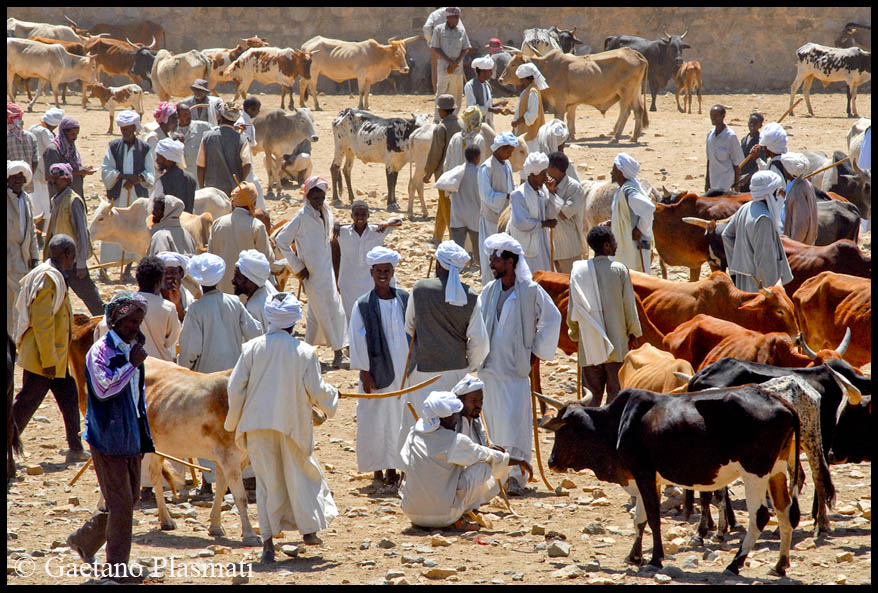
“This exhibition is a prism of callous realities and haunting metaphors of issues of climate change. Photographs of the exhibition will reveal the bare bones of climate disaster which causes human life to suffer for eternity. Either it is flood or desertification worst is these had severe effect on human life. Desertification is already causing changes in the social environment of certain areas of the African Sahel. Agriculture, livestock, and over-population have been the primary reasons that this previously stable dry-land ecosystem has been turning into desert. At the same time as these physical changes have been occurring, social destabilization and migration also have been, leading to food insecurity, disease outbreaks, and increasing levels of cultural extremism. more than 42 million people were displaced in Asia and the Pacific during 2010 and 2011. This figure includes those displaced by storms, floods, and heat and cold waves. Still others were displaced by drought and sea-level rise. Most of those compelled to leave their homes eventually returned when conditions improved, but an undetermined number became migrants, usually within their country, but also across national borders”

gaetano (1)

water from akash (27)

Gaetano Plasmati:

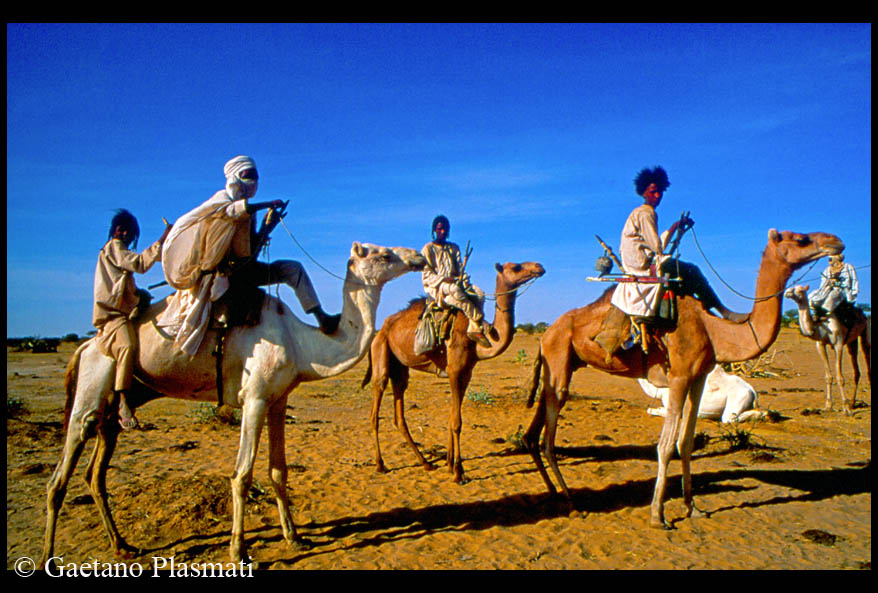
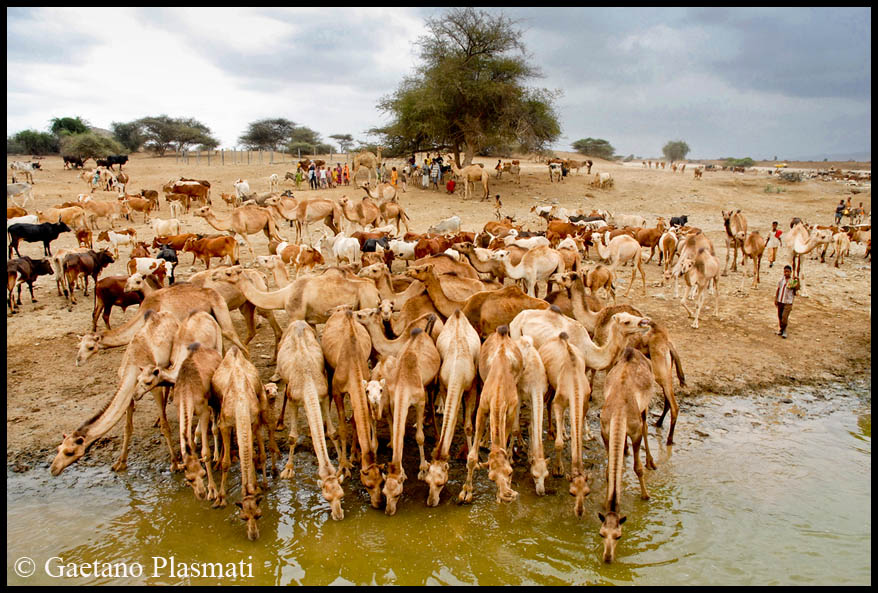
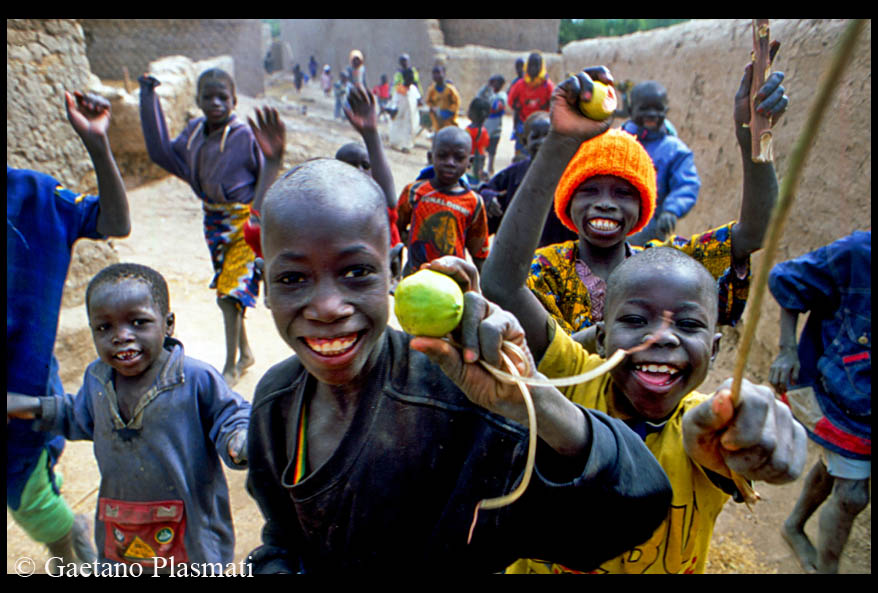
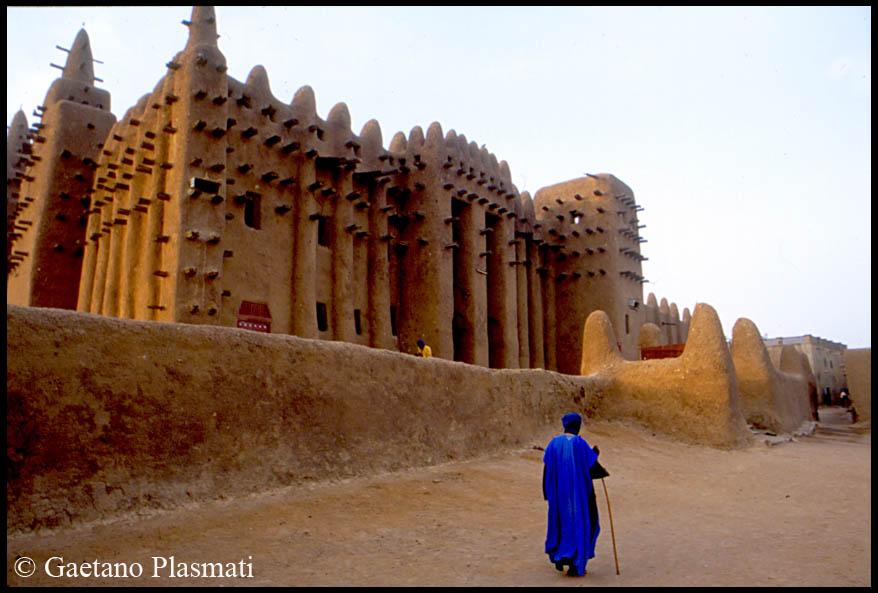
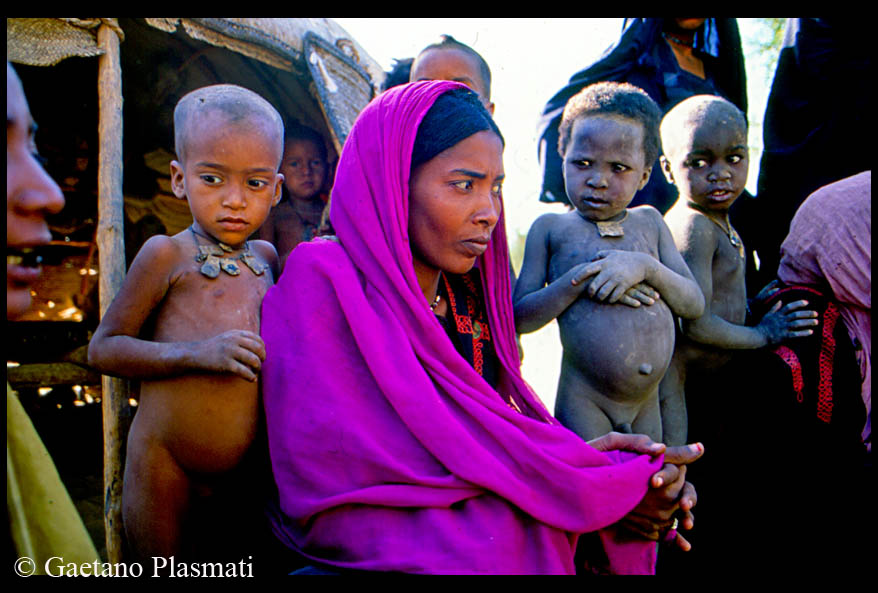
The project of Gaetano Plasmati is the result of a journey that lasted 15 years and has developed over a series of trips to Algeria, Libya, Tunisia, Morocco, Mali, Niger and Eritrea. The beautiful shots by Gaetano Plasmati describe a journey in search of people who live the drama of desertification, such as the Wodaabe, the Dogon, the Tuareg. Plasmati has followed the slow and inexorable retreat of the nomadic’s territories which become less and less comfortable for traditional economic activities that sustain them.
Desertification is a danger to almost 50% of the land and puts at risk more than 100 countries with approximately one billion inhabitants. The continent most affected is undoubtedly Africa: here over two-thirds of the cultivated lands are at risk. The path of Gaetano Plasmati winds through the dunes and the rock paintings of the Acacus and Tassili N’Ajjer in Algeria, the great Sahara, the markets of the mythical town caravan Timbuktu, Djenne, Agadez, Niamey and Djanet. Plasmati has portrayed hostile landscapes and people tempered by the roughness of nature, dunes vivid colors and rocks that are museums, suks and caravans in a succession of faces and landscapes which give rise to the extreme dignity and composure with which the “nomads of water” live their atavistic discomfort.

gaetano (5)

gaetano (4)

gaetano (6)

gaetano (3)

gaetano (2)

gaetano (8)

gaetano (9)

gaetano (7)

GMB AKASH:

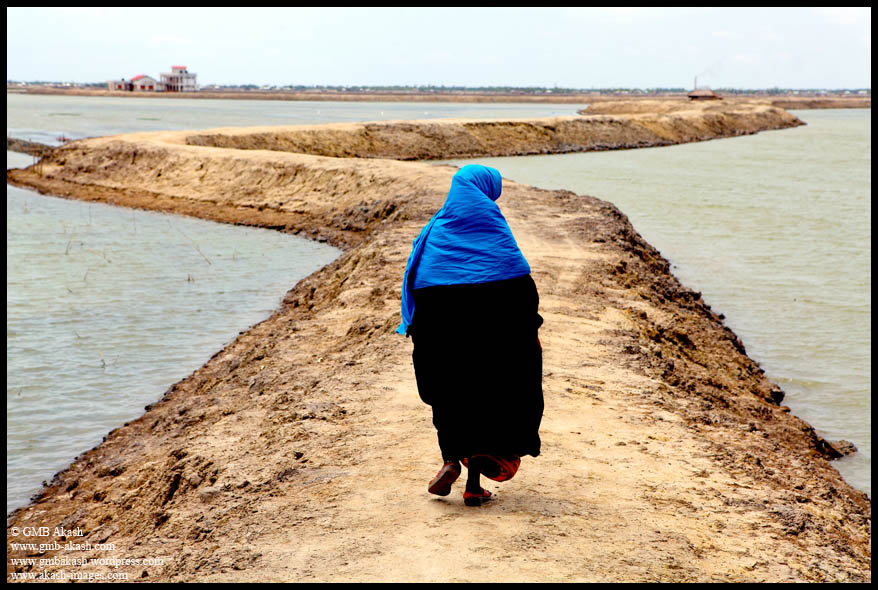
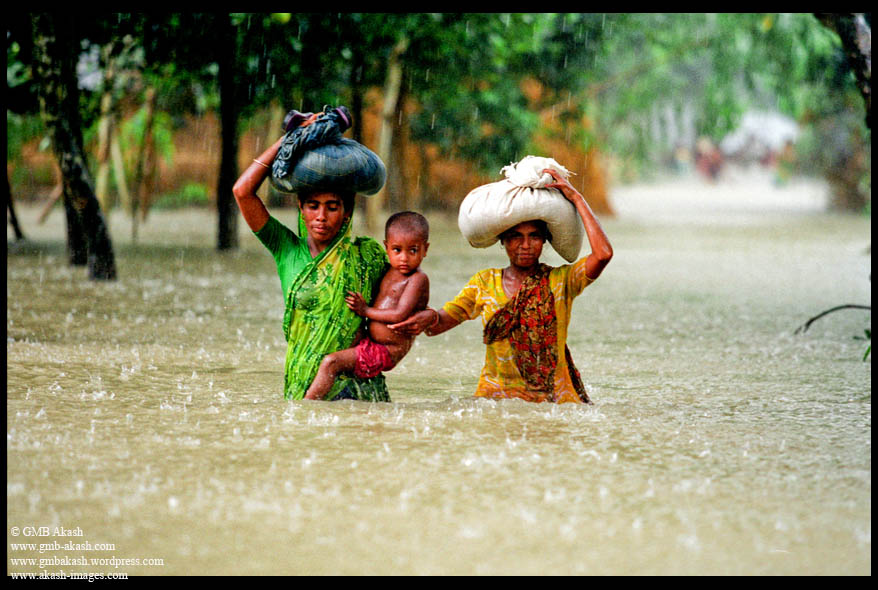
“I have framed how every year flood causes people suffer miserably in Bangladesh. I experienced how with the drowning sun villages go under water. How People sheltered in roofs of their houses and lost their lives. Moaning of old people & shouts of children of the miserable atmosphere can only describe small bits of devastating sufferings of flood. After facing devastating flood every year, people still fights to live apart loosing shelter for existence. Still they fight to live. They collect all destroyed pieces of house to shed their head. Women go for fishing, children dry their damp books, and men rebuild homes. In flood I spend days, nights and months in flood affected areas past 12 years. Throughout the journey, the rotten water wrapped me by leaving a restless feeling. Every day, I encounter a new tragedy by finding people who have no way to escape from rising water, who can only surrender everything to the mighty nature. Several times I have been severely injured or illnesses have torn me down. Nevertheless I continue working because of my strong belief that my pictures can make a difference.” – GMB Akash

People in Bangladesh live precariously close to the risks of cyclones, floods and droughts and more than 100 million people live in rural areas. Two-thirds of the country is less than 5 meters above sea level and in an average year, a quarter of the country is inundated. Bangladesh has experienced severe floods every 4 to 5 years that may cover more than 60 percent of the country, resulting in significant losses. United Nations’ Intergovernmental Panel on Climate Change predicted that rising sea levels could submerge 17 per cent of Bangladesh by 2050, creating 20 million “environmental refugees”.

water from akash (4)

water from akash (5)

water from akash (6)

water from akash (26)

water from akash (25)

water from akash (28)

water from akash (7)

water from akash (18)

This exhibition intend to speak about harsh reality of many who are displaced from their homes and living in exile in another country, and/or from issues to become victims of natural disasters and internally displaced in their own countries. The displacement, and migration, of very large numbers of people, will be one of the most significant effects that climate change will have on humans. Often times these displaced populations will have nowhere to go except to regions that are already densely inhabited. Many of which, will likely already be having trouble supporting their own population. We are cordially inviting you to visit how water impacted life. If you are in Matera in 14th of April 2013 do visit the exhibition and those who are far away from the exhibition Gallery, this post will give you a trailer of the show. We hope that while you are in Matera, Italy, you will take a moment to visit the exhibition.

Exhibition: WATER

Gallery: Galleria di porta pepice present

Exhibition Date: 14 April 2013

 Gallery address: Via delle beccherie 55, Matera, Italy

cartolina acqua 2013 con caratteri piccola


Decaying Earth

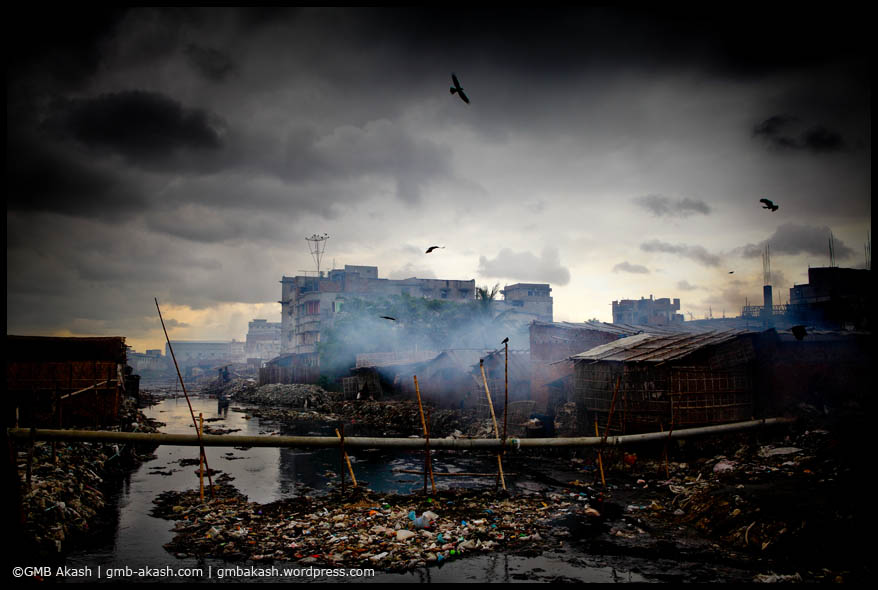
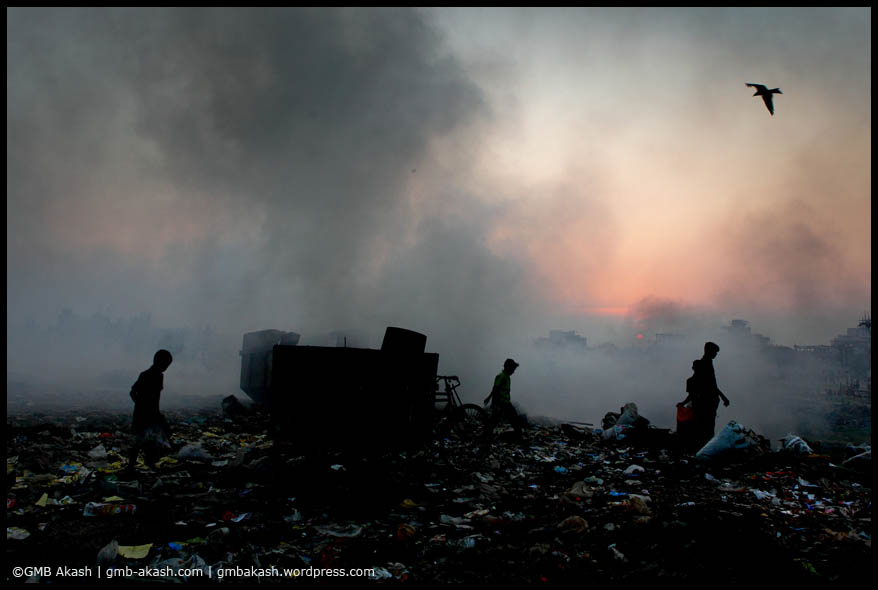
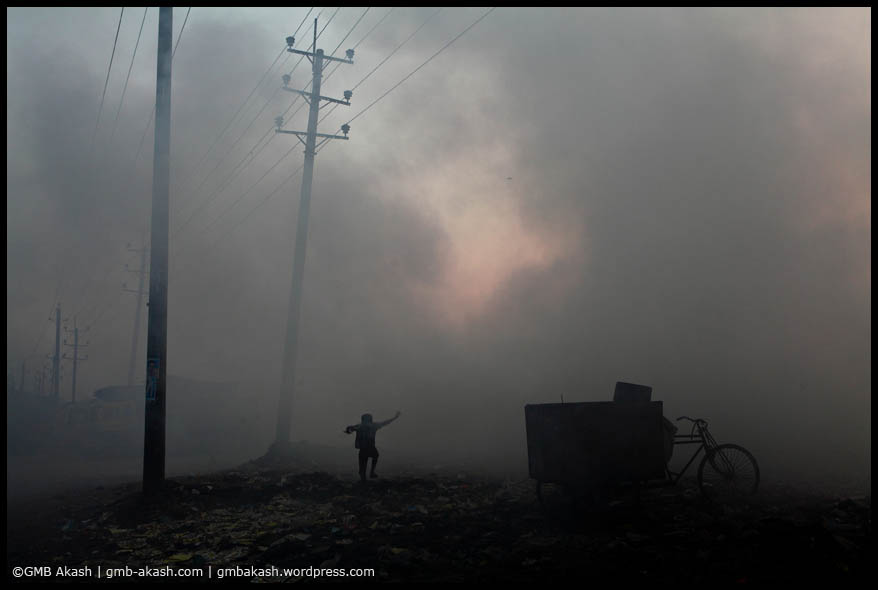
The overall global environment is declining fast and for Bangladesh it has been doing so more rapidly during the last few decades because of many obvious reasons. But we are still not surprised. We, all of us, pollute our own cities with trashes. So how can we claim owners of these factories, with hardly any education be conscious about the environment, feel the need to protect the environment? We need to count ourselves first to protect our own ecosystem to survive in an earth which will be a gift for our next generation – ONLY IF WE CARE

“Pollution is an immense crisis that is slowly destroying the world that we live in. It is crucial for every individual to do what he or she can to clean up the environment. Whether it is in the home or on a management level, or within us, every person is important and has the ability to make a difference and can help to stop pollution”

– GMB Akash

pollution (1)

pollution (5)

The mighty river Buriganga is now so polluted that all fish have died, and increasing filth and human waste have turned it like a black gel. Even rowing across the river is now difficult for it smells so badly.

pollution (2)

Bangladesh has about 230 small and large rivers, and a large chunk of the country’s 140 million people depend on them for a living and for transportation. But experts say many of them are drying up or are choked because of pollution and encroachment. A World Bank study said four major rivers near Dhaka — the Buriganga, Shitalakhya, Turag and Balu — receive 1.5 million cubic metres of waste water every day from 7,000 industrial units in surrounding areas and another 0.5 million cubic meters from other sources. There is no fish or aquatic life in this river apart from zero oxygen survival kind of organisms. Bangladesh enacted a law in 1995 making it compulsory for all industrial units to use effluent treatment plants in a bid to save river waters from pollution, but industry owners often flout the rule.pollution (3)

 pollution (6)

pollution (4)

Dhaka city alone generates about 3500 to 4000 m tons of solid wastes per day. The amount increases with the increase of population every year. The domestic, commercial, street sweeping, combustible and non-combustible wastes include discarded food, grass, plants, paper, cardboard, textiles, plastics, polythene materials, glass, metals, and construction debris.

pollution (13)

pollution (8)

pollution (12)

Industries and factories have been polluting the water bodies in and around Dhaka city for the longest time. There are about 1000 small and large industries in Dhaka city producing a large amount of toxic and hazardous wastes contributing significantly to environmental degradation. The emission of various greenhouse gases such as CO2, CH4, among others from various industries, increases the overall temperature of the earth, resulting in global warming and making the area unsuitable for human habitation, animals and plant species.In the Hazaribag area of Dhaka there are 149 tannery units daily producing about 18,000 litres of liquid wastes and 115 m tons of solid wastes; nearly all of these are dumped in the Buriganga river, and a part is thrown into nearby drains and sewers. These wastes contain sulphuric acid, chromium, ammonium chloride, ammonium sulphate, calcium oxides etc. These may seep into the ground causing ground water pollution. Also, the intense, unpleasant odour affects the health of the people of the surrounding area. tannery wastes have a very serious and negative effect on the ecosystem.

pollution (17)

pollution (19)

pollution (9)

‘It is very easy for every single person to help stop pollution and stop destructing the earth. It can take little effort, but can be something that makes a huge difference. Start by evaluating how you can make small changes. Even the smallest changes in your own life can have a massive impact.’

– GMB Akash

pollution (15)

pollution (21)

pollution (11)

A World Full of Hungry Apes

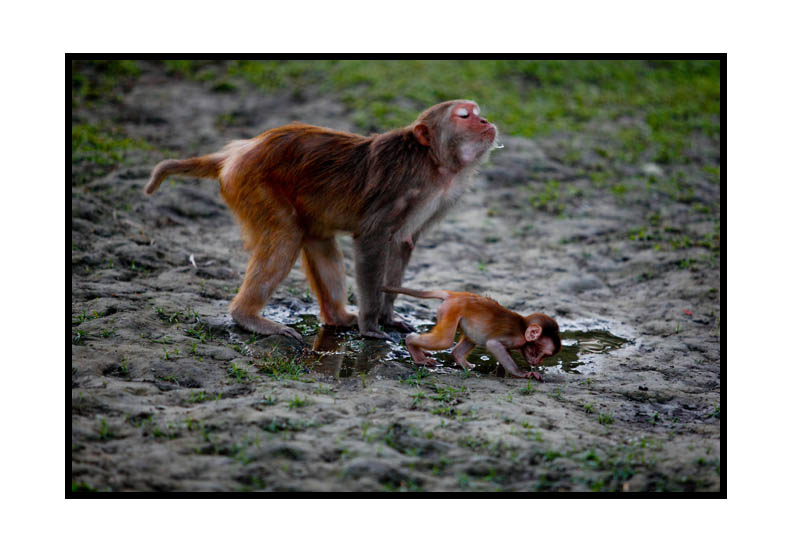
“Photography has taken me to discover many unexpected territory as all time I wanted to see the sights of unseen & unforgiving incidents of reality. I was engaged in one of my personal project’s work on ‘sex workers’ for which I went to Madaripur. I have been working on ‘sex workers’ last 7 years & my works demand me to investigate their situation all over the country. Last year, in the month of August when I arrived at Madaripur it was afternoon. Shockingly I have seen thousands of apes are in street, running here & there. It was an unexpected thing of my life to see thousands of ill monkeys are moaning alone. I was traumatized, unspoken & felt awful when I understand all these thousands monkeys stand in front of me are HUNGRY. I always concern to cover stories of situation which need concentration for helping out by the assessment of the world. So I take out my camera & run to middle of them”
– Gmb Akash

© GMB Akash / http://www.gmb-akash.com

© GMB Akash / http://www.gmb-akash.com

© GMB Akash / http://www.gmb-akash.com

© GMB Akash / http://www.gmb-akash.com

In char Muguria area, Madaripur around 2,500 monkeys are facing severe food crisis. Due to acute food crisis many mother monkeys, passing days starved or half-starved, are even unable to breast feed their babies. Quite a few monkeys have already died in this serious situation. Concerned over the pitiable life of the monkeys, locals and visitors have urged immediate arrangement of food for the monkeys. Though the local communities are already poor to feed themselves but the heartbreaking scenarios of monkeys influence them to share their own food with them. Despite keeping distance with human the unable monkeys are taking foods from people’s hands. The hungry monkeys were competing for the inadequate foods like peanut or biscuit given by the visitors. They were also trying to eat whatever they got — grass, garbage, polythene etc. Baby monkeys are suffering badly in malnutrition. Even the water crisis made their lives more pitiful. Local community sought allocation for food for the monkeys but the higher authorities are yet to give any response in this regard.

© GMB Akash / http://www.gmb-akash.com

© GMB Akash / http://www.gmb-akash.com

© GMB Akash / http://www.gmb-akash.com

© GMB Akash / http://www.gmb-akash.com

“A mother monkey by carrying its dead child was passing from trees to trees. When it came in front of me & begged foods I realized the monkey did not identify its child is already dead. This pitiable situation made me terrified. These apes, whose residents are jungle, came out for food & begging to feed themselves. These climate victims are more alike my working project of  ‘Sex workers’. Human & animal all are helpless in front of starvation & need. They are survivors of dreadful situation which many of us over looked or never know”- Gmb Akash

© GMB Akash / http://www.gmb-akash.com

© GMB Akash / http://www.gmb-akash.com

© GMB Akash / http://www.gmb-akash.com